ezstandalone.cmd.push(function() {
ezstandalone.showAds(102);
});
# The High Cost of “Extra” Horses
Apr 08, 2009
[ Twitter ](https://twitter.com/intent/tweet/?text=The%20High%20Cost%20of%20%E2%80%9CExtra%E2%80%9D%20Horses%20%20&url=https%3A%2F%2Fboattest.com%2Fview-news%2F3278_the-high-cost-of-%25E2%2580%259Cextra%25E2%2580%259D-horses.md&hashtags=boattest&via=&related=&in-reply-to=)[ WhatsApp ](whatsapp://send?text=Check%20out%20this%20page%20-%20%20https%3A%2F%2Fboattest.com%2Fview-news%2F3278_the-high-cost-of-%25E2%2580%259Cextra%25E2%2580%259D-horses.md)[ Share on facebook ](https://www.facebook.com/dialog/feed?app_id=966242223397117&name=The%20High%20Cost%20of%20%E2%80%9CExtra%E2%80%9D%20Horses%20%20&link=https%3A%2F%2Fboattest.com%2Fview-news%2F3278_the-high-cost-of-%25E2%2580%259Cextra%25E2%2580%259D-horses.md&caption=&description=&picture=&source=&ref=&display=popup)[ Email ](mailto:?subject=Share%20this%20article&body=Check%20out%20this%20page%20%22The%20High%20Cost%20of%20%E2%80%9CExtra%E2%80%9D%20Horses%20%20%22%20-%20https%3A%2F%2Fboattest.com%2Fview-news%2F3278_the-high-cost-of-%E2%80%9Cextra%E2%80%9D-horses%0D%0A)
Once you have selected the brand and
the model stern drive boat you want, which engine option should you select? In all
likelihood the decision you make will greatly impact how well you enjoy your boat
– and how much it costs both now and tomorrow. The days of “go-for-the-big-engine”
are over. Now consumers want to get engine selection right without being wasteful.
Now consumers expect both performance AND value for money. Recently BoatTEST.com
looked at optional engine pricing at six popular boat brands and discovered that
you can save a lot of money by selecting the right engine.
| [](http://www.boattest.com/boats/Premier/Any%20Size/Any%20Type/search_result.aspx) |
|:--|
| ***When selecting the engine for your new stern drive boat should you pick a 4.3L 225-hp weakling, or the 8.1L 375-hp muscle mill? And, how much do extra horses cost?*** |
Back in the good old days -- that was about a year ago
\-- it was relatively easy to pick the power option. “Just make sure it’s got enough
poop,” was the common instruction to the boat dealer as he was filling out the new
boat contract.
**A Paradigm Shift**
But, if what we are hearing from our readers these days is typical of boat buyers
in general, there is a new paradigm when it comes to engine selection. No longer
is the primary focus “how fast does she go?” – it is much more about what is her
best cruising speed, and how many miles does she get per gallon. Of course all of
this started when fuel spiked to $5 per gallon last summer in the U.S., and while
prices have dropped in half, boaters have not discarded their new-found concern
for economy, prudence and value for money.
**Performance of a Different Kind**
Increasingly boaters are looking at the performance test tables on BoatTEST.com
(up 56% in the last five months) and are comparing one engine with another. Sometimes
we have tested the same boat with two engines and sometimes readers have to look
at a similar boat with a different engine to make the comparison. Either way, they
are finding and making the comparisons in numbers we have not seen since we started
in 2000.
What diligent researchers are discovering is that the big engine is not always the
best way to go for range and fuel economy, and often they offer only marginal increases
in top speed. Then when buyers compare the up-charge for larger engines they often
discover bewildering pricing for extra horsepower by some builders. Builders are
charging anywhere from $55 to $200 per horse for upgraded engine packages.
**Marking Up Horses**
Typically, boat companies select an engine as their “standard” and the base MSRP
price is set on that. If you want to pick a larger engine, the price is X dollars
more. (In one case we found, the builder actually offers lower horsepower options
as well as higher ones than its standard package.) In looking at the pricing of
six popular brands, we found no obvious consistency. Each brand seems to have its
own policy with some passing on their increased costs with only a few dollars added,
while others list prices that seem to bare little relationship to the actual added
cost of the engine.
**Back to Basics**
Consumers need to think seriously about what
performance they want from their boat with its intended load. Next, they need to
check our performance tables, then zero-in on the engine horsepower that will get
the job done. Finally, they should determine how much “extra” the engine they need
will cost. Smart buyers will look at both initial cost and operating costs.
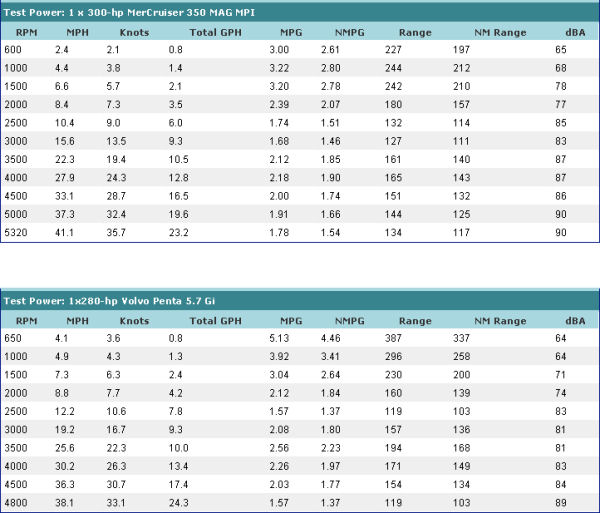
For example, here are test results from two
identical 26-foot stern drive boats with two different horsepower engines using
the same 5.7L GM block:
|  [](http://www.boattest.com/boats/Premier/Any%20Size/Any%20Type/search_result.aspx) |
|:--|
As expected, the 300-hp powered boat goes slightly
faster. And it goes faster at best cruise, too, but here its fuel economy is not
as good as the 280-hp engine which gets 2.56 mpg, 17% better than the larger engine’s
2.18 mpg. That translates into 29 miles more range on a 90% tank of fuel.
If a buyer can be happy with a best cruise
of 25 mph instead of 27 mph, then he will save himself 2.8 gallons per hour. If
this boat is operated at best cruise for 100 hours per season (unlikely, but you
get the idea) and fuel costs $2.50 per gallon, going with the lower horsepower engine
will save $700 in operating costs per season.
Not only that, but with the lower horsepower
engine our buyer will save himself considerable money when he buys the boat. Among
four brands we checked that offered both 280-hp and 300-hp engines, the upgrade
charge ranged from $1500 to $4500. The privilege of being able to go 3 mph faster
is expensive.
**Example #2**
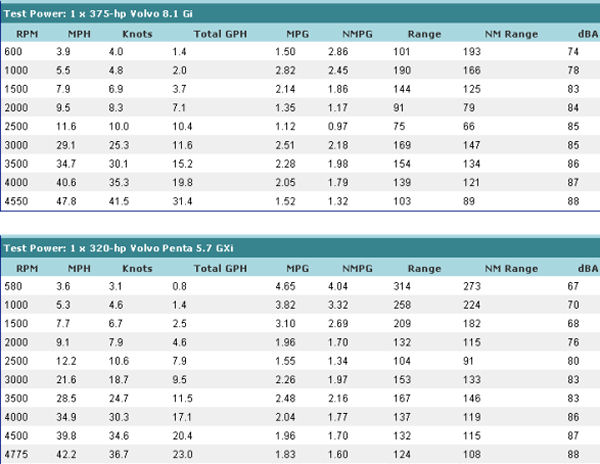
A second example is another from two identical
26’ boats from a different builder and in this case one engine was an 8.1L (375-hp)
and the other was a 5.7L (320-hp).
|  [](http://www.boattest.com/boats/Premier/Any%20Size/Any%20Type/search_result.aspx) |
|:--|
In this example the big block moves the boat 5.6 mph faster,
is only .6 mph faster at best cruise, and gets a fraction better fuel mileage than
the lower horsepower engine. So in this example, the big engine’s operating costs
and range are about the same as the smaller engine at best cruise, and only the
initial cost of the engines is different.
And quite a bit different it is: In checking
several builders we noted that the up tick charge from a 320-hp stern drive to a
375-hp package is anywhere from $3,800 to $10,200. Again that’s quite a premium
for an extra 5 mph at WOT.
**A Caveat**
Small boats are weight sensitive. The smaller the boat, the more weight sensitive
it is. If you plan to have a load of heavy people aboard your boat most of the time,
you must be very careful about engine selection. For example, some builders offer
3.0L 135-hp stern drive engines in their smallest boats, which usually perform adequately
with two people aboard. However, if you load it up with eight guys from Animal House,
chances are you will be disappointed in the performance.
When looking at test data, be sure to scroll
down and look at the section titled “Test Conditions.” This will tell you how many
people, how much fuel and other weight was aboard. We generally test with two people
aboard, but there are occasions when we test with more aboard. Also, check the temperature
and sea conditions. Obviously the boat will perform better on cold days in flat
water, so crank that into your equation as being worth a couple of miles per hour.
Some boats are tested in big water when it is relatively rough, so if you are planning
on using a boat in a small lake, the boat may perform better there than what you
see in our tables.
**Load As A % of Displacement**
Larger boats are less sensitive to added people
aboard because the percent of weight increase is lower. For example, two people
weighing a total of 300 lbs. represent 20% of the weight of a 1,500 lb. boat. Add
6 people at 150 lbs. each and you have 900 lbs. additional pounds, or 60% of the
boat’s displacement. Performance that looks good with two people aboard will be
disappointing if not a disaster with 6 people aboard.
Conversely, in an 8,000 lb. boat, 2 people
at 300 lbs. total are only 4% of the boat’s displacement, and 6 similar bodies are
only 11% of the boat’s weight. Adequately powered boats in this example with two
people aboard should perform relative well with six aboard, and chances are you
won’t notice the difference.
By using BoatTEST.com performance tables, and its handy links to builders websites,
you can easily check out performance and pricing before you make your buying decision.