ezstandalone.cmd.push(function() {
ezstandalone.showAds(102);
});
# Repowering a Trojan 10 Meter with Yanmar Diesels
May 13, 2009
[ Twitter ](https://twitter.com/intent/tweet/?text=Repowering%20a%20Trojan%2010%20Meter%20with%20Yanmar%20Diesels%20%20&url=https%3A%2F%2Fboattest.com%2Fview-news%2F3361_repowering-a-trojan-10-meter-with-yanmar-diesels.md&hashtags=boattest&via=&related=&in-reply-to=)[ WhatsApp ](whatsapp://send?text=Check%20out%20this%20page%20-%20%20https%3A%2F%2Fboattest.com%2Fview-news%2F3361_repowering-a-trojan-10-meter-with-yanmar-diesels.md)[ Share on facebook ](https://www.facebook.com/dialog/feed?app_id=966242223397117&name=Repowering%20a%20Trojan%2010%20Meter%20with%20Yanmar%20Diesels%20%20&link=https%3A%2F%2Fboattest.com%2Fview-news%2F3361_repowering-a-trojan-10-meter-with-yanmar-diesels.md&caption=&description=&picture=&source=&ref=&display=popup)[ Email ](mailto:?subject=Share%20this%20article&body=Check%20out%20this%20page%20%22Repowering%20a%20Trojan%2010%20Meter%20with%20Yanmar%20Diesels%20%20%22%20-%20https%3A%2F%2Fboattest.com%2Fview-news%2F3361_repowering-a-trojan-10-meter-with-yanmar-diesels%0D%0A)
It's hard to believe these days, but in
the early 1980s most boat builders were still building power boats that had evolved
only slightly from the early days of fiberglass boat building in the 1960s. In those days plugs were typically built of
wood and curves were few and not much more than you could bend into some thin plywood.
In other words, most power boats were pretty boxy. That is why when drawings of
the Trojan’s radical new 10 Meter express appeared in a spring 1980 issue of *Boating*
magazine many American boat builders gasped.
A couple actually called the magazine’s editorial offices complaining that touting
such a design “as the wave of the future” would only make their squared off boats
obsolete, and, by the way, they were cancelling their advertising. As the saying
goes, the rest was history. If you would
like to find an old boat that is cheap to buy but has contemporary styling, the
place to start looking is with the Trojan 10 Meter. Dozens of them are on the market
from $18k to $40k.
[
**Explore Yanmar engine videos**](http://www.boattest.com/engines/engine_search_result.aspx?manufacturer_ln=Yanmar)
| 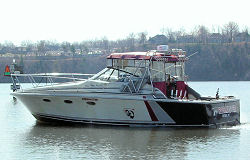 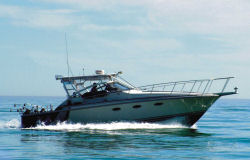 ***The Trojan 10 Meter debuted the summer of 1980 and set the U.S. boating market on its ear with Harry Schoell’s European styling both topside and down below.*** [ ](http://www.boattest.com/Resources/view_news.aspx?NewsID=3294) |
|:--|
There are a lot more things to commend the Trojan 10 Meter
beyond the fact that you can pick one up cheaply. At 13’ the boat was relatively
beamy for its day, and its Harry Schoell-designed “Delta Conic” hull has proved
itself over the years repeatedly on different models and different brands. It is
stable and rides well. Designer-inventor Schoell has always been known for being
on the cutting edge of development.
| 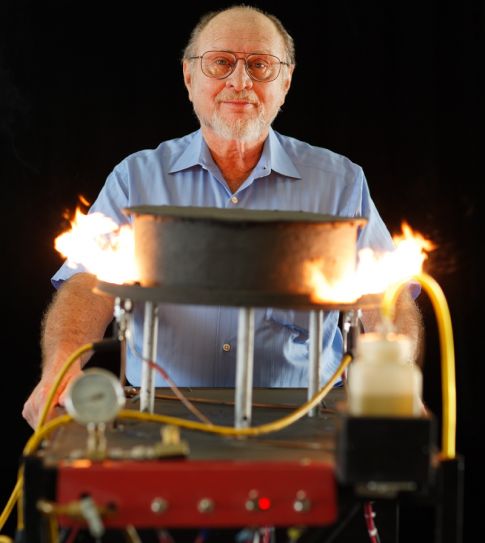 **This is Harry Schoell today, nearly 30 years after he designed the 10 Meter, in front of one of his latest inventions – a high-pressure steam engine for automobiles that lowers the carbon footprint lower than all-electric cars.**[](http://www.boattest.com/Resources/view_news.aspx?NewsID=3294) |
|:--|
**A Trend Setter**
Below, the 10 Meter layout and design were right out of Star Trek, and its round
sliding doors to cabins and heads were the first to be seen in the industry on this
side of the Atlantic. The ample beam permitted this 32’6” boat to have more room
below than virtually anything on the market in its class at the time. For example,
the more traditional early 1980s 34 Sea Ray express design had an 11’11” beam and
weighed 11,400 lbs.
At first boaters either loved the new 10 Meter design or hated it, and that is why
Trojan continued building the old F-Series for a number of years. But as time went
on, the number of Harry Schoell “Meter” models grew, and the F-Series models were
discontinued one by one. After a few years, Trojan was building many more boats
than the far more famous and prestigious Bertram, a sister brand, also owned by
the Whittaker Corp. (And it was making more money, too.)
**Hundreds of Trojan Meter Boats Were Built**
As you can see in the lead pictures for this article, at least a few owners of these
boats think they make great fishing boats, and they do because of their huge cockpits
and stability. But they also make good cruising boats because of their room both
below and on deck, their seakeeping abilities, and their good ride.
Most of the Trojan 10 Meters were powered with twin gas engines, with 330-hp 454
blocks being a popular option. But at 12,500 + lbs. the 10 Meters really needed
the torque that only diesel engines could provide. Trouble was back in the early
‘80s few buyers wanted to spring for the heavy and expensive diesels. And in those
days Americans really didn’t consider diesels until they got into boats in the high
30s or low 40s.
**Luxury Tax Strikes Again**
Just about the time that a good diesel option came along in the form of lightweight
Yanmar engines in the 1990s, Trojan had been devastated by the 10% Luxury Tax, was
sold and lost its way in the competitive world of boat building. Today its name
is only a memory to the old salts. But there are dozens of these great old boats
still floating quite happily and as everyone knows, fiberglass is virtually indestructible.
Smart boaters looking to get into a good 32’ boat inexpensively will search for
a Trojan 10 Meter with a good interior and two lumps of rust in the engine room,
something that should not be too hard to find. Once a deal is made, then repowering
with the diesel engines that should have been in the boat all along will turn one
of these boats into a fine offshore yacht.
| [ 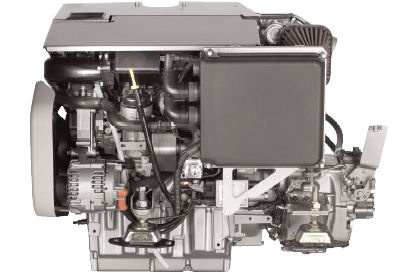](http://www.boattest.com/engines/Engine-Test.aspx?ID=10014) The Yanmar 4BY-180 diesel develops 180-hp at 4000 rpm. Its compact size makes it ideal for repower applications. [](http://www.boattest.com/Resources/view_news.aspx?NewsID=3294) |
|:--|
**Yanmar Repower**
When it comes to repower, as we have said before, no brand takes better care of
its customers than Yanmar. Repowering is a major aspect of the company’s marine
business and its distributors know their business, are equipped with both the manpower
and the experience to hold an owner’s hand through the repowering experience, and
their prices are usually as good as they get.
We think that twin Yanmar 4BY-180 180-hp diesels are an ideal choice for a Trojan
10 Meter repower project. One could put larger diesels in the boat, but speed was
never this vessel’s strong suit. And, after all, this boat is a vintage craft being
repowered, so it is wise to keep costs low. We would play to the boat’s strengths
– good seakeeping stability, room and comfort. The small diesels give her respectable
speed and tremendous range for cruising or fishing.
| 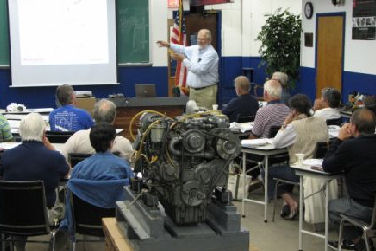 ***Mack Boring is famous for running diesel maintenance classes for consumers and has been doing so for 28 years.*** |
|:--|
**The Cost, All Up**
The folks at Mack Boring, the Yanmar master distributor in New Jersey, did a repower
job on a Trojan 10 Meter a few years ago, so we asked them for the cost today, and
what their performance numbers were on their 10 Meter repower. They installed twin
4LH DTE, 170-hp Yanmar diesel engines. Since the installation a few years ago, Yanmar
has superceded this engine with the common-rail 4BY-180, which has 10 more horsepower.
Mack Boring’s spokesman told us that they can sell a customer a pair of Yanmar 4YB180s,
pull out the old engines, install the new diesels, and do all of the needed plumbing
and electrical finishing for about $56,000, total.
That means if you can pick up a 10 Meter for, say, $30,000, for a total of $86k
($30k + $56k) you can have a great riding hull, beautiful topsides that are as modern-looking
as anything on the water, and one that runs economically at reasonable cruising
speeds, and has great range. And then there is the reliability and safety of diesel
power.
Thankfully, before Mack Boring yanked out the old 454s and turned them into mooring
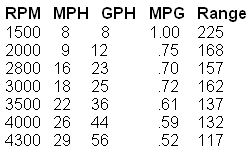
anchors its engineers ran speed trials on the boat. Below are the speeds that they
reported, which is on the high side of what this boat generally is credited with
doing. Take a look at the used boat listings and you will see that most say the
boat goes 18 to 26 mph, with only a few claiming a WOT of 28 mph. This gas-powered
boat had a reduction of 1.5:1 and was swinging 16x15 props.
Twin 454 Mag (300-hp) Performance Numbers from Mack Boring—
|  |
|:--|
Based on the numbers above we would say that best cruise is at 3000 rpms, going
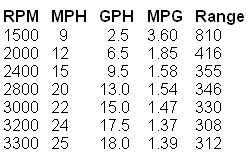
18 mph, getting .72 mpg for a range of 162 statute miles. After the Yanmars had
been installed, the engineers at Mack Boring took the same boat out and ran speed
trials again. This time the reduction gear was 2.07:1 and the engines were turning
20x22 props. Note that the torque and gearing of the Yanmar diesels permitted props
that were 25% greater in diameter with 47% more pitch. It is here that the boat
gets its incredible jump in fuel economy and range. Just look…
Twin Yanmar 4LH DTE (170-hp) Performance Numbers from Mack Boring—
|  |
|:--|
While the best range is at 2400 rpm going 15 mph, we suspect most people would run
the boat at 20 mph, which still gives the boat a range of 346 statute miles or over
twice the range of the gas-powered boat going slightly slower. These ranges mean
that the 10 Meter is ably suited for going out to the canyons, fishing a long day
and coming back with plenty of reserve. Or, a family can easily cruise to Nassau
or the Abacos or most other places in the Bahamas on a tank of fuel.
[For more information about repowering
and how much it costs, contact Yanmar… ](http://www.yanmar.com/)
[
**Explore Yanmar engine videos**](http://www.boattest.com/engines/engine_search_result.aspx?manufacturer_ln=Yanmar)