Beware The Angry Sea
The loss of three fishermen 38 miles off Clearwater, Florida, several years ago might not have garnered headlines across the country were it not for the fact that two of the men were NFL football players. In fact, accidents like this happen all of the time and are rarely reported beyond the local community. The good that can come from this tragedy is to bring basic aspects of the sea, seamanship and boating safety to a larger audience. We think this accident could have been avoided in a number of ways, and rescue could have been effected far more rapidly had the men been properly prepared for an offshore trip. What did they do wrong? Could they have saved themselves and if so, how?
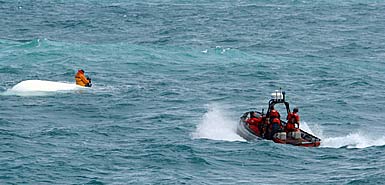
For those of you who have just entered the room, on February 28th at 6:30 AM four friends left Clearwater, Florida to go fishing in (what were at the time) calm seas. Marquis Cooper, owner of a 21' Everglades center console and an NFL football player, Corey Smith, another NFL player, Will Bleakley, and Nick Schuyler were former college football players at the University of South Florida, and were all longtime friends who loved to fish. Their boat capsized Saturday night. Three of the men died of hypothermia or drowned and Schuyler was rescued about 40 hours later sitting on top of the overturned boat holding onto the outboard motor.
It Happens All the Time
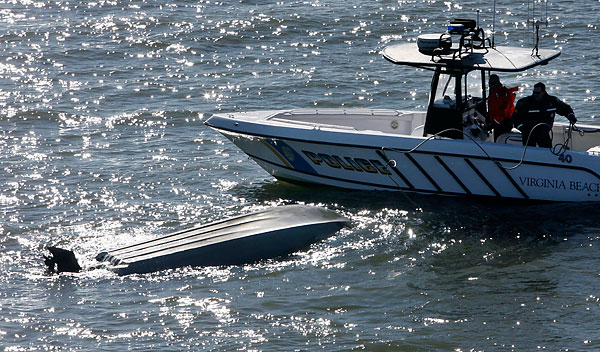
Capsizing is one of the leading boating accidents, according to the Coast Guard's most recent report on recreational boating. Officials report there were 398 accidents from capsizing in 2017 (the last year data is available), causing 286 deaths and 284 injuries.
"The oceans are an unforgiving environment," said Coast Guard Lt. Cmdr. Chris O'Neil. "Weather can be unpredictable. Any time you are in an open environment, you are taking a certain amount of risk."
Many boats capsize because of overloading, but many also happen offshore in rough seas when boats ship water, lose stability, and are then rolled over by a large wave. Capsizing can happen to virtually any boat in certain conditions.
Weather Reports
According to Rick Davis, a meteorologist in Tampa, the forecast for February 28th called for 15 knot winds and six-foot seas and a small-craft advisory was issued on Saturday. Did Marquis Cooper or any of his friends hear this report? Did they check weather maps on the Internet the night before?
Sea Conditions
It is reported that on February 28th the seas were calm in the morning, but that later in the day the wind came up fast and the sea conditions deteriorated rapidly. This is typical of what happens offshore. Quickly building wind energy creates waves that are relatively close together and as the wind increases they become higher and steeper. These are called "immature" waves compared to the sea conditions that exist after high winds have been blowing for some time and for some distance, which generally create "mature" waves which have greater spacing from crest to crest.
Short, steep seas are the enemy of any small boat. When they begin to occur, prudent boaters will immediately take the appropriate action. There is an old saying among veteran sailors, that the best time to reef is when one first thinks about it. Likewise, for powerboaters, we suggest that the best time to batten down the hatches and head for port is when one first thinks about it.
Size Matters
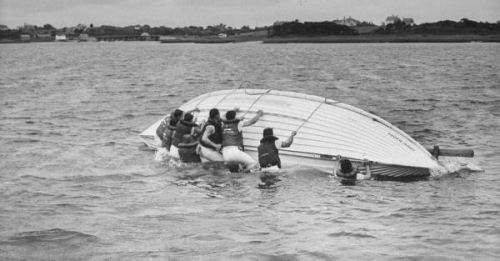
Everyone knows that all things being equal, larger boats are safer offshore than smaller ones. It is a rule of physics. Larger boats are usually better able to handle larger waves. But one doesn't have to own a megayacht to go safely offshore. Indeed, the 635-mile Newport, RI, to Bermuda race held for sailboats every other year (mostly) since 1906 has not lost one boat. Many of these races have run into gales and over the years they have encountered several hurricanes as well. The race is now organized by the Cruising Club of America and the Royal Bermuda Yacht Club and they have a size requirement of about 35' and most of the boats are 37' or longer. There is also a strict list of safety equipment that must be carried, the boats must be inspected and the skipper and crew must meet some experience requirements.
Was a 21' boat too small to have been taken 38 miles offshore into the Gulf? According to newspaper accounts, the captain affiliated with Marquis Cooper's boat, Clay Eavenson, declined an invitation on the boat for Saturday's trip due in part because he felt the boat was too small to go 50 miles offshore. Corey Smith had expressed misgivings about going out on the boat to his friend Mario Bridges. Bridges said in a TV interview after the accident, "He

said that he was never going to go
because they were far out and he felt like the boat was a little too small for how far out they were."
Proper Boat Selection
One reason that there are so many boat models available – more than 6,000 at our last count -- is that builders are trying to design boats for virtually every conceivable use. Generally boats are built for specific missions. 21' center consoles are not built for steep 10' to 15' seas 30 miles offshore, just as cruise ships are not built for going across the shallow Bahamas Bank.
Because of the large number of deaths among people using small powerboats, in 1978 the USCG promulgated a federal law requiring that powerboats 20' and under have positive flotation. Boats with outboard engines over 2-hp had to be able to float "level" in a swamped condition with the engines attached. Inboard and sterndrive powered boats 20' and under had to have "Basic Flotation", which allows their sterns to sink but part of the boat must be above water. All of the USCG requirements are measured in "calm" water.
There are no federal or USCG requirements for flotation for powerboats longer than 20 feet. In the words of one boatbuilder, "these boats could sink like a hot rock and be in perfect compliance with USCG regulations."
Level Flotation
Many builders of center consoles and walkarounds over 20' claim that their boats float. But to our knowledge, only three builders claim that all of their boats will float level -- Everglades, Boston Whaler and Edgewater.
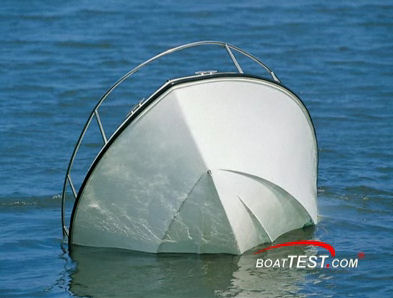
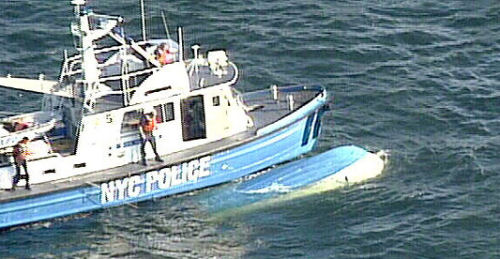
But as we have just seen, level flotation is no guarantee that a boat would not capsize nor is it a guarantee of survivability. Boats which are swamped and floating level are extremely vulnerable to "surface effect" and in a tumultuous sea such as the one off Clearwater on February 28th they are prone to capsize. Water inside a boat sloshing from side to side radically alters the boat's center of gravity and stability with disastrous results. Once capsized, it is virtually impossible to right all but the smallest powerboats.
While the advent of level flotation since the 1978 law for boats 20' and under has undoubtedly saved many lives, the fact remains that each year hundreds of people still die when their boats capsize, no matter what the size. This is one reason why the USCG continues to campaign constantly for boaters to wear PFDs. Coast Guard officials maintain that if people in capsized boats wore their life vests, and stayed with the boat, many more would survive.
Not Wearing PFDs
None of the men were wearing PFDs before the capsize. The capsize evidently happened quickly. Will Bleakley is credited with diving under the boat and retrieving three life vests and one Type IV cushion. He used the cushion. Did the boat have the required four PFDs aboard when it left shore?
Anchoring in Rough Water
The lone survivor of February 28th's accident, Nick Schuyler, has reported that the boat capsized while the boat was anchored and the crew was trying to hoist the anchor. Assuming that is true and that Schulyer’s recollections of events have not been affected by hypothermia, this may indeed explain what brought the boat to grief. If anchored from the stern, its 25" of freeboard would have been vulnerable to a wave cascading into the boat, particularly with one or two large men working in the stern to bring up an anchor. In fact, numerous small boats are on record for swamping when anchored by the stern.
If the boat was anchored by the bow, even though the freeboard there is higher and the boat's bow is designed to create buoyancy, two large men working in the bow will lower the freeboard and make it easy for a large wave to come cascading into the boat -- or, if the anchor was off the bottom and the boat was abeam of the seas, the boat could have shipped water over the side and then rolled over.
We assume that the anchor rode was line. Why didn't they cut the anchor line? (This is the reason that large powerboats with all chain anchor rode have a piece of line connecting the bitter end of the chain to the boat -- so it can be easily severed in an emergency.)
Based on everything that has been reported, we cannot help but think that if the boat had not been anchored and in the process of hoisting the anchor, and was underway, it may not have capsized.
No "Ditch" Bag
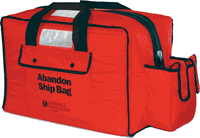
Private pilots flying over water often carry what they call a "Ditch Bag." These are compact bags containing all the equipment needed to have a chance of surviving and rescue if the plane goes down in water. Boaters also use them for the same reason. Both ACR and Landfall Navigation make bags with positive flotation -- enough to float 100 lb. The Landfall bag has been rated "Top Choice" by Practical Sailor newsletter. Some people call it a "Flee Bag."
No matter what you call it, it should contain an EPIRB, Waterproof VHF handheld radio, red and white parachute flares, flare gun, red handheld flares, orange handheld smoke signals, dye marker, signal mirror and whistle, waterproof flashlights with spare batteries and bulb, air horn, floating knife, and 10 water packets per person as a starter. Well equipped ditch bags contain medical kits, watermakers, fishing gear and more.
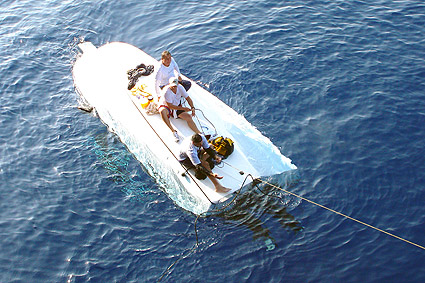
The sad irony of all of this is that ditch bags are something that our sailor friends are likely to have aboard, but few power boaters ever think about it. Yet more powerboaters die each year in boats that capsize or sink in the U.S. alone, than recreational sailors who meet a similar fate all over the world.
Builders of center consoles of all sizes are aware of the importance of stowage, so finding a place for a ditch bag should not be a problem.
Visit Landfall Navigation's Abandon Ship web page...
Mayday Radios and Beacons
The Coast Guard encourages boaters to purchase Emergency Position Indicating Radio Beacons (EPIRBs) that can cost between $150 to $1,500. The 406 EPIRBs, or PLB (personal locator beacon) prices have fallen to about $200 to $500, depending on brand. ACR makes a mini personal locator which sells for $160. EPIRB technology enables emergency signals to be sent out automatically or manually. Some EPIRBs have global positioning devices that can help provide the rescuers with a more exact location.
The new DSC VHF radios have a red Mayday button that automatically sends out a distress signal. If it is hooked up to a gps, it will automatically broadcast the unit’s position as well. The USCG's new "Rescue 21" program can take a bearing on the signal. (At this time the "Rescue 21" towers are not all in place and it will be another couple of years before the job is complete.) All USCG vessels now monitor the DSC VHF signals. But remember, VHF has essentially "line of sight" range so when you are 50 miles offshore you are more apt to reach a fellow boater than a USCG land-based tower.
If Marquis Cooper or any of his friends had taken the time to pack one of these emergency communication devices, their story might have ended far differently.
Too Small for a Life Raft
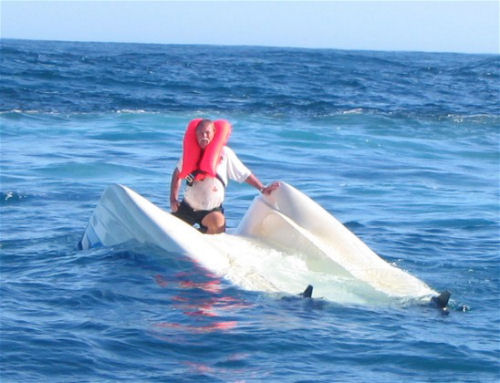
Isn't a 21' boat that is only going 38 miles offshore on day trips too small for a life raft? We would say that this accident proves the case for life rafts in small boats. Marquis Cooper bought a top-of-line 21' center console, yet that boat could not overcome the tremendous forces of Mother Nature's high seas. His boat floated as well as any would have in the conditions, yet it wasn't designed to keep people safe upside down, nor could any monohull in its class.
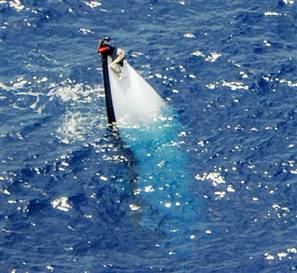
According to survivor Schuyler, both Cooper and Smith gave up and drifted away after only four hours or so in the 68-degree water. Schuyler says that Bleakley saw a light the next night and swam away toward it. Clearly all three men were suffering from hypothermia, something that a PFD cannot protect against. They might all have survived had they been in a life raft.
"Coastal" life rafts are on the market for lower prices than those intended for transoceanic voyages. Some are recommend for up to 3 miles from shore, others for up to 20 miles from shore. For example, Switlik makes what it calls 4 person "Rescue Pod" as opposed to calling it a life raft. It comes in a 12" X 24" fabric valise weighing 33 lbs. Landfall Navigation sells them for $2200.
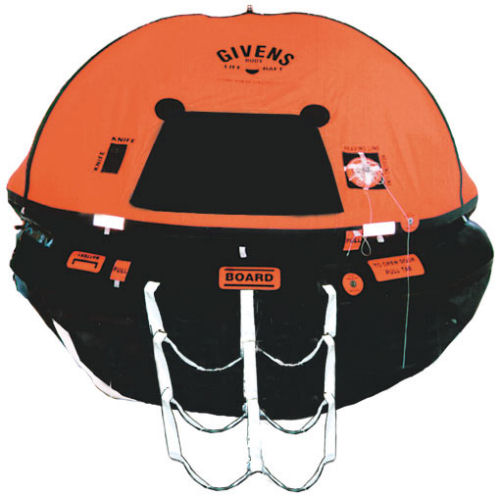
There are other so-called life rafts on the market for "coastal" use that are cheaper, but we don't recommend them. The Mercedes of life rafts is the Givens brand. It makes a 4-man coastal life raft called the "XT Rescue Raft" that has two tubes and most of the features of its transoceanic-rated units. It retails for $5,600 and measures 31"L x 21"W x 14"H and weighs 75 lbs. FYI, the same forces that capsized Cooper's 21' center console would most likely do the same to the cheap life rafts, and that is why Givens Life Rafts are your best bet.
With all of the stowage compartments on modern center consoles, certainly one could be found for a “coastal” life raft for those people regularly venturing far offshore.
Conclusion
While hindsight is 20-20, a few things should have been obvious from the start. First, the boat was not prepared for an emergency. There was no ditch bag or even handheld VHF, EPIRB, and no usable flares that we know of. They did not leave behind a specific float plan with an ETA, only a vague message with a friend.
Second, sometime around mid-day the weather service put out small craft advisories, yet the men either did not heed these warnings or were not tuned into a VHF weather channel and did not hear them. Either way they made a fatal mistake.
Third, at mid-afternoon, winds were recorded at 25 mph at the Tampa-St. Pete airport and we assume the same happened near that time offshore, yet our anglers did not call it a day when it should have been obvious that bad weather was coming in.
Fourth, once the boat capsized there was little they could do except don their PFDs and conserve their energy. Since they could not communicate, their fate was in the hands of Lady Chance.
We hope that the passing of these three young men serves as a lesson to powerboaters everywhere that we all must take responsibility for ourselves and be prepared to rescue ourselves. We also must realize that as boat owners we are responsible for the safety of everyone who gets aboard with us. There are no excuses.