10 Complaints About Center Consoles
Based on recurring owner comments, compromises inherent in the design, and the experiences of our test captains, friends and neighbors, here are the 10 most common complaints about center-console boats. Their importance varies considerably according to boat size and intended use.
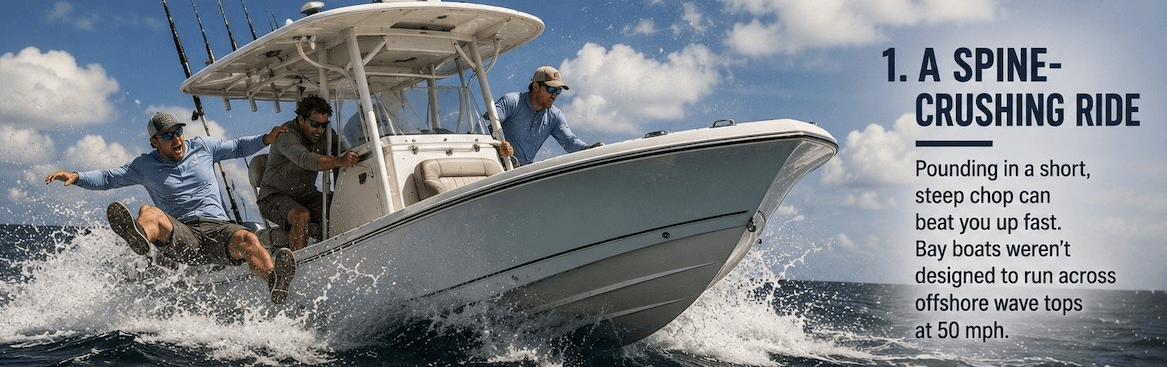
1. A Spine-Crushing Ride
Owners often complain that their boats pound when running into a short, steep chop. This is especially common with smaller, lighter center consoles or hulls having relatively low deadrise angles, particularly forward.
For example, bay boats were not designed to run across offshore wave tops at 50 mph. A deep-V can soften the ride, but all deep-V hulls are not the same. The deadrise at the stagnation line—where the boat is actually running while on plane, often roughly beneath the helm station—is what counts.
Don’t know the deadrise of a boat amidships? You’re not alone. Only a few builders provide that information.
2. A Wet Ride
Spray blowing over the bow or around the console is a frequent complaint. Hull design, wind direction, wind speed, boat speed and loading all matter. There is also a basic trade-off: Sharper hulls may cut through waves more softly, but they can also throw more spray.
Some boats have double chines to knock down spray. Others have Carolina-style bows intended to throw water outward rather than upward. Some boats are simply wetter than others. If a dry ride under normal conditions is important to you, choose your boat carefully.
3. Too Little Protection from Wind, Rain and Cold
Welcome to the world of center consoles. Remember why these boats were invented in the first place—and it was not to keep passengers snug and dry.
Wide T-tops, windshields extending all the way to the hardtop, and glass or clear-vinyl side curtains are about as good as it gets. They will usually keep the skipper and companion dry, along with passengers who can crowd in behind the helm.
Our best advice is to check the weather forecast before leaving the dock, bring foul-weather gear and remember that you won’t melt.
4. Uncomfortable Passenger Seating
Virtually all center consoles are designed primarily around fishing space. Forward seats may be upright, narrow or poorly supported, while aft seating may be limited to a folding transom bench. Passengers sometimes discover that seating that looks attractive at a boat show is uncomfortable when the boat is underway.
These days, large and expensive center consoles usually have comfortable helm seats and often additional seating immediately behind them. Most builders claim their center consoles are family-friendly because they know that approximately 60% of their buyers will use the boat primarily for family outings. The other 40%, however, may want a dedicated fishing machine.
That is why some center-console builders also produce dual consoles: They are genuinely more family-friendly.
If family comfort is your number one priority, a center console may not be the right type of boat for you in the first place.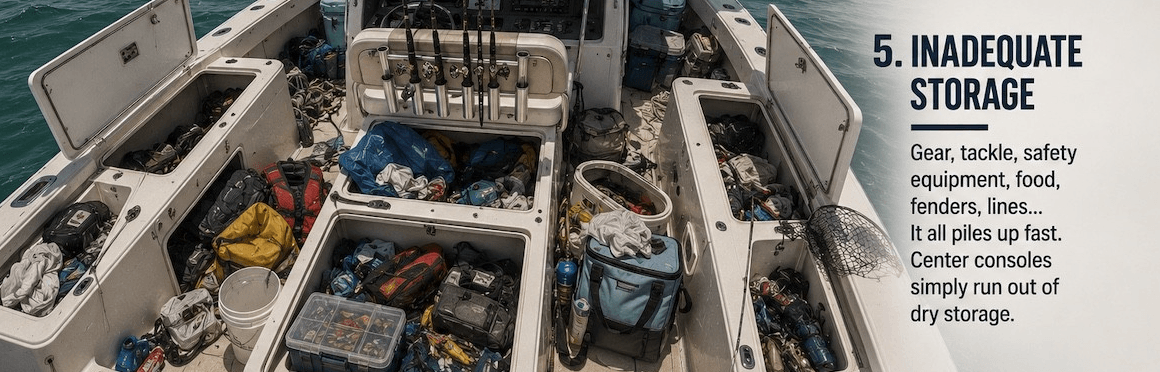
5. Inadequate Storage
Owners frequently run out of dry storage for tackle, safety equipment, fenders, lines, clothing, food and family gear. Large fishboxes and livewells may appear generous, but they cannot always substitute for properly divided, easily accessible storage.
Keeping the compartments beneath forward seating dry requires good design and effective gaskets, which relatively few boats have. In-deck storage can also be problematic. That is why we often see center consoles with the console compartment stuffed with gear.
Remember that center consoles are open boats. Without a foredeck and large enclosed spaces below, everyone needs to pack lightly.
More of the better builders are beginning to use otherwise wasted space inside the gunwales for storage and more could also be done with larger consoles. We say: Try before you buy.
6. A Cramped Head Compartment
Consoles with side-entry doors are invariably difficult to enter. Only a few builders go to the trouble of cutting away part of the overhead or creating another solution—such as forward entry—to make access easier.
Once inside, an adult should actually sit on the toilet to make sure there is adequate headroom. Looking down at a toilet inside a compartment often creates the optical illusion that there is plenty of room when there really isn’t.
Relatively few center consoles have opening portlights in the console, and generally only luxury models are equipped with exhaust fans.
7. Poor Access to Pumps, Batteries and Plumbing
Bilge pumps, seacocks, batteries, filters and livewell plumbing are usually installed before the “lid”—also known as the deck—is put on. That saves construction time and should make installation easier, but the quality and accessibility of these systems vary widely from one boat to another, and sometimes even among models within the same brand.
This is one of the most important areas of the boat because it contains through-hull fittings and hoses carrying raw water from below the waterline to various systems.
ABYC standards require seacocks to be readily accessible. Nevertheless, we regularly inspect center consoles on which critical components are difficult to reach.
It is not unusual for bilge pumps to be nearly inaccessible, or for the outboards’ hydraulic trim-and-tilt components to be located where only a midget orangutan could reach them. Battery placement presents another set of issues altogether.
If you are not prepared to enter the mechanical compartment and determine whether it can be easily inspected and serviced before buying, you may have to live with the consequences later.
8. High Fuel Consumption and Operating Expense
Large center consoles have become beamy and heavy. Deep-V hulls require more power than moderate-deadrise boats, and many owners also want speed and bragging rights.
All of that, combined with large four-stroke outboard engines, means fuel consumption can be high. With three, four or even five engines on the transom, many of these owners are more concerned with speed than economy.
For buyers worried about fuel consumption, we advise considering a smaller boat with a single or twin-outboard installation capable of reaching approximately 40 mph—which is fast enough for most people.
9. Limited Aft Cockpit Space
Oversized consoles, forward loungers, coffin boxes, multiple livewells and elaborate seating can consume substantial deck space. Some fishing-oriented owners feel that modern, family-friendly layouts leave less room to fight fish and move around the boat.
They are right.
However, there are still quite a number of boats on the market that have not been compromised in the interest of family comfort. It is simply a matter of finding the right one.
10. Difficult Boarding and Water Access
Outboards occupy much of the transom, making it harder to board from a dock, beach or the water. Narrow side doors, short ladders and crowded engine wells are common frustrations, especially for older passengers, children and swimmers.
Recent designs increasingly emphasize better boarding arrangements because traditional center-console layouts were not intended for swimming and water sports.
ABYC standards specify that boarding ladders should extend 22” below the waterline, for all boats, which was a step in the right direction. Some builders have created water access ahead of the engines, while others provide wide side doors.
Perhaps, in the future, an intrepid builder will even put “wings” on a center console, similar to the fold-down terraces now appearing on many day boats.
Observations
All boats, regardless of size, are expensive these days. That places a premium on careful research—and makes BoatTEST’s independent, third-party reports more valuable than ever.