The 5 Most Dangerous Words in Boating
We Go Round in Circles
Wouldn’t it be nice if - can be an innocuous little daydream on one hand or lead to a world war on the other. Hitler, no doubt, uttered this into his Fuller Brush moustache prior to taking back the Rhineland in 1936. I’m sure Alexander uttered these words before he became “Great” and Attila bellowed these words before he started his rampage to prove he was a man (because everybody called him “hon”).
From Contorted Positions to the Ultimate Setup
“Wouldn’t it be nice if”… also applies in a big way to the pleasure boat scene. These few, simple words have cost boat owners billions of dollars since the dawn of boating: “wouldn’t it be nice if I hollowed out this log so I could sit inside instead of straddling it?”, “Wouldn’t it be nice if I could get rid of these complicated, confusing sails and rigging and install a motor?”, “Wouldn’t it be nice if hulls could transcend the displacement mode and rise atop the water for higher speeds?”, “Wouldn’t it be nice if I had some protection from the elements?”
This last phrase concerning protection from the elements was first heard (as far as power boats are concerned) around the turn of the century when engines were installed in blow boats which were denuded of their rigging and had their masts sawn off to become the first power boats. We all know that blow boaters have always sat out in the elements conning their vessels in a contorted position propped up at an angle trying to look happy in their miserable little cockpits with salt or rain water running down their butts. Well, this was the “position” in which pioneering power boaters found themselves at the turn of the century. Then, it started … “Wouldn’t it be nice if I had a windshield forward of the cockpit to deflect wind and spray?”
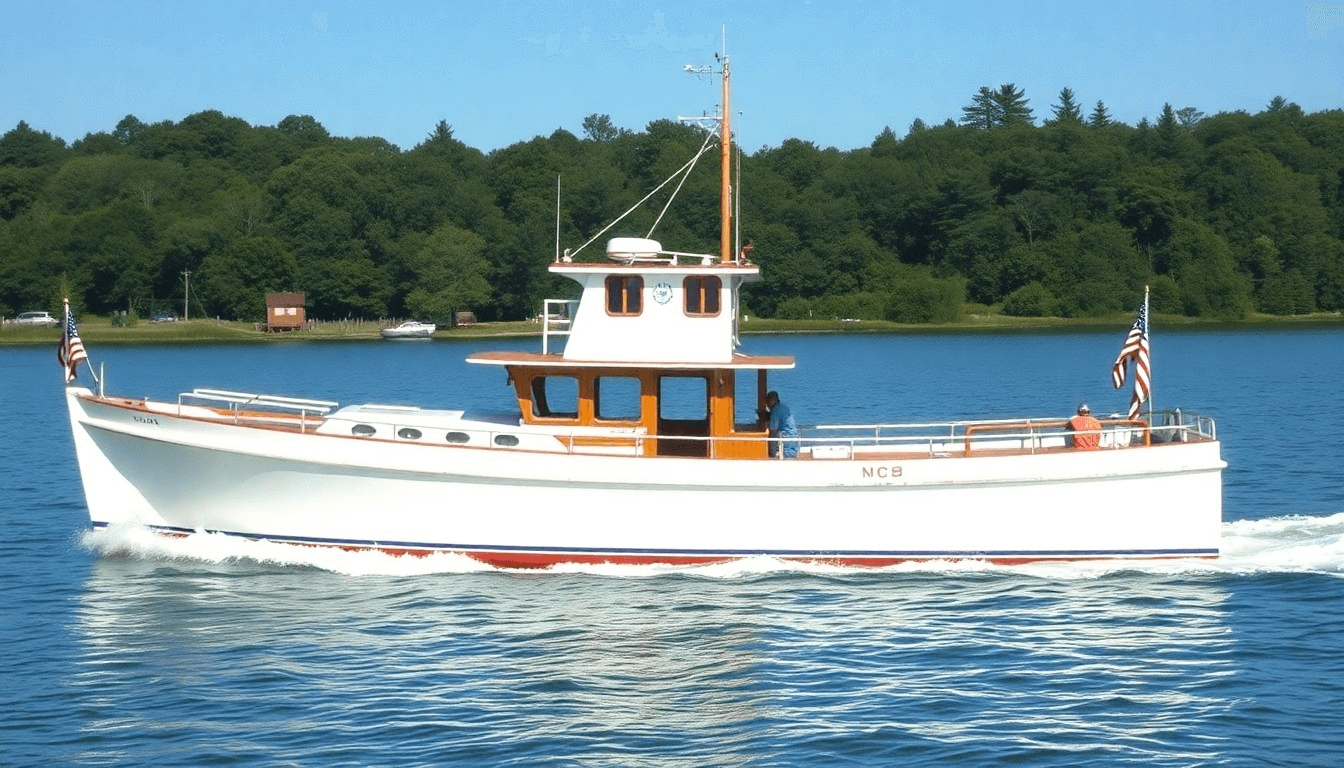
These simple words set in motion a never-ending spiral in powerboat design that continues to the 21st century. The Evolutionary Scale of Helm Positions – an open boat (blow boat hull) with a console, to which, eventually, a windshield was added and, thereafter, in quick succession a top over the helmsman, and a full enclosure around helmsman. At this point, helmsman thought they were really living with a fully enclosed, protected pilothouse isolated from wind, spray and rain, which could be heated (or cooled). Yes, a fully enclosed pilothouse was the ultimate setup.
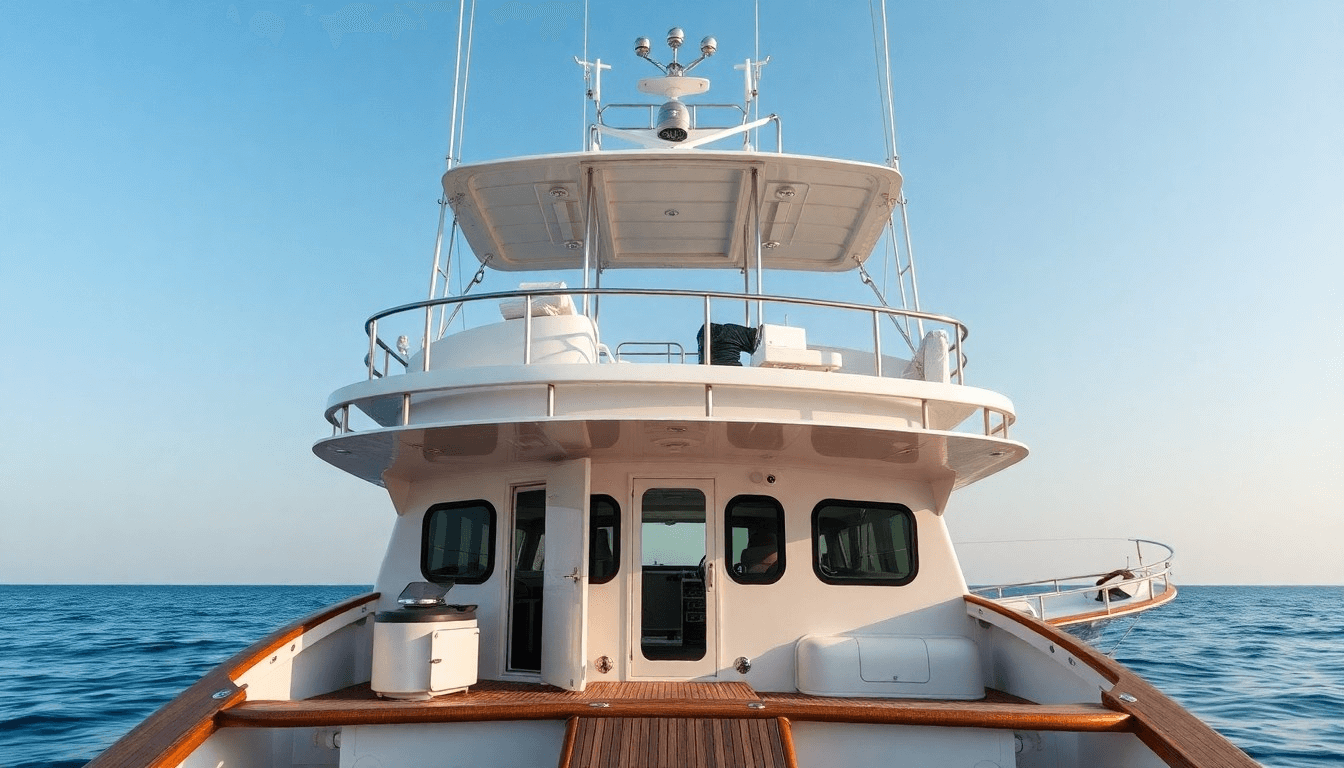
But wait! Sometimes it got a little stuffy and the visibility over the bow wasn’t that great. Wouldn’t it be nice if, in addition to the closed control station, a second open station could be added? This lead to the development of the flying bridge. I can clearly recall when the addition of flying bridges first became popular after WWII. At that time, I remember my dad speculating that once a top had been added to the flying bridge that another flying bridge would be added.
This was a big joke back then. We never dreamed that configuration would ever come to be. The flyingbridge eventually went through exactly the same metamorphosis as the open console boat (a windshield, top and full enclosure was added) bringing us to – the raised, enclosed pilothouse. Although visibility was better it was still a bit confining and wouldn’t it be nice to breathe clean air and catch some rays? This lead to the tuna tower, which, in turn, developed, into an open flyingbridge atop the enclosed pilothouse to which was eventually added – you guessed it – a windshield and a top.
Evolutionary Spiral
Powerboats are constantly spiraling back to their early roots only to reinitiate the inevitable evolutionary process. In the 50’s, “open express” boats were introduced, which eventually, metamorphosed into flyingbridge sedan cruisers. Look at the situation in the big (40 to 80-foot) speedboat market today. These big, go fast wonders started out with a simple windshield forward of the helm. Eventually, using the thinking outlined above, a top was added and inevitably, a full enclosure evolved. This is what we see today in many of these boats including the Pershings, Sunseekers, Leopards, big Searays and the new Fountain 65-footer. But the same problems exist in the boats of the 1920’s (poor visibility, stuffiness) and I can guarantee that, soon, these vessels will ascend to the flyingbridge status.
Lofty Heights
And so, where we find ourselves today on the Evolutionary Scale of Helm Positions – the highest form (literally and figuratively) of helmsman location. I must tell you that I’ve heard whispered rumors that there are some boats that have pushed beyond my evolutionary scale and have attained a lofty status although this has never been documented. I believe it will happen, however, because I have had numerous clients who arbitrarily wanted to make their boats higher than their neighbors. Building “superstructures to the stars” is only limited by the vessel’s stability and, I am sure that in the future some bold designer will eventually push through the evolutionary stage.
We all know that “the difference between men and boys is the price of their toys.” What’s happened with helm positions is simply the building block syndrome. Kids just love to stack blocks atop another – until they collapse. Man is never happy with the “status quo” and must always keep climbing higher. Hell, man has visited the moon, why can’t he break through helm configuration? So be the first in your marina (and the world) to build a flyingbridge atop a flyingbridge atop a flyingbridge and attain boating immortality.
(Reprinted with permission of Regina Fexas.)
If you would like to read more of Tom's pearls of wisdom, tune in next Friday -- "Fexas Friday."
Better yet, why not get a full dose of infectious Fexas whenever you need it -- and buy one of the volumes below. Better yet, why not buy all of them -- we call them the "Fexas Five." They will provide many evenings of fun reading (better than Netflix), and you'll make the widow Regina very happy knowing that Tom will live on with you the way most of us remember him.
Order 1, 2 or "The Fexas Five" --

To find the "Fexas Five" on Amazon, click here...
Tom Fexas (1941-2006) was one of the most influential yacht designers of the last quarter of the 20th century. With the narrow Wall Street commuters that were built in the 1920s and '30s always on the back of his mind, he wanted to design boats that were at once fast, comfortable, seaworthy and economical to operate. Over the years, he and his firm designed over 1,000 yachts for some of the most prestigious boat builders in the world, including Choey Lee, Palmer Johnson, Grand Banks, Mikelson Yachts, Burger, Abeking & Rasmussen and many others.
Even though toward the end of his career he only designed megayachts and superyachts, including the remarkably influential PJ "Time" in 1987, he is best remembered for his first major vessel in 1978 -- Midnight Lace -- which became a series of 44-52-footers. They were light, narrow, and fast with relatively small engines. He was also influential in the boating community because of the monthly column he wrote for Power and Motoryacht, which began in its very first issue in January 1985.