Air Lubrication on Hull Bottoms Can Reduce Drag

Possible Trawler and Displacement Motoryacht Application?
Something going on in the Northern European bulk carrier design is the addition in the after market of what is called the Damen Air Cavity System (DACS). While primarily designed for flat-bottom ships in may have applications for some recreational trawlers and displacement motoryachts in some areas of their hulls to reduce resistance. This fastening explanation of the new system might turn-on on some light bulbs in recreational boat design.
Air Lubrication
The Damen Air Cavity System (DACS) is a patented Air Lubrication System (ALS) that was originally developed at the Delft University of Technology (TU Delft) in the Netherlands and commercialized by Damen Shipyard Group. By maintaining a thin layer of air between the hull and the water underneath the flat bottom area, a significant reduction of the resistance can be achieved. This leads to a higher efficiency of the propulsion system, reduction of fuel consumption and emissions.
Hull optimization generally helps to reduce the wave making and pressure resistance whereas the frictional resistance, which is dominant, is considered as given and it is proportional to the wetted area. DACS is reducing the wetted area of the vessel. This is done by creating a stable layer of air that separates the hull from the water. The system has a high overall efficiency and can be used on ships for fuel consumption and emission reduction.

How DACS Works
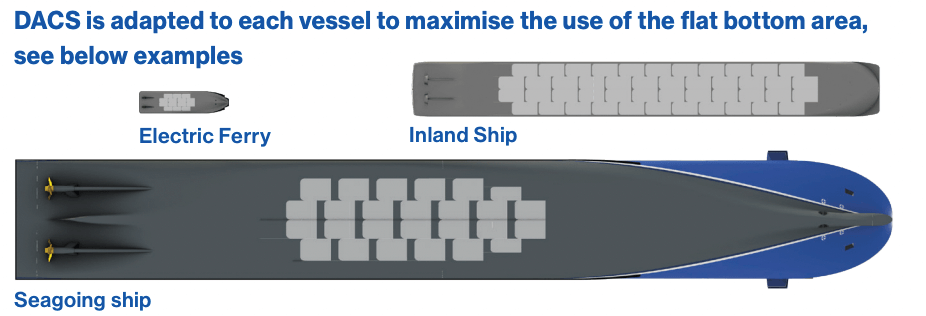
With DACS an air cavity is created by injecting air underneath the vessel behind a small caveator plate that separates the water flow. To secure the cavity, longitudinal skegs are installed to prevent the air from escaping. The air only needs to overcome the hydrostatic pressure due to the draught of vessel. As a result of this, the air cavity method requires considerably lower air flow, thus compressor power, then competitive first generation systems. To maximize the area of the hull covered by the system, a series of subsequent cavities are created, separated by transverse skegs that ensure seakeeping behavior is maintained. Having a series of cavities in place has the additional advantage that any air escaping from one cavity is absorbed in the next.
DACS
DACS was developed in a collaboration with Delft University of Technology. The technology is patented worldwide. Damen Shipyard group has adapted the technology for various shipping applications by using MARIN and HSVA to validate under real ship conditions.
The system aims to reduce resistance in the water, particularly for ships with a low Froude number. Such vessels are known to encounter the greatest resistance in the water. By reducing this, DACS looks to lower both emissions and fuel consumption/OPEX. At similar flow rates, the air cavity reduces the friction significantly more then the traditional bubbles generating systems, as shown in the graph below.
Inland Waterway Ships
Inland waterway ships have a large flat bottom area and they sail at relatively low speeds, often in shallow water. This is why for this type of ship the relative fuel consumption reduction by DACS is the highest. The fuel savings and emission reduction is between 10 and 20%.
Seagoing Ships
Depending on ship type the confirmed fuel savings on seagoing vessels are between 5 and 12%. Although the relative savings are smaller compared to the inland waterway vessels, the absolute values are often much larger. This is because seagoing ships are larger, have more installed power and sailing at a higher speed.

https://www.damen.com/equipment/green-solutions/damen-air-cavity-system