Another Dark and Stormy Night
Lost and Alone on the Intracoastal Waterway
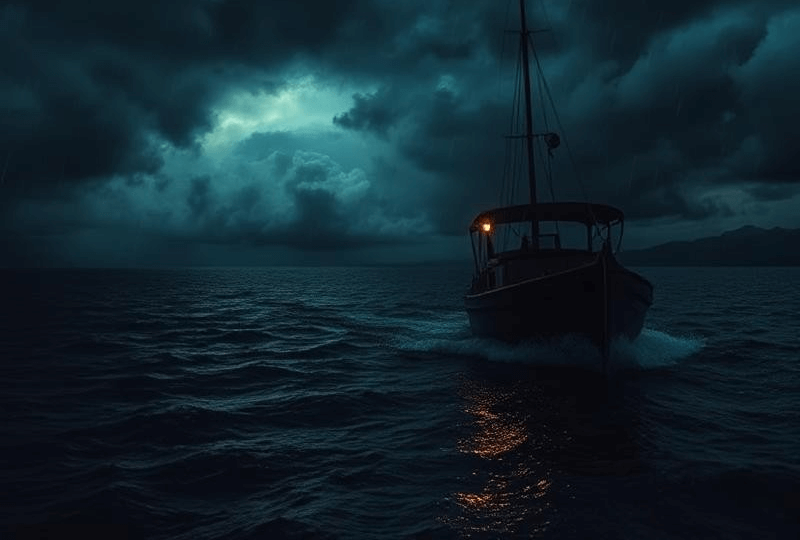
This is an inconsequential story about unpreparedness and stupidity. Although I was never in danger, it shows how someone who should know better can get in trouble.
Being from the hinterlands of Long Island and Connecticut from where I immigrated in 1977, I could strongly visualize what Southern Nights were all about fueled by endless articles in the marine press and a few trips to Paradise.
Southern Nights, The Dream - warm breezes rustle the palm fronds which filter a kaleidoscope of moonlight onto the lush ground. The natives mostly sit around outside dancing and drinking piña coladas while planning their next day of fun in the sun activities. Boats silently and elegantly cruise up and down the intracoastal stopping here for a drink, there for dinner and winding up at a place like Shooters for late night activities.
Southern Nights, The Reality - a cold, black, moonless night. The wind is howling about 35-knots out of the northeast producing wind chills below freezing feeling like a stormy night in November in Connecticut. I am alone on the open bridge, of a 52-footer making the intracoastal run from Fort Lauderdale to Stuart. I have just entered the East “Clover Leaf” of the Saint Lucie River – home waters for me – and I am completely lost and helpless. How did I get in such fix?
Hawking Laces
In the early 80’s, myself and a fine gentleman named Scott Meissner were hawking “Midnight Laces.” I am a “new to the scene” designer of the vessels and Scott pays for the boats and runs the business end of things. We are on one of many runs between Fort Lauderdale and Stuart shuttling brand new Laces around for one reason or another. As new boats, they were stripped – devoid of such niceties as radios, bimini tops, etc. This trip, we are taking a 52-foot “Lace” north in the late fall. The timeline goes as follows:
-11:00 A.M. (approx.): Depart Fort Lauderdale
Huge seas discourage an outside run so Scott and I run inside.
-4:30 P.M. (approx.): Arrive North Palm Beach
Scott has a winter residence here and I insist that he debark since we are going right by his home. Scott thinks he should come with me to help out and keep me company but, considering the logistics of getting him back home late at night, I persuade him to jump ship. “You going to be alright?”, he asked me. AM I GOING TO BE ALRIGHT? I thought to myself, “Come on, running the Intracoastal is for wusses. After all, I am from the Great North where one really has to navigate – a place where rocks and ledges and open water and swift currents prevail. What was the ICW but a watery I95? Hell, a none too bright preteen girl with a bad hangover could navigate the ICW.”
-4:45 P.M. (approx.): Departure North Palm Beach
I head North alone.
-5:30 P.M. (approx.): Sunset
The sun is going down and it is getting dammed cold. A jacket and some chow would be nice but neither is aboard.
-6:00 P.M. (approx.) Darkness
It is now completely dark and really cold on the open bridge. I realize that, not only I am completely unprepared for a daylight run but I am ABSOLUTELY UNPREPARED for a night run. I am ashamed to admit it now, but I had no charts, an uncompensated compass (that only marginally indicated north, south, east and west), no binoculars, no electronics, no searchlight and no warm clothes. But, hey, just keep the pointy end of the boat between the red and green markers and you have it made, right? Well... maybe. In those days, there were far fewer “no wake” zones on the ICW between Palm Beach and Stuart so, wanting to arrive as quickly as possible, I run “balls to the wall” when possible at around 24-knots. The problem is, traveling at high speed with no searchlight forces me to pick out the markers from the glow of the running lights! Indeed, an exciting way to run a boat.
-7:30 P.M. (approx.): Jupiter
I miss a marker and slide up on a sand bar. It is a nice, soft deceleration. With visions of spending a long, cold, hungry night on the beach, I try to work her off with the little French engines that could. Luckily, she is in deep water aft and, finally, I back her off the bar and continue north at 24-knots.
-9:00 P.M. (approx.): “The Crossroads”
The infamous “Crossroads” at Stuart is where the intercostal, inlet to the ocean and the Saint Lucie River converge. Dammed if I couldn’t find the buoy to port so I could turn the corner into the river. The wind has a straight shot off the ocean here and the boat rolls and the wind shrieks as I feel my way around until I finally locate the buoy, turn to port and go “balls to the wall” again.

-10:00 P.M. (approx.): The Stuart A1A Bridge
I pass under the bridge entering the east cloverleaf of the Saint Lucie River. As previously mentioned, these are home waters to me and I have passed through here many times but, on this pitch night with no moon and no search light and the lights ashore confusing things along with the strong winds and waves, I could not make out a dammed thing. I know I have to turn to port but if I turn too soon I put the boat on a shallow, hard bottom. If I turn too late, I run aground on the North Shore. I never felt so foolish. So I am in the Saint Lucie River feeling my way around at idle going in circles trying to find some familiar landmark when, out of the blackness appears ... the cops!
Hey, who says you can never find a cop when you need a one? I should point out here that in the early 80’s drug running was looked at by many as a fine sport and was widespread. Although I have never carried any drug but aspirin, as a lone guy running a long, black boat around in circles in the Saint Lucie River at night, I fully expected to be boarded and searched. Sheepishly, I explain my situation and, miracle of miracles, the cops offer to lead me to the marker that leads to the channel to the Roosevelt Bridge, and... my warm bed at home.
-11:15 P.M. (approx.): Home
I enter the cut leading to the canals at Lighthouse Point and dock the boat behind my house vowing to never again make any trip anywhere without having proper gear aboard. It has been a long, cold, hard day and after wolfing dinner, I quickly fall asleep dreaming of moonlight filtering though rustling palm fronds.
(Reprinted with permission of Regina Fexas.)
If you would like to read more of Tom's pearls of wisdom, tune in next Friday -- "Fexas Friday."
Better yet, why not get a full dose of infectious Fexas whenever you need it -- and buy one of the volumes below. Better yet, why not buy all of them -- we call them the "Fexas Five." They will provide many evenings of fun reading (better than Netflix), and you'll make the widow Regina very happy knowing that Tom will live on with you the way most of us remember him.
Order 1, 2 or "The Fexas Five" --

To find the "Fexas Five" on Amazon, click here...
Tom Fexas (1941-2006) was one of the most influential yacht designers of the last quarter of the 20th century. With the narrow Wall Street commuters that were built in the 1920s and '30s always on the back of his mind, he wanted to design boats that were at once fast, comfortable, seaworthy and economical to operate. Over the years, he and his firm designed over 1,000 yachts for some of the most prestigious boat builders in the world, including Choey Lee, Palmer Johnson, Grand Banks, Mikelson Yachts, Burger, Abeking & Rasmussen and many others.
Even though toward the end of his career he only designed megayachts and superyachts, including the remarkably influential PJ "Time" in 1987, he is best remembered for his first major vessel in 1978 -- Midnight Lace -- which became a series of 44-52-footers. They were light, narrow, and fast with relatively small engines. He was also influential in the boating community because of the monthly column he wrote for Power and Motoryacht, which began in its very first issue in January 1985.