The Art of Anchoring

Successful anchoring is a basic skill every motor yacht owner should master. Beyond the essential safety of everyone on board, it opens so many wonderful options including the enjoyment of a relaxed lunch in a picturesque bay, leaving your yacht secure if you want to explore ashore or staying overnight or longer near a favorite beach where no public mooring or marina is available.
Learning how to set your motor yacht’s anchor and how to retrieve it is a vital skill of seamanship. Equally, a dragging anchor is frustrating and potentially dangerous.
The Riviera owner’s manual includes a section on anchoring which should be studied before you venture into the wonderful world of boating.
Every current Riviera model is equipped with an appropriate anchoring system selected by the design and engineering teams to providing the best setting and holding capability.

When well set, your anchor will work together with the chain to hold the yacht secure, even against strong wind, current and tide, but only if you release enough “scope” for the system to work efficiently. “Scope” is the length of chain you release.
Riviera supplies Ultra anchors that are either included with selected yachts or are an option that are designed to dig into the sea floor and grip tighter as the boat pulls on the chain. To do so, it needs sufficient scope to create a horizontal force and serve as a shock absorber. If the pull is too vertical, the anchor’s suction will break.
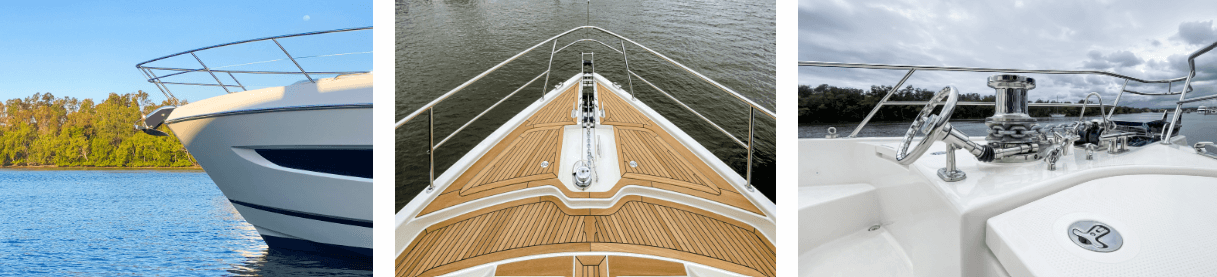
A Skipper's Advice
We asked Riviera’s Final QC and Sea Trials Manager Dean Brickell, who has extensive experience in delivering Riviera yachts along the Australian coast and to the Pacific Islands, for his advice.
“First and foremost, listen to and read all the weather forecasts and choose a spot that will provide the best shelter from wind and waves.
“Second, prepare an exit strategy, checking where other boats nearby are anchored and the best way to leave the anchorage in case of problems or you can’t successfully anchor in that spot.
“Aim for as much chain as you can safely release. It is an adage that chain is better utilised in the water than in the chain locker,” says Dean. “You do need to be aware of the potential risks and obstacles in the area you have chosen. How close is the shoreline, are there other boats already anchored nearby and are there any obstacles in the water such as cables, rocks or debris on the bottom?
“It is important to think about ‘swing room’ or the diameter of the circle your Riviera could create over time as it moves around the anchor point, pushed by wind, current and tide. You don’t want to find that, although you are anchored safely away from a rocky shore or far enough away from other boats, a change of wind or tide puts you at any risk.
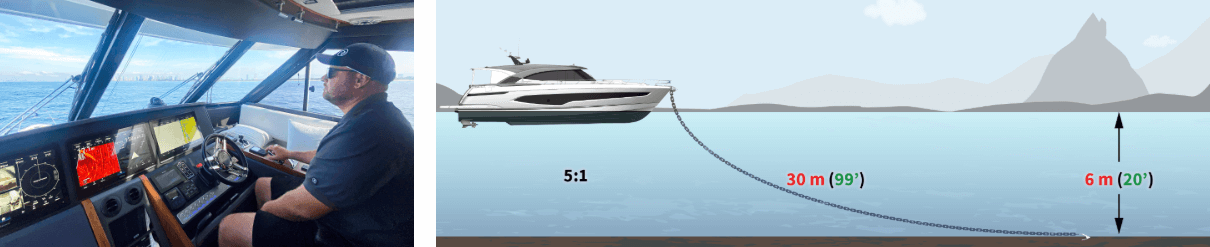
“After taking that area into account, and to ensure the efficiency of your anchoring system, you need first to know the depth of water at high tide in the area you wish to anchor,” says Dean. “To calculate scope, multiply that number by at least five if you plan to stay for a short period – for lunch and a swim, for example. For longer stays, such as overnight, you should use a ratio of seven or eight-to-one. Remember to consider added length for the distance from your bow roller to the water.”
Chain linkage size is another consideration. The Riviera team installs the most efficient chain for your model. On smaller yachts, links of 8mm thickness will generally work well. Larger motor yachts carry 13mm.
Knowing your Riviera’s draft – the distance from the surface of the water to the lowest point of the motor yacht, including propellers – as well as both the timing and range of tides, is a major consideration. Ensure you have 1 metre of clear water under the keel at dead low tide at all points in the swing circle of the anchor, not just at your anchorage point. In 5 metres of water with a scope of 8:1, you need to make sure the depth at all points within the 40-metre circle around the anchorage are safe. Remember that, as a tide rises, you may need to release more chain.
Look ashore for signs warning of submarine cables and never anchor on coral, seagrass or among rocks if possible as these offer poor holding or could damage the natural environment.
Now let’s discuss the process of anchoring. First, double check that the end of the chain – opposite to the anchor – is secured safely to the yacht. More than one skipper has dropped anchor only to watch the entire length roll out into the water requiring a diver to retrieve it.
You have decided upon a good place to anchor, well away from other boats and the shore. Now you need to send at least one crew person forward to unlock the anchor and then monitor activity as the anchor is deployed and chain run out. Use a set of UHF radios for communication or agree on a set of hand signals from crew to skipper to convey when to release the anchor and how well the chain is running out. If possible, crew should wear polarized sunglasses to see into the water.
Observe how other boats in the area are facing. It is a further assurance of wind and tide direction. Your crew should be on the bow and have the safety strap to the anchor released and ready to deploy. Drive the motor yacht in a circle around the spot you have chosen to check swing room and allow crew to look down into the water for any obstructions. Approach the anchor point heading directly into the wind. Drive slowly and steadily a couple of boat lengths beyond your chosen spot to allow for backward drift as you release the anchor.
Monitor your transducer depth. When the anchor has reached the sea floor – your crew should signal this by seeing the chain go slack – engage reverse gear and drive steadily backwards in a straight line, paying out chain to your selected scope, monitoring your chain counter.
Ensure that your crew stand well clear of the windlass and chain to avoid risk, keeping hands, feet, hair and clothing well away from the action.
Once the chain is paid out, bury the anchor with a short burst of reverse power. If the anchor is secured, the yacht should rebound forward a little when you ease the throttle.
Check for any vibration on the chain while it is taut; vibration is a warning of dragging. Confirm that you are secure by lining up marker points such as trees or posts on the shore.
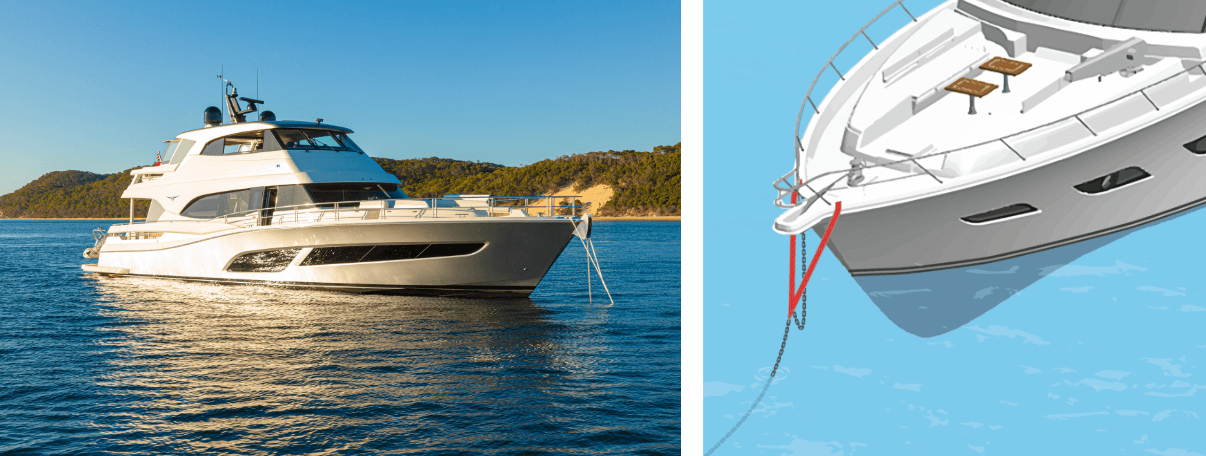
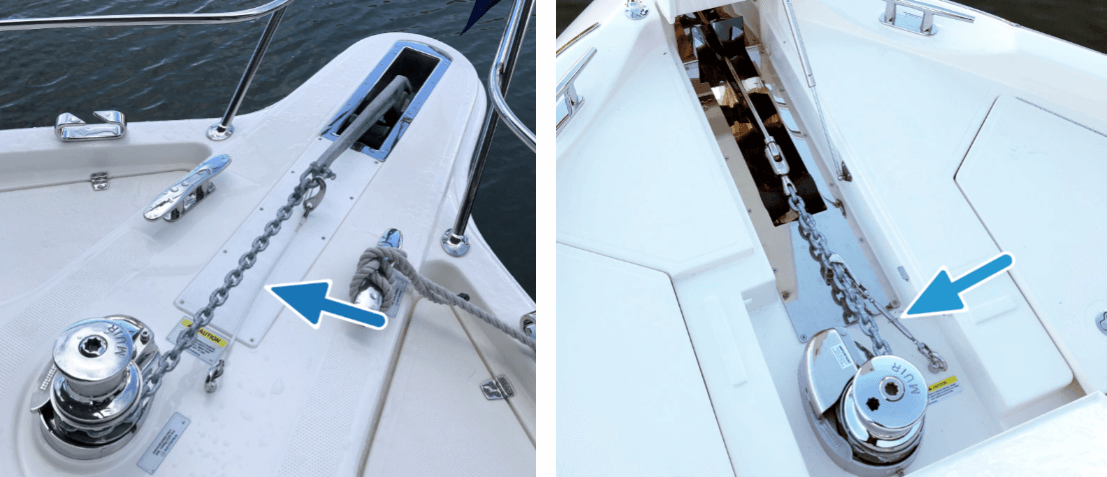
If you are planning an overnight stay, fit a snubber. A snubber prevents transferring the shock load from the chain to the yacht. An ideal snubber is made from three-strand nylon rope for maximum stretch – more stretch absorbs more motion. Ideally the snubber with be designed as a Y-shape with a grab hook to link into the yacht’s chain at the bottom end of the Y. Secure each end of the Y to cleats on each side of the bow. Attach the snubber hook to the anchor chain and then slacken the chain a little. Snubbers are not standard equipment; your Riviera Dealer will be able to advise the appropriate snubber for your yacht.
If you discover that the anchor is dragging, first release the snubber (if you are using one) then let out more chain or simply weigh anchor and try again.
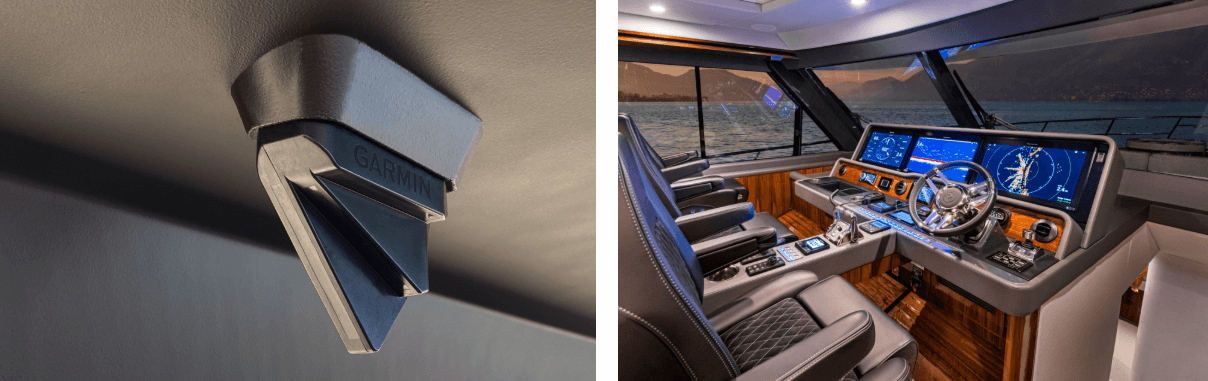
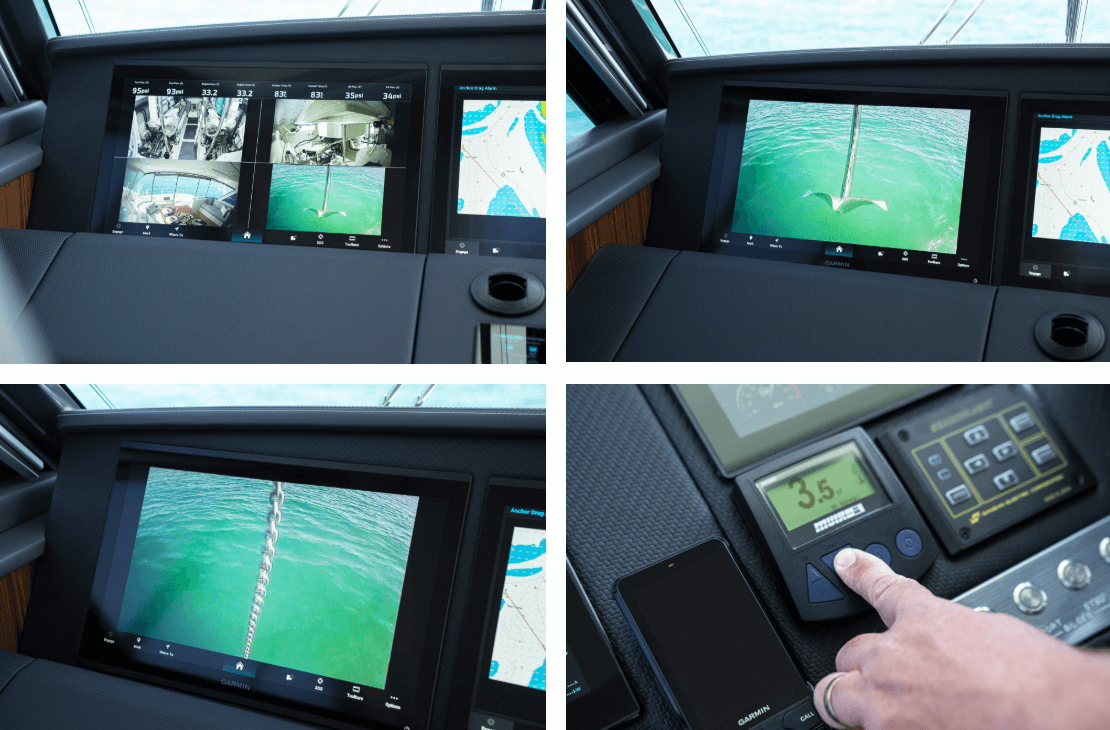
Your Riviera’s Garmin navigation system includes settings for several alarms including anchor drag to warn of movement beyond your chosen swing circle. The alarm is wired through the yacht’s Fusion sound system to the saloon speakers to provide an audible alarm.
At night, switch on the anchor light – an all-round white light – so that other vessels can see you.
Weighing Anchor
When you are ready to continue your voyage. Weighing anchor should be taken as seriously as setting it.
Once again, have crew forward, ready to signal, particularly whether to turn to port or starboard to ensure the chain is coming in straight. You can also option an anchor camera that gives the skipper a clear view from the bow to the water so you can watch the chain and anchor being retracted (or deployed).
Before anything else, turn on the engines and set them to idle in neutral for a few minutes to ensure they’re warm and responsive as well as to top up the batteries; your anchor windlass draws a lot of power, particularly during the weighing process.
With everything and everyone ready, first release the snubber – this should be simple if the chain is slack – then engage the engines and motor forward slowly, bringing chain in as you do so, watching (or listening) to the crew’s signals. They should look to ensure the chain is running in smoothly with a little slack. It is also worth having someone monitor the chain as it returns to the anchor locker to make sure it does not form a pyramid that could result in a jam either when retracting the anchor or next time you attempt to drop anchor. Crew should not attempt to correct the chain pile in the locker by hand while it is running in. Simply stop the windlass, and using a boat hook dislodge the chain pile.
If the chain, and likely the anchor, is muddy as it arrives on deck, the crew should wash it down with the deck hose as it comes in.
When the yacht’s bow is directly over the anchor, the chain should be vertical. Stop the yacht and draw in the chain slowly to complete the retrieval so the anchor itself can’t drag or strike the hull. Remember that your yacht now has little or no steerage so be prepared for the bow to turn with the wind.
If the anchor won’t release from its hold on the sea floor, don’t force it. Release the windlass clutch to reduce the pressure and motor gently forward and the anchor should break out. If it still won’t budge, try steering at 45-degrees to one side or other.
Once the anchor is safely back on board, ensure you attach the safety strap to prevent the anchor accidentally falling and potentially damaging the yacht’s hull when underway. The safety strap is either a snap hook and lanyard or a devil’s claw, a metal hook with two curved fingers that grab one link of chain to hold the anchor firmly in place.

Before you venture too far, practice anchoring with your family or crew so that, when the time comes, you will be well prepared and confident.
Enjoy cruising and the great sense of freedom it has to offer aboard the safety of a well-anchored Riviera.