Axopar 28 Tested with Sharrow Props
The surprising performance of Sharrow Marine propellers is now widely known throughout the marine industry, but some of the hard-data tests the company continues to turn out with various boat models is still very impressive.
Rather than simply claiming their propellers are superior, the company shows the performance repeatedly in real world tests on a wide variety of boat styles and varied propulsion systems, and in nearly every case the innovative engineering has proven its value. But, with the Axopar 28 Cabin, we thought that perhaps the Sharrow prop design had finally met its match.

The Sharrow’s once again proved their value by multiple measures when tested on an Axopar 28 Cabin powered by a Mercury 300 V-8 outboard.
The Axopar, in the popular and efficient Nordic style, has a 9’8” (2.95 M) beam and a 30’ (9.18 M) LOA including the swim platform/motor mount. Weight is around 4,877 lbs (2,212 KG) with the single 300.
How Does Sharrow Fare Against Mercury’s Inertia ECO?
The Sharrow was tested against Mercury’s Inertia ECO three-blade prop in 16 x 18, which Mercury promotes as being a more fuel efficient propeller than others in its line which are designed primarily for top speed or exceptional hole shots.
The Sharrow propeller chosen by company engineers was a 15 x 18 four-blade, to give the boat more stern-lift and maximize fuel efficiency in the mid-range.

The blades are a continuous or loop design, which the company’s founder, Greg Sharrow, says is the secret of its remarkable efficiency—as well as its unusually smooth and quiet operation.
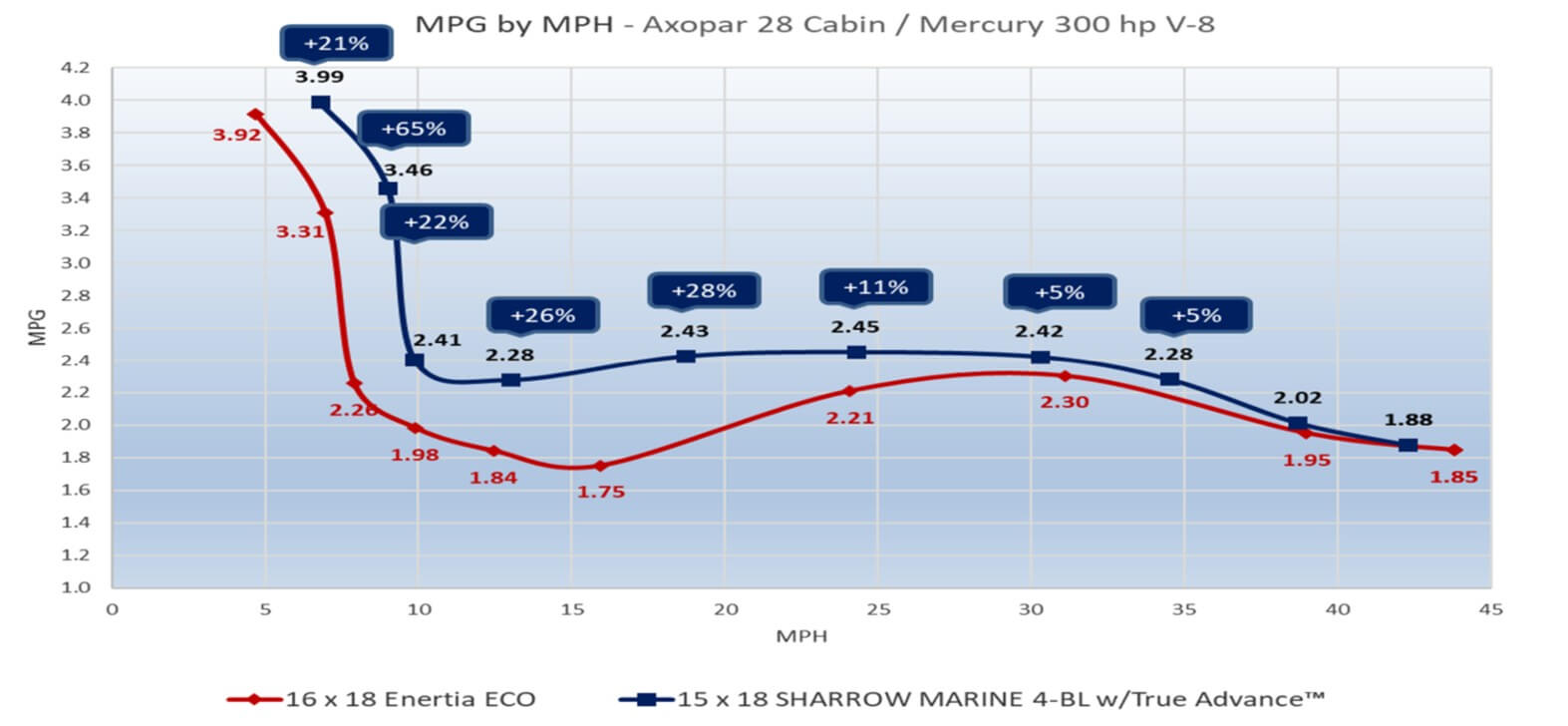
The first test the Sharrow team typically runs is to compare mpg to mph delivered by each propeller with the exact same load and during the same test conditions.
As shown in this chart, the Sharrow produced much better mpg all the way from about 6 mph up to near full speed at over 40 mph, with particularly impressive performance at displacement speeds and on plane up to about 30 mph. Only at full throttle did the efficiency advantage disappear.

What “True Advance” Means
Sharrow designates its propellers as “True Advance” models, because they advance further with each revolution than conventional propellers, marking their higher efficiency.
While no propeller advances the full amount of its designated pitch due to slip in water, propellers with less slip advance further and so are more efficient in terms of fuel economy and sometimes in terms of speed.
Note that the Sharrow propeller had a dramatic advantage in the mid-range as seen in the above chart, maxing out at 52% better at 3500 rpm.

Propeller efficiency follows along with advance rate. As the above chart shows, the Sharrow propeller was 45% better at 1000-rpm trolling speed, maxing at 53% better than the Inertia Eco at 3500. Only at maximum rpm, above 5000, was it edged out by the conventional propeller.
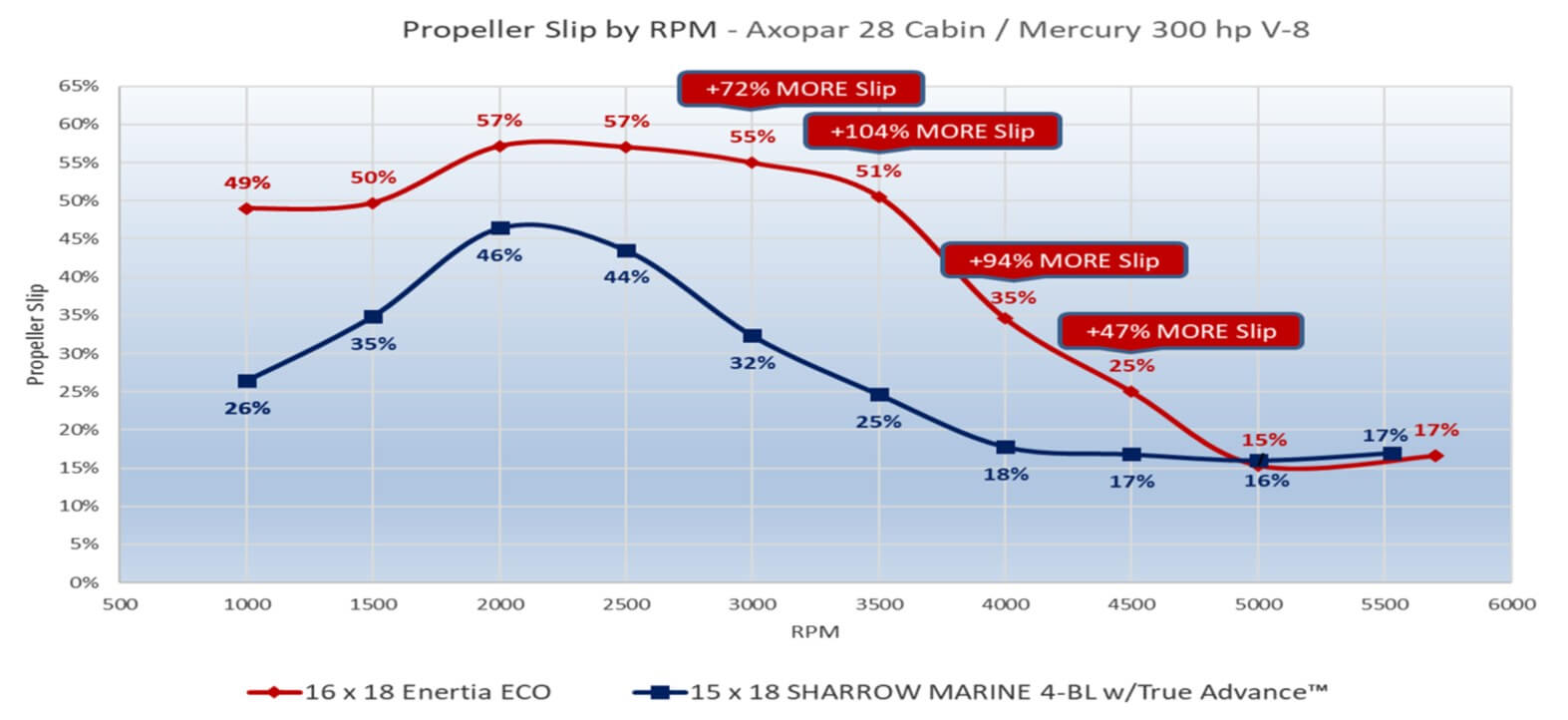
Propellers that slip more don’t give as much propulsion for each turn of the prop. This chart shows significant differences in the slip rate for the two propellers, reaching an amazing difference of 104% at 3500 rpm and 94% at 4000 rpm.
Once again, the two propellers equalized at maximum rpm—but most of us don’t run our outboards at maximum rpm very often.

Predictably, the three blade Enertia ECO was slightly faster at WOT than the four-blade True Advance—in general, more blades reduce top end speed.
But check out the graph from 1000 up to 4500 rpm, the range most of us run our outboards in most of the time. The Sharrow was 53% faster at 3500 rpm and 26% faster at 4000.
A Propeller that Pays for Itself?
Perhaps most importantly for boaters who want to maximize their boating dollar, the Sharrow is significantly better in fuel economy throughout the operating range of this package. For those who make longer cruises or who run far offshore to fish, the added range made available by better fuel economy reduces “range anxiety." For those who run a lot, the advantage will make a significant difference at the fuel pump.
But people don't buy boats or Sharrow props to save money -- they buy them because they want the best boating experience they can have. Though Sharrow props represent a greater investment at purchase than conventional propellers, that up charge works out they can pay for themselves for those who run extended distances and for those who have to have longer range to operate. Even for boat owners who don't use their boat that often, many people say it pays for itself because they creater a quieter, more enjoyable environment.