The Bayesian Disaster: A Speculative Analysis – Part I

On the afternoon of 18th August 2024, the sailing yacht Bayesian lay at anchor among other cruising craft a few hundred meters off the small but picturesque fishing village of Porticello in eastern Sicily. The weather was calm. On board, owner Mike Lynch, a respected and wealthy computer entrepreneur, was celebrating victory over the giant computer company Hewlett Packard after a lengthy legal battle which, had he lost his case, could have ruined him and may even have landed him in jail.
With him were his business partner and his lawyer; close associates who had helped him in his struggle. Wives and his children completed the gathering. The mood was one of celebration and relief and the luxurious 56 meter yacht with its six-star accommodations was symbolic as a new starting point for his life, family and fresh commercial opportunity.
The Quiet Before the Storm
The experienced professional skipper, James Cutfield, was relaxed. The forecast gave indications of some local thunderstorms later but nothing to cause undue alarm as the yacht lay to gentle winds securely anchored in 50 meters of water. Thunderstorms in the Europe are usually an inconvenient nuisance due to the rain, stronger winds and the scary flash of lightning. The crew provided the usual discreet service for guests while chef Recaldo Thomas worked his magic in the kitchen.
The seclusion of such an anchorage generated a feeling of privacy and security far from the madding crowd; a six-star hotel afloat. As darkness fell and the deck lights came on the superyacht would be admired and envied by those on lesser craft in the anchorage. The lofty mast lights would confirm that Bayesian was cock of the roost with its single spar towering 72 meters (236’) above the water, its mast head light a warning to any low flying aircraft. The tallest single yacht mast in the world.
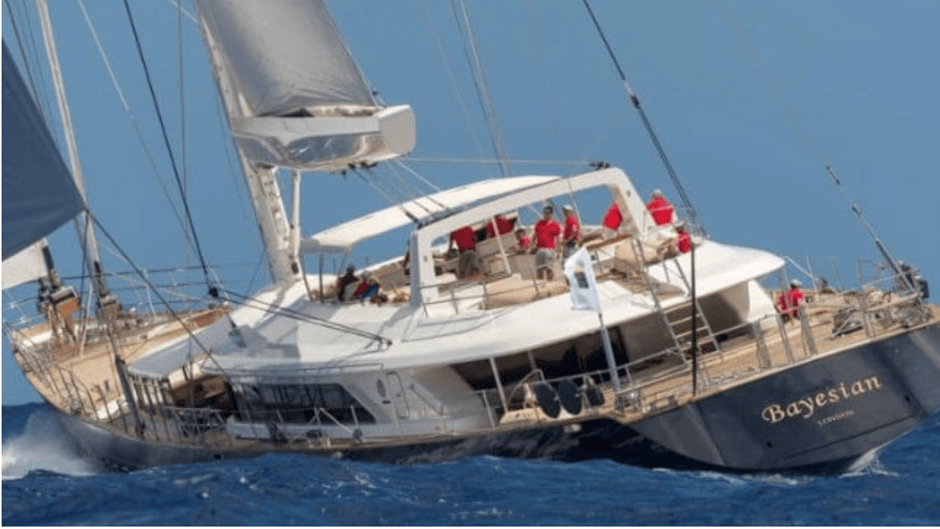
Bayesian, or Salute as she was first named, was built by Italian shipyard Perinavi and launched in 2008. She was one of a series of custom yachts of about the same size but could be regarded as middle of the road in terms of dimensions compared to other vessels in the category. The sailing superyacht industry is relatively young following on from the larger power yachts which emerged in the late 1980’s as the world economy created huge personal wealth among individuals trading in everything from stock markets and computers to oil and armaments.
These vessels became the must have status symbol of the rich who wanted to enjoy the privacy and security they offered but also to engage in a growing worldwide social circuit of equals who used their yachts as business and political venues. The wealth and lifestyle are unimaginable to the man in the street.
My Mast is Higher Than Your Mast
But one factor is always in play and that is one of ego. Size matters and, if not size, then some other feature conferring status and bragging rights to set one’s vessel apart from the herd. This culture has produced some very strange and ugly monstrosities as well as many outstandingly beautiful vessels. Although modest in length Bayesian’s claim to fame was a mast taller than any other.
One benefit of the superyacht industry over the past thirty years is the growth of worldwide employment in a sector that was always struggling for viability. It is estimated that there are about one hundred and fifty vessels of this category under construction in any year redistributing millions that would otherwise be spent elsewhere. It brings employment to thousands of ordinary folks paying mortgages and school fees.
The downside is that superyachts are simply an up market offshoot of the tourist craze that brings thousands of cruise line passengers to destroy the attraction of locations which were once regarded as timeless treasures. A superyachts’ arrival does nothing to enhance the ambience of the once remote island fishing villages we enjoyed as adventurers, sailing our small yachts fifty years ago. Such is progress in the modern world. Yachts are getting bigger and their on-board toys more irritating.
A facet of naval architecture less known to the average sailor is the Law of Mechanical Similitude. That sounds complicated but is not. If you double the dimensions of a vessel the displacement does not double, it rises to a factor of eight. A fifty-footer of 30 tons will become a 100 footer of 240 tons. Other dimensions have similar factors of similitude such as stability which will increase by sixteen times. One sees this effect in miniature on model yachts that have disproportionately large lead weights to keep them upright.
One other oddity is that large vessels require proportionately less power to drive them at design speeds. In other words, a smaller rig and sail plan which should make the boats easier to handle and safer in terms of stability. Racing yachts in comparison carry large sail plans supported by heavy deep keels with the relative proportions of the rig to hull producing a sporty ‘look’ which spells performance to an admiring audience rather in the way that an unnecessarily oversize engine, huge tyres and twin exhausts create bragging rights for a petrol head.
Bayesian would have had more than adequate performance from a much smaller rig.

Sail Area Run Amuck
In the time before super-sailing yachts rig dimensions were governed by the sensible area of sail required to drive a vessel comfortably and the ability of the crew to handle the sails using muscle and hand winches. Schooners and ketches broke sail areas down to manageable levels. But the arrival of superyachts and a new type of ‘non-sailing’ owner made these rigs look unfashionable relative to contemporary racing rigs and so was born the ‘power’ yacht in which sail handling became mechanical.
Material for masts, rigging and sail design kept pace with this development to offer new limits to rig size. Sail handling became the preserve of the engineer with huge hydraulic or electric winch systems adding to the complexity of the vessel. This in turn creates another problem because a sailing yacht needs more crew than a power yacht of similar size but the hull shape of the two vessels is different. Length for length the yacht’s more lissom shape restricts the accommodation.
A sailing superyacht should have more crew but often space restrictions prevent this, especially as watch keeping and ‘hotel’ service staff are similar in number. So, a sailing crew operating huge rigs and sails can have manpower problems, except in ideal weather conditions.
How Deep is the Ocean?
One other anomaly is the keel problem. Superyacht owners want to visit attractive locations where draft is a restriction requiring a shallow keel or a retracting ballast keel of some sort which in turn challenges standard stability and rig size factors.
Racing yachts don’t have to waste displacement with heavy luxury accommodation or fuel and water and therefore can have a high percentage of ballast. Neither do racers have to worry about depth of water so their keels are usually deep with a big bulb giving a lot of righting moment with automatic positive recovery from any knock down. With cruising superyacht owners requiring ‘the look’, stability becomes a significant consideration for the designer.
The rules of stability for superyachts are defined by such authorities as the UK body; the MCA and section 11 of “The Large Commercial Yacht Code”. To certify a vessel as safe they check the design numbers and issue advisories for any new build. Designers and builders often work to the MCA stability minimums to maximise the luxury of their masterpieces while relying on the captain to keep within the safe limits for any situation.
To this end the skipper has an on-board book, the “Stability Information Booklet” (SIB), with all the numbers and many ‘advisories’ as to safe practice. Using this 88-page tome as a guide the captain is also responsible for operational decisions using experience and the judgement of the situation. It’s clear from the numbers that Bayesian was a vessel designed to enjoy lighter winds and the captain would have to be alert to this when sailing.
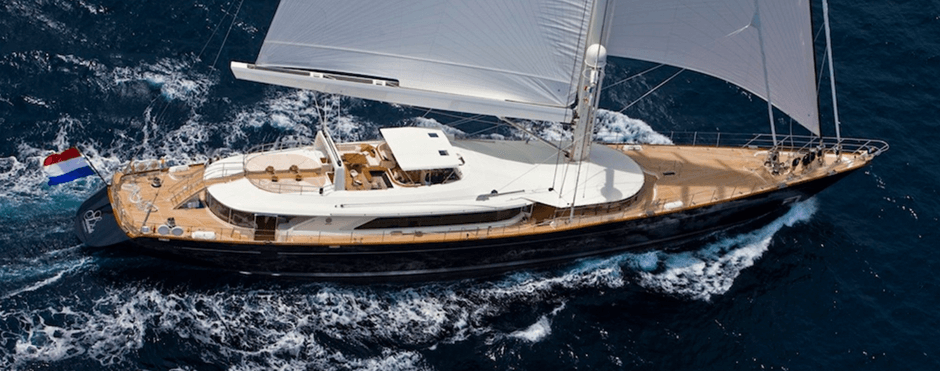
She did not have the stability curves common in many lesser yachts which give an inbuilt larger safety margin. Her captain would have to be on the alert at all times as to sail plan and load condition. Not a relaxed situation.
The SIB is issued when the boat is new. Salute (later Bayesian) was 14 years old and on her third owner so one would expect that any modifications over time would be revealed in the SIB as a recalculation of the basic data; and any accident inquiry should start with a verification of the vessels specification and loading at the moment of the accident to confirm the numbers.
A Remarkably Low Ballast to Displacement Ratio
Bayesian had a lifting keel weighing about 55 tonnes. Significantly, this increased the draft from 4 meters to 9.4 meters with a concurrent lowering of the centre of gravity giving increased stability. Her fixed ballast as built was about 41.3 tonnes tons giving her a ballast ratio of about 17% on a displacement of about 525 tons.
For comparison, racing yachts often have ballast ratios of more than 50 % and some as high as 80% on deeper keels. The ability to achieve stability with a low ballast percent on large vessels is due to the law of similitude. Bayesian also carried about 73 tonnes of fuel and fresh water. Her SIB flags the variable stability at varying load conditions as the fluids are used. Her numbers show that she mostly complied with the minimum MCA stability requirements with the ballast keel down.
The advised maximum heel angle to allow for stronger gusts when sailing was 17.5 degrees. Generally, she would be deemed safe while motoring without sail in fair conditions of wind and sea with her keel up and this would also cover her at anchor. Her keel would often be raised at anchor, not only because of draft, but because the build tolerances for this heavy underwater device leave a little play to assure free movement and this, while gently rocking at anchor, can cause an irritating noise for sleeping guests.
That fateful afternoon Bayesian sat at anchor with her keel up, her sails furled; three on the forestays and the heavy mainsail rolled into the boom; her fuel and water tanks maybe half full in the middle of her voyage. The summer weather meant that the cabin aircon would be working with the large sliding deck saloon doors probably open for social comfort. To ensure electrical power certain deck openings would be open. Anchored she would normally lie peacefully head to wind in the flat water of the protected anchorage.
Summer Squalls and Worse
A feature of summer weather is what we call thunderheads or more scientifically, cumulonimbus clouds; cunims for short. These magnificent and sometimes beautiful monsters tower up to 12,000 meters and are often seen in coastal areas due to the heat of the sun affecting the sea and land temperatures. In summer evenings they roil upwards with their white caps turning pink in the setting sun. But their beauty can mask a danger.
In certain conditions these clouds produce unpredictably strong cyclonic winds and rain accompanied by thunder and lightning. This was the forecast on 19th August and was nothing unusual. A rainy and windy night. Cunims have a darker side when allied to local hot weather. The UK Met office states “Cumulonimbus clouds are born through convection, often growing from small cumulus clouds over a hot surface. They get taller and taller until they represent huge powerhouses storing the same amount of energy as 10 Hiroshima-sized atom bombs.”
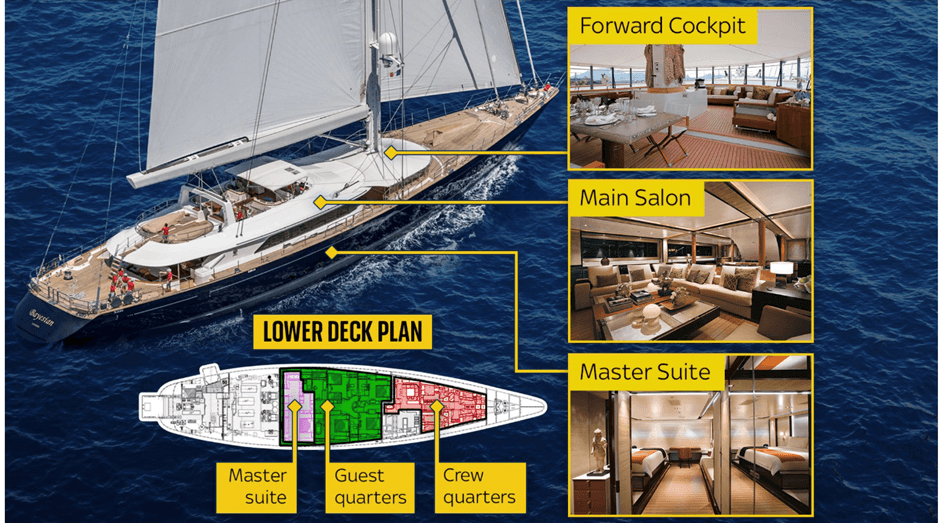
Aircraft avoid them by any means. As the cunims energy approaches the ground level they can wind up into tornadoes, waterspouts and williwaws. These are very localised revolving winds with velocities upwards of 100mph. It’s useful to look up waterspout events on YouTube to discover how narrow their paths can be. In daylight you can see them – at night you cannot.
Another phenomenon is the downdraft or micro-burst caused when a lump of cold air from high in a cunim literally drops straight down to earth to fan out radially from its centre with little association to the prevalent wind direction. Again, wind velocities of 100mph plus are common although the chances of being caught by one or other in the vast oceans is rare. You have to be in the wrong place at the right time. The winds and lashing rain and hail are instant and short lived as the local weather system moves on its way.
Night Watch
One notable feature is that thunderstorms are more common at night as the temperature effects change from the hot sunny day. Also at night, under a thunderhead, it is usually very dark because dense cloud cover can drop to 400 meters and the volume of rain and hail can be so severe as to make humans feel disorientated.
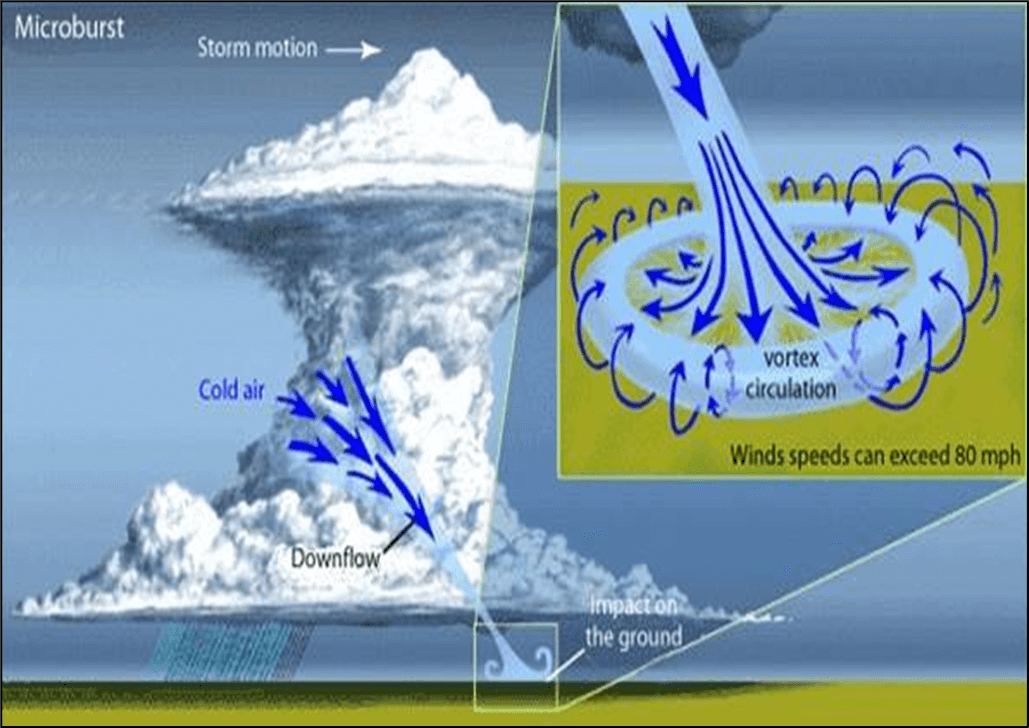
A yacht in the path of a microburst or waterspout is often hit hard from an unexpected direction with no warning. In August 2019 in Westhaven, New Zealand a yacht the size of Bayesian was knocked flat by one and recovered, presumably because its stability numbers were favorable.
In the design of yachts we use wind pressure coefficients to calculate the effect of wind on sails and rigs to derive the correct stability for safe operation relative to the use of the vessel. Coastal, sheltered or oceanic. I’m going to drop into mph at this stage because I’m old and that is my background. Wind can be assessed as a force per square foot of area. A 20mph wind gives about 1lb per sq foot pressure.
In a fresh gale at 40mph the wind pressure is 4 lb sqft. In a moderate twister of 100mph the wind pressure is around 26 lb sqft. For those with a bit of math, the factor uses wind velocity squared. Internally micro-bursts can be in the 200mph range causing 100 lb/sqft plus pressures. For a yacht the pressure is acting on the height of the rig and any other equipment like radar domes and furled sails.
The force multiplied by the distance (the lever) on tall masts can be calculated to give a heeling force. The presented square foot area of the mast, rigging, sat receivers, furled sails and furling boom on Bayesian with its ‘tallest mast’ was bigger than average for the size of vessel.
Gale Force Winds
Along with other yachts Bayesian was at anchor, at night, in what turned out to be a gale with wind speeds higher than forecast and, when it came in well after midnight, she was tracked by her AIS system which recorded random movements away from her original anchor position. From this information it appears that the anchor was dragging, and this would have been apparent to the officer of the watch who would no doubt have called the captain who was probably already aware of the problem by the vessel’s motions.
To make sail handling easier the three headsails forward on the yacht were permanently rigged on powered furling stays. Each sail will have the weight of the stay, the aluminium furling extrusion and the sail itself which does not help stability. They also offer considerable windage. These, and the mast, are often ahead of the centre of pressure causing a turning moment which in strong winds makes the boat ‘hunt’ and not lie easy which adds to the heeling force and the strain on the anchor.
One method to restore a bit of order is to let out more chain or run the engine gently to take the strain off the anchor while being careful not to overrun the gear. In 50 meters of water the boat probably had well over 100 meters of chain out. Normally a boat at anchor will lie head to wind but when a yacht drags anchor it is common for her to veer out of line with the wind direction and this causes the wind gusts to hit at odd angles to heel the boat in response.
The sideways force of windage on Bayesian’s tall mast and gear would then become a factor. Reports indicate that Bayesian was at times heeling 15 degrees during the gale. At this point all the crew were probably on deck attending to the skipper’s orders. The service crew might be helping and making sure that all the ‘hotel’ gear was secure and under cover.
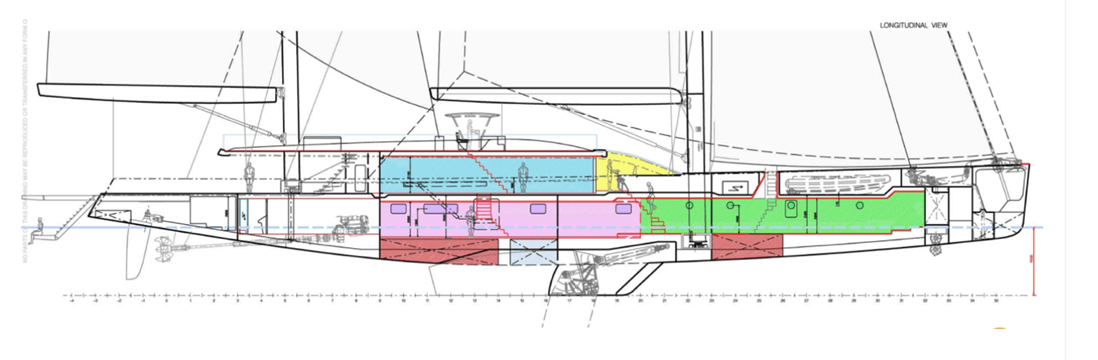
The conditions on Bayesian in the dark black night are familiar to sailors but never pleasant. The situation is not unusual or a cause of fear for one’s safety. Then, without warning, a stronger gust (microburst?) hits and within a few seconds the yacht heels to 45 degrees pitching everyone and everything not tied down across the wet deck. You hang on with the expectation that she will right herself aware of the massive wind force and the shrieking noise in the rigging – it’s a moment of loneliness for every individual.
Chris Freer – copyright
TOMORROW: THE KNOCKDOWN, SINKING, AND RESURRECTION OF BAYESIAN
Over a long career, Chris has worked as a yacht designer, author, journalist. He was born in wartime Leicestershire in 1943 and then grew up among the bombsites of Exeter. At the age of 16, having lost his mother to cancer three years earlier, he went to sea on tankers training as a navigator before living in Australia in the early sixties. He was a crewman on the Australian challenger for the 1970s America’s Cup held in Newport, RI.
He became a production engineer and yacht designer travelling widely. When he became a father for the first time at 55, he wanted his son to Alex to have a multicultural background, he moved the family to Lagos, Portugal, and now teaches flying.