Blobs on the Way Out
Slipping and Sliding Towards Oblivion

Dear Mr. Fexas... I feel compelled to issue a cry for help to possibly the only designer... who will listen to reason.
At the Syracuse Boat Show this Friday, my darkest fears became reality. I figured it was only a matter of time but I did not expect the manifestation to be so hideous. First, I encountered the new run-abouts from (Brand X). I shuddered and quickly moved on as, in the interest of self-preservation, I diluted myself into thinking it was merely an aberration. Then I saw the new (Brand Y). If you have not seen it yet, please approach with extreme caution and not soon after eating. I cannot describe it here as this correspondence may pass through the hands of someone who may be offended by the language.
I respectfully and urgently request that you use every ounce of you journalistic powers to prevent these floating eggs from ever appearing on the waterways we all cherish. If I do ever encounter one, I will thank Reggi and my Fountain for allowing a fast getaway. Sincerely, J. B., New York.”
This letter was received just prior to submittal of this piece to the powers that be at PMY. An awful lot of people are feeling this way nowadays and I thought I’d slide this very appropriate letter in as a preface to this article.
Making the Call
I am calling it RIGHT NOW. The end of a marine styling era. The end of the extreme blobism period in yacht design. Traditionally, eras end when the masses overreact to a trend and that trend overdevelops until it becomes a joke or cartoon. We are just about at that point now as far as boat and yacht styling in the “round theme” is concerned.
Inside Out or Outside In?
“Yacht Stylists” are a big deal nowadays. Since the dawn of pleasure boating, yacht designers and naval architects have traditionally done their own “yacht styling” and, in fact, never really considered it styling at all. Every architect had his own “signature” – his own “look” locked into each design for better or worse (just like handwriting). In our office, we have always “styled” our designs. Designing the complete package is the only way to do a complete, holistic vessel.
Vessels can be designed from the “inside out” or from the “outside in.” When designing from the outside in, an extravagant, optimistic, very pretty picture is drawn first and becomes the controlling factor in the development of the design. This is the “artistic element” of yacht design. It is then the job of the naval architects and marine engineers to make this pretty picture work. Often times, great compromises are required to adhere to the pretty picture.
Designing from the “inside out” on the other hand dictates that vessels be formed around a seaworthy hull capable of carrying the proper machinery and tankage. Interior levels and headroom are worked out and then the outer skin of the superstructure is “formed” around these perimeters. The problem with this method is that the boat usually winds up looking like a dammed beat-up old shoe! I always find that compromise works best: draw the pretty picture then work out the basic mechanics of the design always revisiting the pretty picture and revising it to suit. Soon, the project arrives at a point where everything is in perfect harmony.
Many of the extreme bloblist boats being produced today are absolutely of the “outside in” design school (and, by the way things look, school has been out for quite a while). Many designers go out of their way simply to be “different.” On some of these boats, it appears that the styling mind-set was such: “everyone else has straight or stepped sheers – why not make ours like a roller coaster going up/down/up/down like waves over the length of the boat? All boats have flat windshields. Let’s make ours so they bulge out like the eyes of a flounder with goiter – that will get a lot of attention. And let’s not make any radius less than 6-feet.”
A Blob is Born
The roots of blobist styling are set in the late 30’s and 40’s when “art deco” styling came on stream and geometric, streamlined shapes became very fashionable. This look proliferated for about 30 years until the early sixties when industrial designers decided that hard corners and creases where “in.” This hard corner, origami look proliferated for 20 years until the 80’s when we started seeing cars and boats and objects in general become rounder again.
As far as boats were concerned, it was really difficult to build rounded shapes in wood (although Chris-Craft did a hell of a job in the 50’s producing beautiful, scalloped shaped vessels which are considered classics today). When fiberglass appeared on the scene in the 60’s, the sky was the limit as far as shapes were concerned. Suddenly, curves, arches, bubbles, swoops, sweeps and bows were possible in unlimited quantities. Strangely enough, fiberglass boat builders responded with a big yawn retaining the hard cornered look for another 20 boring years.
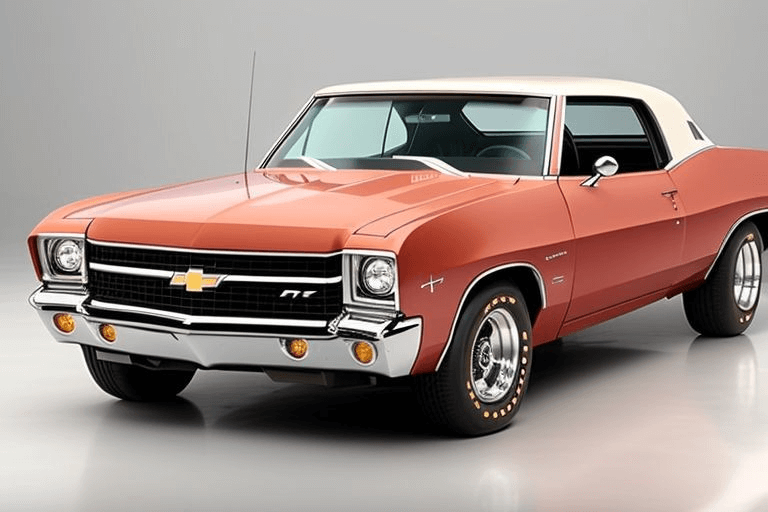
Think Chevy Monte Carlo
I have always said that yacht styling mimics and lags auto styling by about 5 years. In the case of round styling themes, however, this latest round of “the rounds” seems to have been started by the American boat industry in the early 80’s.
Look at boat styling in the 60’s and 70’s. Sheers were conventional raising by the bow. Sometimes a sheer step might be included. Bows were raked but not excessively so. Transoms were of traditional raked aft style. Hard corners proliferated on superstructures. Windshields and flyingbridge faces had hard corners and were very upright. Windows were rectangular with very hard corners and, in general, the state of yacht styling was following that of auto styling which, in this period generally was abysmal (think 1970 Chevy Monte Carlo – need I say more?). There were a few bright spots. Riva of Italy went their own way producing vessels with nicely rounded contours inside and out. But Riva was a voice in the wilderness of squares.
This is the fourth article in 11 years that I have done concerning yacht styling. The Italians have always been seen at as the leaders in styling of cars, clothes, and boats and the Italian Boat Shows have always mirrored the state of the boat industry around the world in general. That mirror now is a dammed fun house mirror distorting, exaggerating and blowing things way out of proportion. Time for a cool change. Next month we will study the rise and fall of the blob.
(Reprinted with permission of Regina Fexas.)
If you would like to read more of Tom's pearls of wisdom, tune in next Friday -- "Fexas Friday."
Better yet, why not get a full dose of infectious Fexas whenever you need it -- and buy one of the volumes below. Better yet, why not buy all of them -- we call them the "Fexas Five." They will provide many evenings of fun reading (better than Netflix), and you'll make the widow Regina very happy knowing that Tom will live on with you the way most of us remember him.
Order 1, 2 or "The Fexas Five" --

To find the "Fexas Five" on Amazon, click here...
Tom Fexas (1941-2006) was one of the most influential yacht designers of the last quarter of the 20th century. With the narrow Wall Street commuters that were built in the 1920s and '30s always on the back of his mind, he wanted to design boats that were at once fast, comfortable, seaworthy and economical to operate. Over the years, he and his firm designed over 1,000 yachts for some of the most prestigious boat builders in the world, including Choey Lee, Palmer Johnson, Grand Banks, Mikelson Yachts, Burger, Abeking & Rasmussen and many others.
Even though toward the end of his career he only designed megayachts and superyachts, including the remarkably influential PJ "Time" in 1987, he is best remembered for his first major vessel in 1978 -- Midnight Lace -- which became a series of 44-52-footers. They were light, narrow, and fast with relatively small engines. He was also influential in the boating community because of the monthly column he wrote for Power and Motoryacht, which began in its very first issue in January 1985.