CEO Mark Richards on Revitalizing the Grand Banks Brand
Listed on the Singapore Stock Exchange and backed by a dedicated base of boat owning shareholders, GB Marine Group – home to the Palm Beach and Grand Banks brands – has charted steady growth under the dynamic leadership of Australian CEO and accomplished yachtsman Mark Richards.
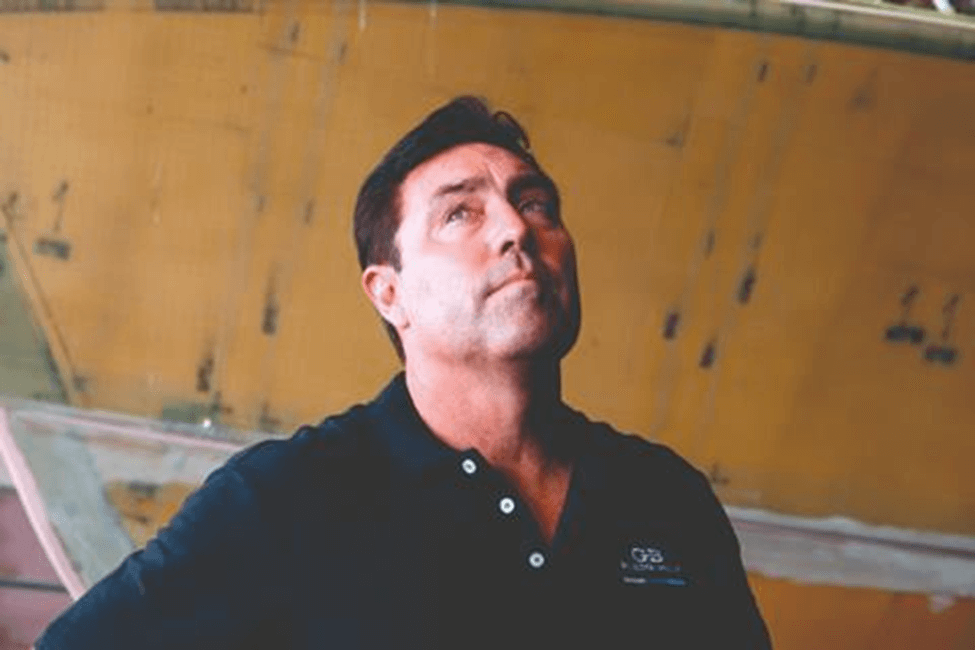
Grand Banks Reimagined
GB Marine Group has delivered around 250 PBs and GBs since Mark Richards took over as CEO. He built just 80 Palm Beach boats in Australia prior to agreeing the Grand Banks deal.
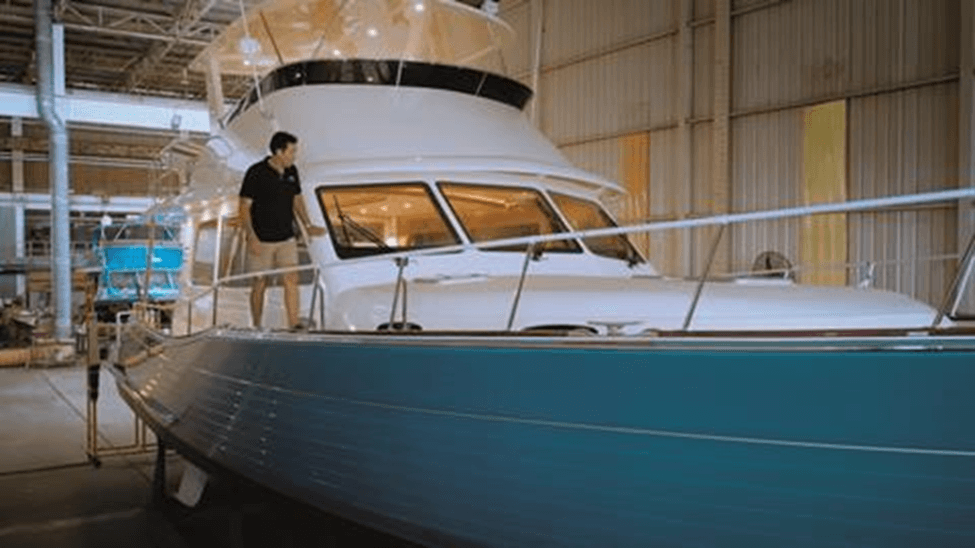
What we know today as Grand Banks is officially the GB Marine Group, although it started out in Hong Kong in 1956 as American Marine. In the 1960s it moved to Singapore, where it maintained a production facility until a dozen years or so ago, but these days its operation is focused entirely in Malaysia where it first opened a factory in the mid ‘90s. It’s located in Pasir Gudang, an industrial zone to the east of the Johor State capital, Johor Bahru, and just a couple of miles north from the island of Singapore itself. It occupies a 150,000m2 (1,600,000ft2) waterside site there, 110,00m2 (1,200,000ft2) of which is covered. The covered ratio is important for a builder located just one degree north of the Equator, where heavy tropical rains are the norm. Before the old uninsulated factory roofing was replaced with modern insulation, the temperatures inside its sheds were usually well above 40°C.
“When we started working with Grand Banks it was pretty much in the toilet, albeit with one leg sticking out,” jokes CEO Mark Richards, whose association with the company began back in 2012/13 when he did a deal that saw Grand Banks acquire his Palm Beach operation, move its production to Malaysia and in the process hire him as its new chief designer and CEO.
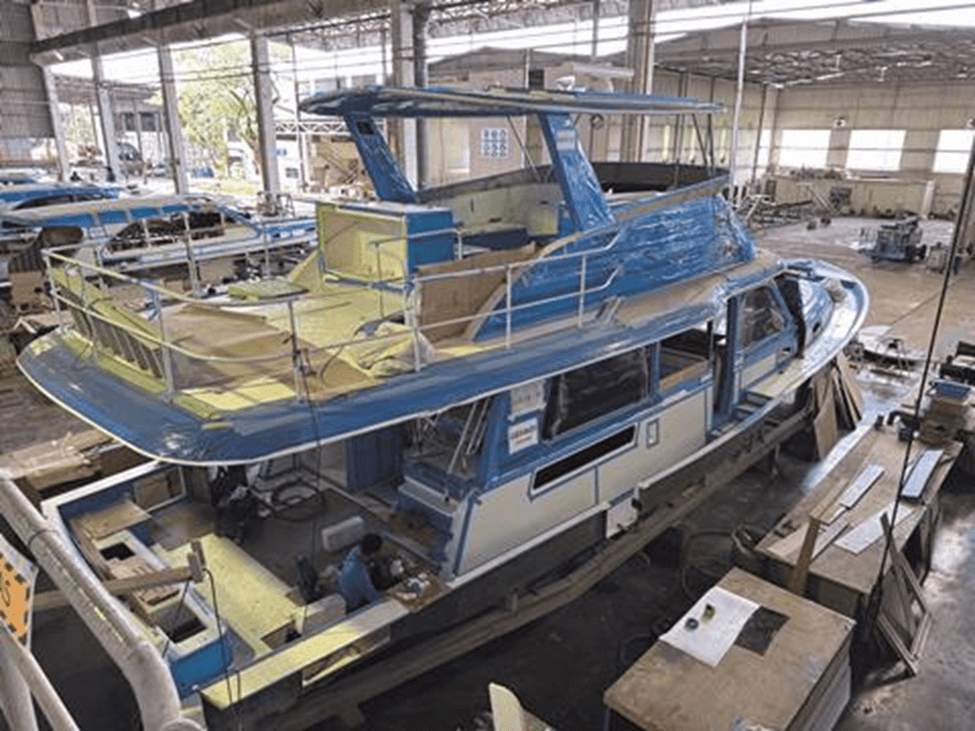
“We arrived just in time, I’d say. It wouldn’t have lasted another year had we not come in. The Grand Banks model range had been neglected, the factory was run down, the roof needed replacing and all the GB mould tooling was in a sorry state. We finished off a few work-in-progress boats, a mix of Grand Banks and Eastbays, then effectively stopped all Grand Banks production for what ended up being a few years and concentrated on Palm Beach. When Grand Banks finally re-emerged in 2017 it was with the-then new Grand Banks 60, in theory an evolution of the old 55, but in practice based on a Palm Beach hull.”
Today, all the PB and GB models stem from half a dozen core hull platforms. They all benefit from what the company terms its ‘V-Warp’ technology, which is essentially a modified-vee with fine entry, graceful amidships and relatively flat deadrise and that references a proprietary lamination process. These semi-displacement platforms are designed to run consistently with bows up at around five degrees and are efficient across a variety of speeds. Infused hulls are e-glass and vinylester resin, while decks and superstructures incorporate plenty of prepreg carbonfibre. All Palm Beaches and Grand Banks are painted, usually with an Awlgrip system.
Comprising three series and 15 base models that stem from half a dozen core platforms – the Palm Beach portfolio extends from 42ft and for the moment runs up to 107ft, virtually capacity for the existing premises. There are now 10 Classics – 42, 45, 50, 52, 55, 65, 70, 85, 101 and 107. The latter two are completely new and the first of each have already signed and the tooling is under construction for delivery in 2027/28. The 101 is for an Australian client and the 107 is for an American.
Then there are GT and GT RS versions designated 50, 60 and 70. The first PB85, the present PB flagship, has only recently launched and delivered to Florida. The second goes in early 2026 to the Gold Coast, Queensland. Most of the Palm Beach models can be propelled by either outboards, shafts, pods or waterjets.
| Turnover history GB Marine Group | ||
|---|---|---|
| Year | Turnover (S$m*) | Net Profit (S$m*) |
| 2013 | 35.3 | -5.2 |
| 2014 | 40.3 | 1.0 |
| 2015 | 58.7 | -4.8 |
| 2016 | 81.9 | 9.5 |
| 2017 | 79.6 | 1.5 |
| 2018 | 81.9 | 9.5 |
| 2019 | 79.6 | 1.5 |
| 2020 | 103.0 | 1.1 |
| 2021 | 96.1 | 4.2 |
| 2022 | 75.2 | 4.0 |
| 2023 | 114.2 | 10.1 |
| 2024 | 133.7 | 21.4 |
| *Singapore Dollars | ||
Tailored Power and Style
The present Grand Banks line-up begins at 44ft and extends up to 85ft and encompasses two lines. The Eastbay 44, which debuted at Miami 2016 and the new-for-2022 Eastbay 60 are billed as the Downeaster Series. The Grand Banks ‘Long Range Cruiser’ series includes the popular 54, the 60, a new 62, the first of which debuted at Palm Beach ‘25, the 65, the new 70 and 73, and the present flagship 85. Although given the new Palm Beach flagship, it’s a safe bet that within a few years there will be bigger Grand Banks models too.
Work is also in hand on two new entry models, one for each brand. Expect to see a PB38 and GB42s join the line-up. Those model launches are probably two-plus years away.
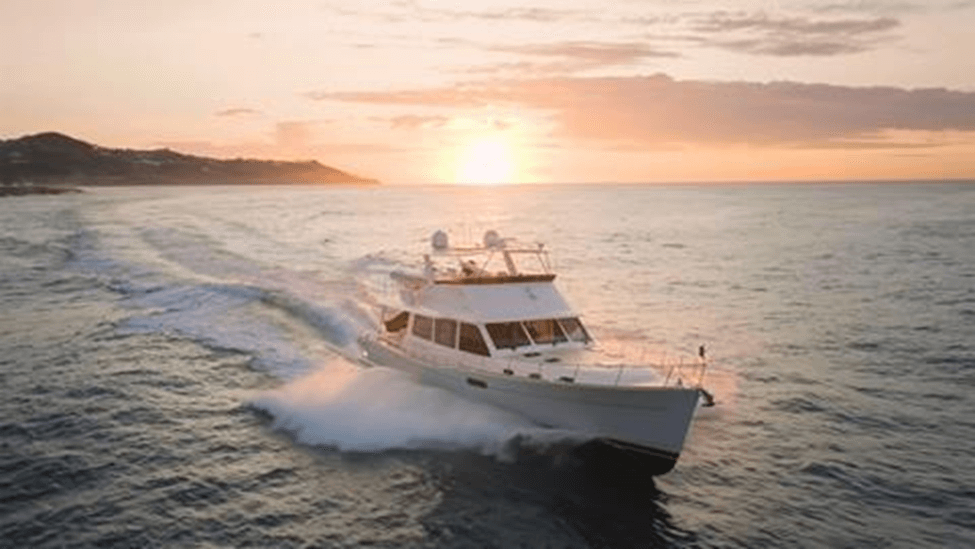
Given the product ranges you would be forgiven for thinking that this was a production operation. It’s not. The PBs and GBs are all built on a semi-custom basis. Owners can make all sorts of choices as regard specifications. The PBs are particularly flexible. Outwardly they can have normal hardtops with or without sunroofs, regular or extended cockpit overhangs and flybridges.
Most are delivered with Volvo Penta powertrains and most of those clients opt for IPS. But other engine builders also get a look in occasionally. Some of the smaller models still deliver with shafts and the odd one goes out with waterjets. If the client wants it, they can usually get it. Outboard installations are also increasing popular for boats bound for the USA and those average sizes are creeping up, thanks to the bigger horsepower V12 engines now being available. Whereas the biggest PBs and GBs are more likely to have straight shaft installations.
“We arrived just in time, I’d say. It wouldn’t have lasted another year had we not come in.”
Both brands are positioned at the premium end of the spectrum. The base price presently of a PB42 is US$2.4m and negotiations for the new flagship PB107 begin US$14m. Similarly, the Grand Banks line-up kicks off with the GB54 at US$3.92m and tops out at US$11.25m for the GB85.
High pricing has certainly not been damping demand. Spring 2025 saw the GB Marine Group with almost 50 boats on its order book, just over 40 of which were already physically underway. That total translates to around two years’ worth of production. Around 70-75% of those are Palm Beach models, a fairly consistent ratio in recent years.
A few March 2025 deliveries illustrate the sort of specification flexibility owners have come to expect. For instance, PB45#20 with flybridge and a pair of shaft drives was bound for Porto Cervo, Sardinia, and a GT60 configured as a single-cabin weekender had twin Volvo Penta D13-100s whisking out via Hamilton waterjets. The latter was bound for New England, as was the third Grand Banks 85. It has twin 1,300hp MAN V8s with vee-boxes and shafts and tops out at 28 knots at full load, the same choice as the second one, which delivered in ’23 and is in Florida. The first GB85, which has Australian owners, delivered in ’21, and is presently in Turkey, has twin Volvo Penta D13-1000/IPS1350s.
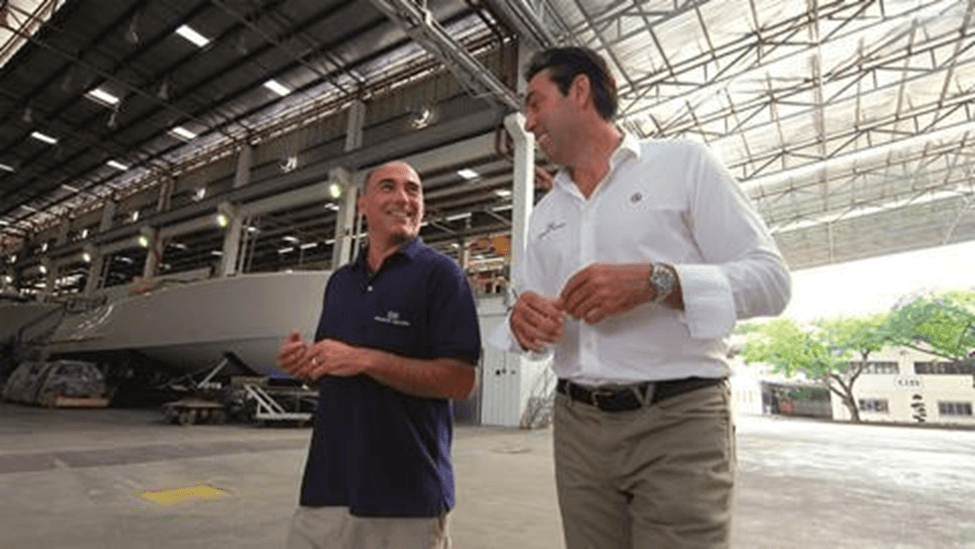
It has long been said that Grand Banks and other trawler brands attract rag-and-stick sailors of a certain age and that third GB85 certainly proves the point. Her owner is none other than Tom Whidden, the founder and longstanding CEO of the North Sails Group and one of 20 or so senior shareholders in GB Marine Group, three of whom are said to be billionaires. She is his fifth Grand Banks, all of which have been called Northlight.
Beyond training as a shipwright, Mark Richards has his own impressive sailing credentials. He has been involved with two Australian America’s Cup challenge syndicates and was the principal helmsman of Bob Oatley’s Wild Oats IX, which was part of the winning 2003 Admiral’s Cup team and he was skipper of Wild Oats XI when she secured line and handicaps honors in a record nine Sydney-Hobarts.
There’s still a distinct advantage to building in Malaysia. “Skilled man-hour rates at Grand Banks are around five dollars an hour,” says Richards, a significant proportion of whose workforce comes from other Asian countries. “But treat your people well and all’s good.”
Grand Banks opened a new lamination facility in late March, which overall represents a US$6m capital investment. If that same building had been building in the USA, admits Richards, it would have probably cost more like US$60m.
Interestingly as that comes on stream over the coming months Richards says he plans to diversify into the composite components business, offering its composite and prepreg carbonfibre parts manufacturing capabilities to the wider industry. He has an idea there will be plenty of demand for hydrofoils in the not-too-distant future.
Unit-volumes have been reasonably stable in recent years – usually in the 22-25 units a year zone. Importantly, average sizes have grown consistently. When Richards came into the company, the average length was more like 50ft. Today it’s nearer 65ft or 60,000 man-hours. At 140,000 man-hours for instance, a GB85 represents two and a half 50-somethings.
GB Marine Group operates seven days a week, but does not run night shifts. It now has capacity for 1,500,000 man-hours a year. That’s five times greater than the capacity of 300,000 man-hours the company had when he first got involved back in 2014. And the group’s present business development plan aims to push that up to 2,000,000 man-hours over the next three to five years.
The cumulative CapEx spend since Richards arrived in 2013/14 is said to be approaching US$100m and all without the need of major borrowing. When Richards entered the company the covered area totalled 45,000m2 (485,000ft2) and the workforce numbered 185. Today the establishment is around 900, nearly all of whom are young and highly skilled, and the covered area has more than doubled.
Since those early days as American Marine, Grand Banks has been a publicly listed company on the Singapore Stock Exchange. Richards says the corporate governance that goes with that has proved really useful in maintaining profitability. And it hasn’t posted a net loss since 2015, despite a dip in turnovers linked to enforced Covid closures. With the consent of its shareholders, it is constantly reinvesting for long-term growth.
The GB Marine group’s turnover for the year to the end of June 30 was S$133.7m, which given the exchange rates at the time of writing puts it around the €90m/US$103m/£77m level. It was up almost 15% on the S$114m in 2023. This year should also see a modest sales growth, despite the economic shocks and tariffs emanating from President Trump’s White House. Revenue for first half of fiscal 2024/25 was up 3.4% compared to first half of 2023/24.
It chose to stop using dealers back in 2017 in favor of a factory-direct model and a handful of strategically located brand representatives working on commission. Richards’ homeland remains a key territory for Palm Beach. It normally takes between a quarter and a third of them. However, the USA has always been GB Marine Group’s biggest single market by a considerable margin.
As we go to press, the White House had at least backtracked a little and declared a 90-day pause to its ‘Liberation Day’ list of tailored tariffs, leaving just a 10% levy applying across the board on just about everywhere in the world except for China. But the implication threat remains, which is a shame given just prior to the Trump initiatives GB Marine Group was ramping up its foothold there too. In early April the group announced that it had acquired two service properties in Newport, Rhode Island from Casey’s Marina for US$21m. Those latest investments join its recently opened West Coast USA office in Kona Kai Marina, San Diego, California, and longstanding service facilities in Stuart, Florida.
“We’d be fools not to consider the ramifications of tariffs in the US market,” says Richards. “But so far there’s been no adverse effect. However, because of the uncertainty and considering the ongoing discussions at the governmental level that we have no control over, our plan is to continue to focus on quality and efficiency… We have complete control over those. They will help us when things stabilise there.”
GB Marine Group is also ramping up its European presence. For instance, Cannes 2025 in September will see it exhibit a PB55 and GB60. And in the same month a GB54#19 will be displayed at both the HISWA and Southampton shows.