Charter Boats Fleeing US Virgin Islands Over Fee Dispute
By Tony Esposito
Nearly 90 charter boats have moved from the USVI to the British Virgin Islands following new fees, taking with them around US$14m in direct seasonal revenue.
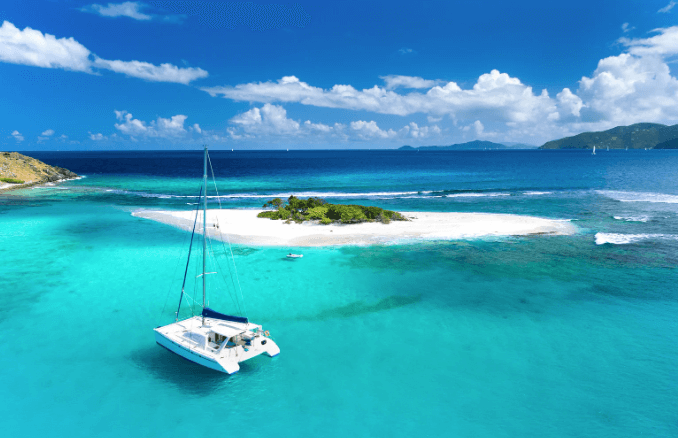
An armada of some 90 charter boats has already relocated from the US (USVI) to the British Virgin Islands (BVI) since new fees were introduced at the beginning of summer, and with it goes nearly US$14m in direct seasonal economic activity.
According to Kennon Jones, executive director of the Virgin Islands Professional Charter Association, when considering the industry’s ancillary spending, the downstream economic loss could be much higher. Consider that the 90 boats represent at least 180 crew, plus potential shoreside employees like managers, bookkeepers, marketers, and more.
“That’s just the lost direct economic spend, which is then multiplied throughout the economy – the cleaning company that is now going to be down 50%, for example, has 50% less revenue to spend on their groceries, business expansion, travel, entertainment, et cetera,” Jones said in the St Thomas Source. “Cleaning, provisioning, flowers, maintenance, laundry, and the trickle down, or lack thereof.”
Fee Hikes and Fallout
The year-long, back-and-forth dispute began when BVI proposed an increase to its 30-year old fees for day sail and overnight charters originating in the USVI.
“The 1992 fee per term charter under 115 feet was $800. Adjusted for 2025, that fee would be a little more than $1,875. The new fee is $7,500 – an increase of more than 837% and nearly 300% above what could reasonably be attributed to inflation,” he said.
Day sailing charters and dive boats got hit even harder, with the fee going from $200 to $8,500 – a 4,150% increase that is more than 1,710% higher than an increase based solely on inflation, according to Jones.
“The BVI’s goal is, it seems, is to bring all charter business to the BVI and prevent charters based in the USVI from operating in the BVI. While they won’t ever openly prohibit USVI based vessels, they will continue to make it either prohibitively expensive, prohibitively bureaucratic or, a combination of both in order to effectively make it not worth it to operate in the BVI,” he said.
Some charter operators told the Source they were planning on cutting the BVI out of their normal tours. Others, with more boats, said spreading the fees across their fleet but that, ultimately, the consumer will pay for it.
Industry Calls for Action
Jones pleaded for the USVI to add boating infrastructure of another kind as well. The territory doesn’t have shipyard and repair facilities that could service the charter fleet. The BVI has two: Nanny Cay and Virgin Gorda Yacht Harbor.
“To be competitive, the USVI desperately needs a world class shipyard and haul out facility. The USVI loses untold millions in business in this sector alone to the BVI each year simply because we do not have the infrastructure in place,” Jones said.
There is simply not enough room in the BVI to add all of the USVI’s charter vessels and crew. Jones said it would be very difficult for the USVI charter industry to survive without easy access to the BVI.
“Neither territory has enough space for all of the charter yachts – bareboat and crewed. The long term solution is creating a Greater Virgin Islands Sailing Zone that facilitates travel and business between the two territories creating the best possible experience for guests,” Jones said.
The cost and red tape of doing business in the BVI has seen some USVI vessels waiting months for their Commercial Recreational Vessel Licenses, as one example.
The Covid-19 pandemic shook up the Virgin Islands charter industry – with the BVI restricting visitors and the USVI remaining largely open. It shattered what had been a symbiotic inter-island relationship, Jones said.
“Before Covid, to take charter guests from the USVI to the BVI, all you had to do was go to BVI Customs, fill out standard paperwork, pay fees, and then off you went,” he said. “You simply entered the territory, did your paperwork, and paid the fees as is the normal process.”
Today, Jones said, foreign-based charter vessels must use a BVI agent, an additional cost of between $3,500 and $5,000, to obtain a BVI Commercial Recreational Vessel License.
“With these new fees, a typical USVI-based 56ft catamaran accommodating eight guests with two crew is looking at over $100,000 in fixed licensing, fees, and government costs – not including variable costs such as provisions, diesel, slip fees, cleaning, maintenance, etc,” he said.
By comparison, the same boat based in the BVI would see around $25,000 in costs.