Chris Craft 35 Calypso Tested with Sharrow Props
Sharrow Props – 16% More Fuel Efficient at 38 mph
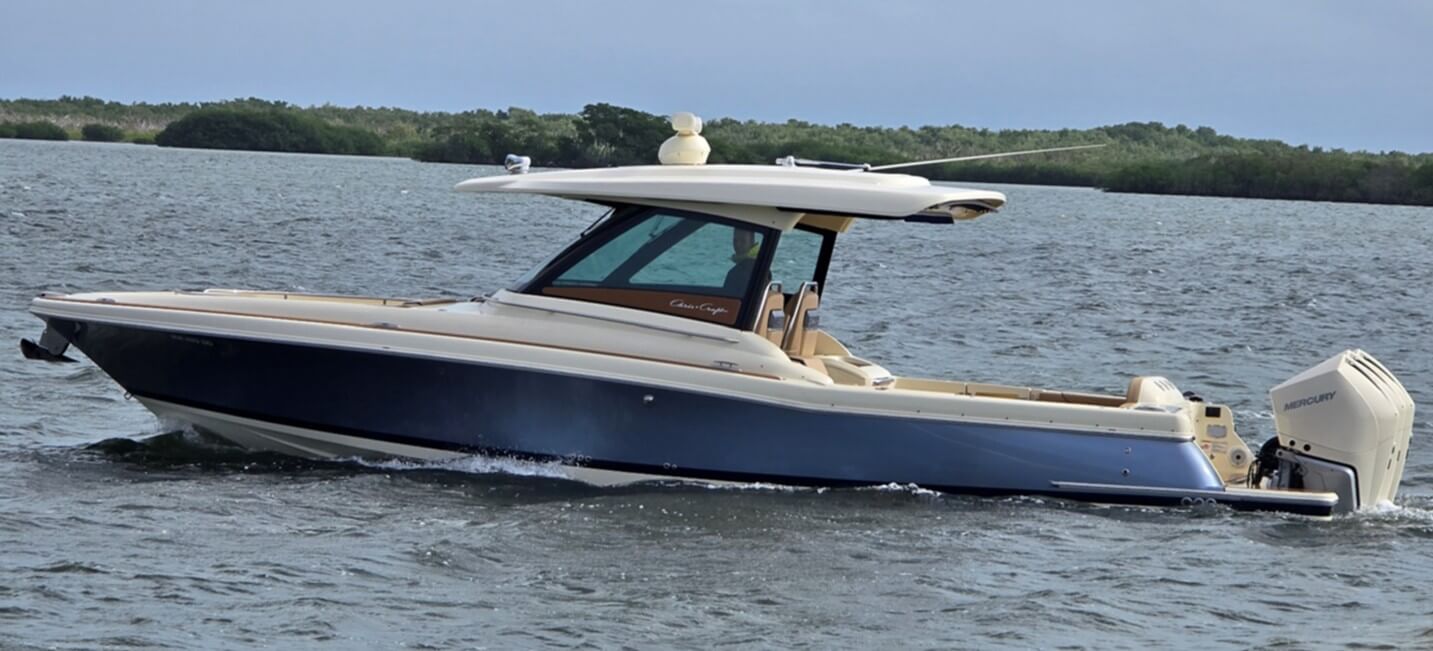
People who buy the Chris-Craft 35 Calypso have paid top dollar to get a boat that is unlike any other on the water. Her lines are, soft, rounded and very easy on the eye. Owners with the 35 Calypso, also want the very best when it comes to performance, where once again, price is no object.
That is why the owner of this boat chose a Sharrow prop set. Join us while we dissect the meaning of the numbers that the Sharrow techs got when they tested this boat before and after its new set of Sharrows.
The Chris Craft 35 Calypso is an upscale dayboat/tender/fishboat by any standard. With a LOA including swim platform of 35’11” (10.93 m), a beam of 11’ (3.35 m) and a dry weight of 14,770 lbs (6,700 kg) model needs to be powered by 3x Mercury 300 Verado outboards to give her the torque needed to get her on plane. Helping in that effort are 3 Mercury’s Rev 4 XP four-blade stainless steel propellers with a 14.625” diameter and 21” pitch.
This is an interesting choice of standard prop, employing four blades to create more surface area to get power to the water, plus having a relatively high pitch of 21” to maximize her top end. Mercury says the Rev 4 XP's long barrel design contributes to significant stern lift, helping boats get on plane quickly and efficiently, and the cupped tips helps improve top speed.
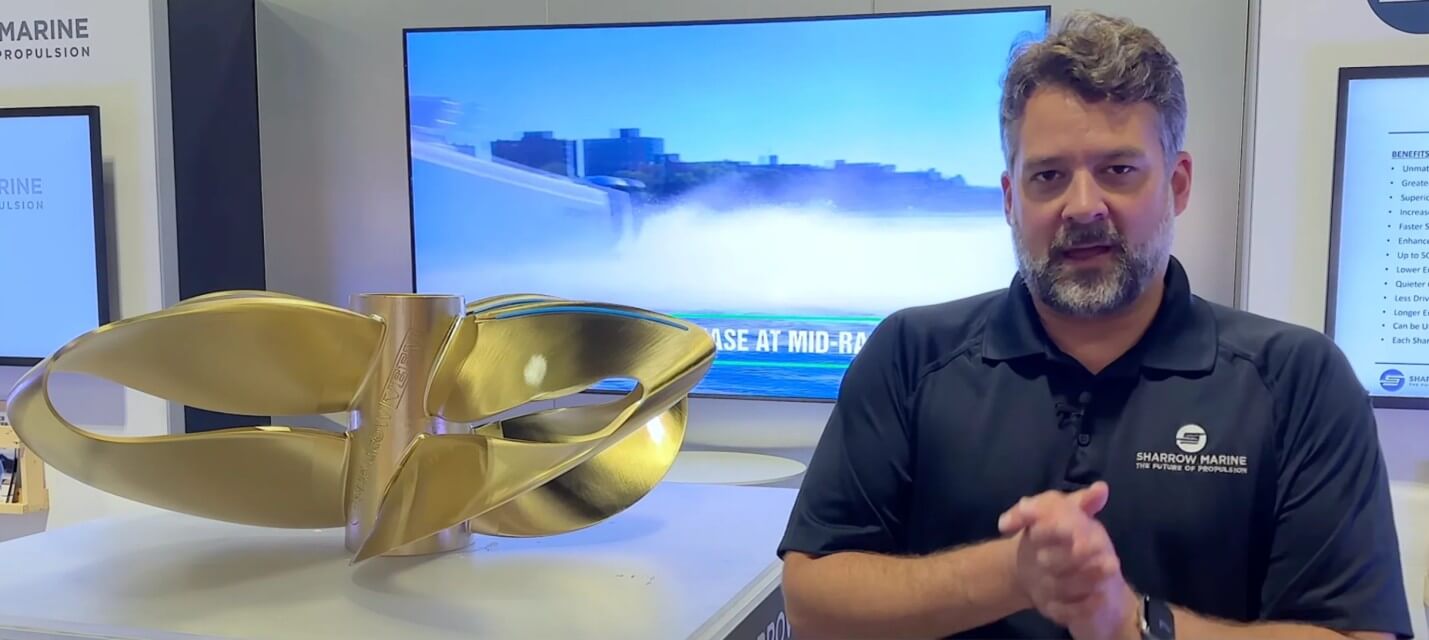
The Sharrow engineering team chose the company’s 15 x 20 four-blade True Advance propeller to test against the Rev 4.
Sharrow has developed a series of tests to challenge the efficiency of their propellers versus many of the best-known stock wheels in the industry, and thus far, in every case the Sharrow’s have proven easier on fuel—as well as being quicker to plane most boats.

More Fuel Friendly in the Mid-Ranges
In terms of MPG, the determinant of fuel cost and range, the Sharrow propellers showed an impressive 26% advantage at idle speed—a big plus when trolling offshore. ICOMIA, the international boating industry association, says that on average, outboard engines run at idle 40% of the time.
As we have seen so many times before, the Sharrow props excelled in the mid-range, improving the Rev 4’s performance by from 13 to 18 percent better from 15 mph to about 40 mph, the speeds at which offshore boats are run most often due to typical sea conditions.

Efficiency is a measure of how well a propeller converts the available torque into propulsion, and the Sharrow design typically does far better than conventional propellers, including four blade models, as seen here.
Note that at 2500 rpm—where the boat is fully on plane with the Sharrow’s but still struggling to get out of the hole with conventional propellers, the efficiency is a whopping 103% better.

Giving Water the Slip
All propellers “slip” as they try to screw their way through the water because of the fluid medium, but Sharrow’s continuous blade design slips much less than standard propellers, particularly in the mid-ranges from 2500 to 4500 rpm.
As this graph shows, the slip is an astounding 231% greater at 3500 rpm with the Mercury propellers.
The reduced slip at displacement speeds up to about 1500 rpm also mean more positive handling in the harbor, and better fuel efficiency while trolling.

Sharrow propellers are engineered to produce maximum efficiency and increase range, rather than delivering maximum speed, and we see that’s the case in this test, with the Rev 4 XP’s topping out at 54.6 compared to 53.8 mph for the Sharrow’s as the engines were able to wind-up higher.
Because the boats runs at a lower RPM than it does with the Rev 4 prop, not only is fuel consumption reduced, but also cuts down wear on the engines.
Long Term Savings Possible
Sharrow propellers are significantly more expensive than conventional propellers, there’s no getting around that. But for those who use their boats a lot and regularly make long runs or troll for many hours, the increase in efficiency can eventually pay for the added cost of the props.
The added benefits of being able to stay on plane more easily, enjoying more positive handling around the docks, and reduced noise and vibration aboard also add to the value of Sharrow propellers in many applications.