Combat-Ready Outboards from Raider
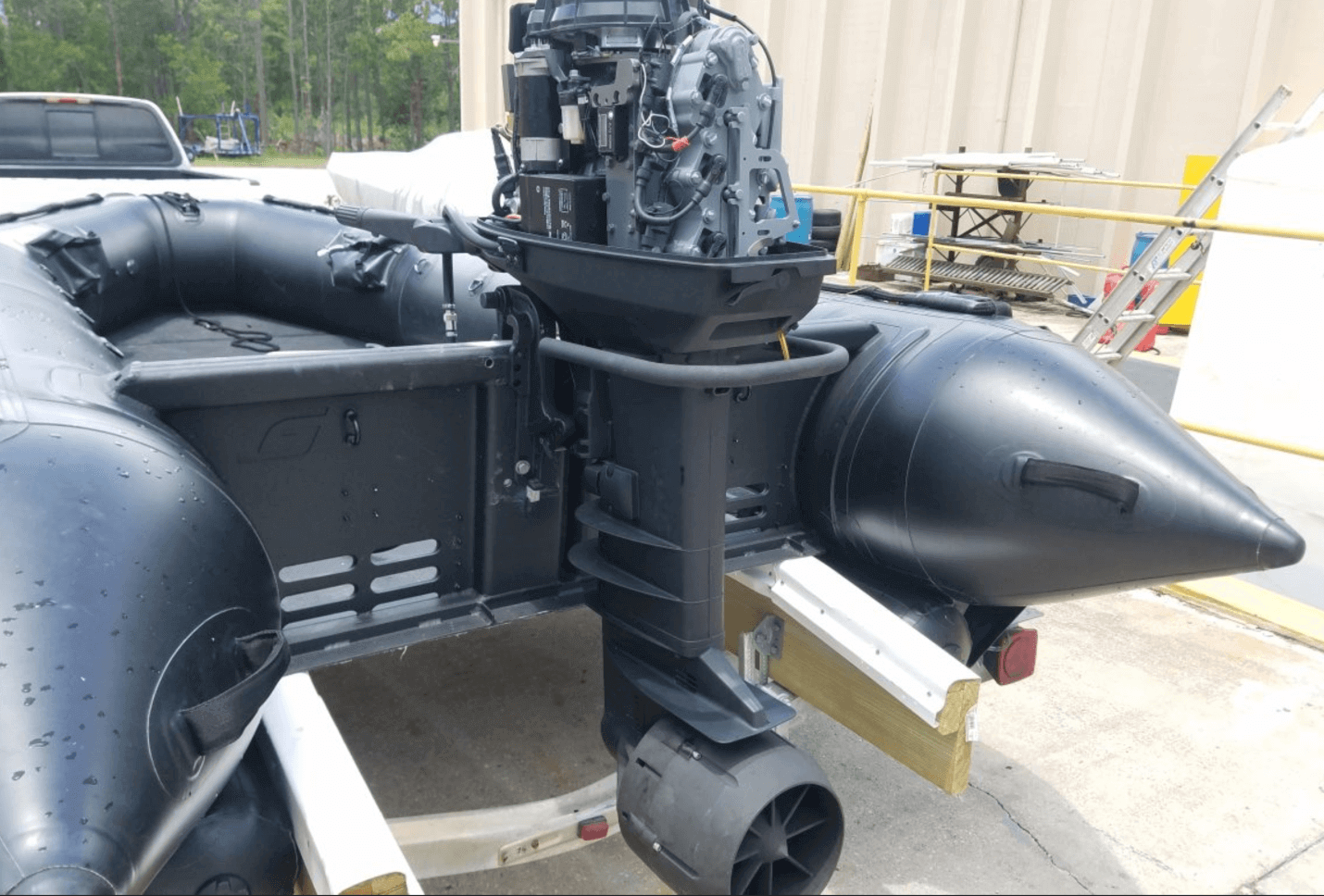
These amazing submersible, air-droppable, multi-fuel outboards are the favorite of America’s warfighters around the globe.

“Submersible” and “outboards” are two words that boaters never expect . . . or want . . . to see together.
But when it comes to the amazing Raider outboard line they are compatible.
You can’t go down to your local Raider dealer and buy one for your Whaler, however.
That is, not unless you are in procurement for SEAL Team 6.
These amazing “warfighter” outboards, most based on 40- and 50-hp 3-cylinder Tohatsu blocks, are custom-built specifically for U.S. military agencies and partner nations to handle covert operations in remote locales around the globe. They can be, and have been, tossed out of airplanes over the ocean and discharged from submerged submarines attached to inflatable attack boats.
They can be submerged in saltwater for 24 hours, brought to the surface and started up in less than two minutes, per the Florida company that has been building them for the last decade.
The Raider concept took wing in 2011, when the fledgling company, founded by George Woodruff, who had spent some 40 years at IBM, Hughes Aircraft and Lockheed Martin developing advanced technology, won a competitive contract from the U.S. Special Operations Command (SOCOM) to design and produce “air droppable, submarine launched, multi-fuel, submersible, lightweight outboard motors”.
The name Raider was given to the new outboards by Woodruff to remember the WWII British “Marine Raiders” who used inflatable rubber boats in clandestine missions behind enemy lines.
The engines were contracted to replace modified Johnson “Enforcer” two-stroke 35-hp outboards after the brand was phased out by Canadian-owned BRP in 2010.

Currently, their customer base includes multiple components of the United States military services; U.S. Navy SEALs; U.S. Air Force Special Tactics; U.S. Army Rangers; FBI; and NASA. In 2018, the company extended its services to the U.S. Marine Corps along with various state and local agencies that operate primarily in the area of search & rescue.
The company has been able to meet rigorous testing and verification of military specifications, and now has over 1,500 motors in service with various military branches
How They’re Built
The two-stroke outboards have custom-machined carbureted fuel supply rather than injection, mechanical shift rather than digital, an easily accessed pull-starter and a durable cowling in military drab, among many other features that keep them simple, relatively light, hard to break and easy to fix in the field.
The company replaces the original Tohatsu heads with custom built machined-aluminum heads to increase compression and boost the flow of cooling water, which the company says also boosts the horsepower, adding an extra 5 hp on the 40 and 7 hp on the 50.
Raider obtains waivers from the EPA to import the outboards because they don’t meet today’s emission requirements.
The reassembled motors have 167 new custom parts, including locking handles, wiring harnesses, heads, shifters, brackets and much more.
They have also installed a port so operators can charge a cell phone or search light, or use the outboard as a power source to run tactical radio systems.
A Multi-Fuel Engine
The company says Raider Outboards run best on gasoline mixed with two-stroke oil, like any other two stroke, but in a pinch they’ll run on diesel, a cocktail of gas and diesel, straight kerosene or JP8 aviation fuel. This versatility makes them extra effective in the remote corners of the world where conflicts often occur.

There’s a dial under the engine cover that the operator can adjust to run the various types of fuel. There’s also an adjustment on the custom-machined carburetor that allows a quick shift from a gasoline/oil mix to heavy fuels.
“Dewatering” the Raider Outboard
But where Raider outboards really shine is how they deal with full submersion. Previous motors used by the armed forces required up to 30 minutes of yanking on the pull start and lots of priming to break the motors out of hydro-lock and start them back up after immersion.
Fighters may not have that kind of time—a quick startup may literally be a matter of life and death.
If an inflatable powered by a Raider rolls in the surf or is filled with water during aerial or submerged launches, the operators can dewater the engine in just minutes.

If the engine has an electric start, which most of them do, along with a compact lightweight AGM battery that’s shoehorned in under the cowling, you hit the starter button for four seconds. This process pushes fuel out of the carburetor which in turn forces any water out of special valves in the back of the cylinder heads.
Then you close the dewatering switch, prime the bulb in the gas line, push the engine primer five times and start the motor.
For manual start engines—the lightest models--after the engine is submerged, the operator puts the switch in the open position and slowly pulls the starting cord 10 times to push water out of the cylinders.

After the Mission
When the mission is complete, the company advises a thorough freshwater washdown. However, RAIDER says the motors can be submerged for days in saltwater, brought up and dewatered and run as if nothing has happened.
To combat corrosion Raider also sprays its motors with Corrosion Zero, a non-conducting, non-flammable corrosion preventive that reportedly displaces water so well that treated electrical parts can run submerged.

Features of the Amazing Raider Outboards:
- Multi-Fuel
Capable of using multiple fuel sources for operation. Gasoline is the preferred fuel but should the mission or situation dictate, various types of heavy fuel combined with the Raider Heavy Fuel Enhancer may be used. - Submersible
Fully submersible in salt water, without bagging, to depths greater than 65ft for periods exceeding 24 hours. - Dewatering
Upon recovery to the surface, fully operational in as little as 30 seconds. Easy instructions for dewatering are provided affixed to the engine cowling of every outboard motor. - Air-Deployable
Capable of being dropped from both fixed wing and rotary aircraft. - Portable
Significantly lighter than other motors in its class, Raider Outboards Model 50 is easily maneuvered by two personnel by using the installed reinforced no slip grab handles and rails. The special rail design allows the motor to be stowed in an upright position of the deck or pallet instead of laying on its side. - Electric Start
Provides fast starting in duress situations and enables rapid dewatering. The installed Absorbed Glass Mat battery adds the ability to start the motor without the use of the recoil starter. - Tactical Communications Power Interface
The system can power and charge tactical communications systems. Various types of connectors may be installed per operator requirement. It can also power tactical radio systems, charge cell phones or power a spot light. - Bolt-On Safety Jet
Designed to prevent injury to personnel from inadvertent contact with a moving propeller, Raider Safety Jet also protects craft propulsion systems from unseen obstructions while transiting through shallow or flooded areas. This provides increased reliability during beaching or search & rescue applications supporting hurricane relief and emergency response.

Sparking Off the Fuel Mix
Spark plugs in submersible outboards must get very hot to evaporate any water left in the cylinders after submersion and dewatering via turning the engine over repeatedly.

Raider worked with Pulstar in Albuquerque, New Mexico, which makes custom high performance plugs for a wide variety of engines, to find one ideal for heavy-fuel ignition in the high-moisture environment.
The production model is a stainless-steel plug with a patented internal capacitor that creates fuel “plasma” (a gas made up of positively charged ions and negatively charged free electrons) and vaporizes any water in the cylinder while at the same time touching off the fuel mix.

Raider also trains military operators and technicians in repairing the motors in the field.
The company is currently under contract with the U.S. Navy to develop an electric outboard for special applications, primarily for low speed mine sweeping, and is pursuing several other avenues of commercial business expansion.
So, it’s not impossible that someday you may, in fact, be able to buy a submersible outboard—but don’t hold your breath.
The company currently has some 1,600 motors in the field and sends 15 to 20 engines out the door every week.
Learn more at https://www.raideroutboards.com.