Electric Power for Boats
A lot has happened since Ben Franklin first captured lightning in a bottle. Consider, if you will, these four technological advancements that led to electric power for boats: First, Enlil, a vertical access wind turbine manufactured by Turkish company Deucei Tech and installed on the medians of major highways, harnesses the energy via the wind generated by passing traffic at the rate of one kilowatt per hour.
Electric Milestones
Second, South Korea’s Sihwa Lake Tidal Power Station, the largest in the world with a seawall containing 10 turbines, generates some 254 megawatts of electrical power. A megawatt, by the way, translates to one million watts. Third, regardless of what you think of its controversial founder, mention Tesla and images of electrically powered cars dominating the roadways in the near future come to mind. Fourth, Global industrial giant Siemens teamed up with Norway’s Fjellstrand shipyard to develop and build a 262’ (79.86 m), electrically operated emission-free ferry, in service since 2015, that can accommodate 360 passengers and 120 vehicles.
To the point, it’s not too much of a stretch for new, technologically driven ideas to find their way into the marine industry to harness electrical power and make some practical applications possible.
Hinckley Dasher
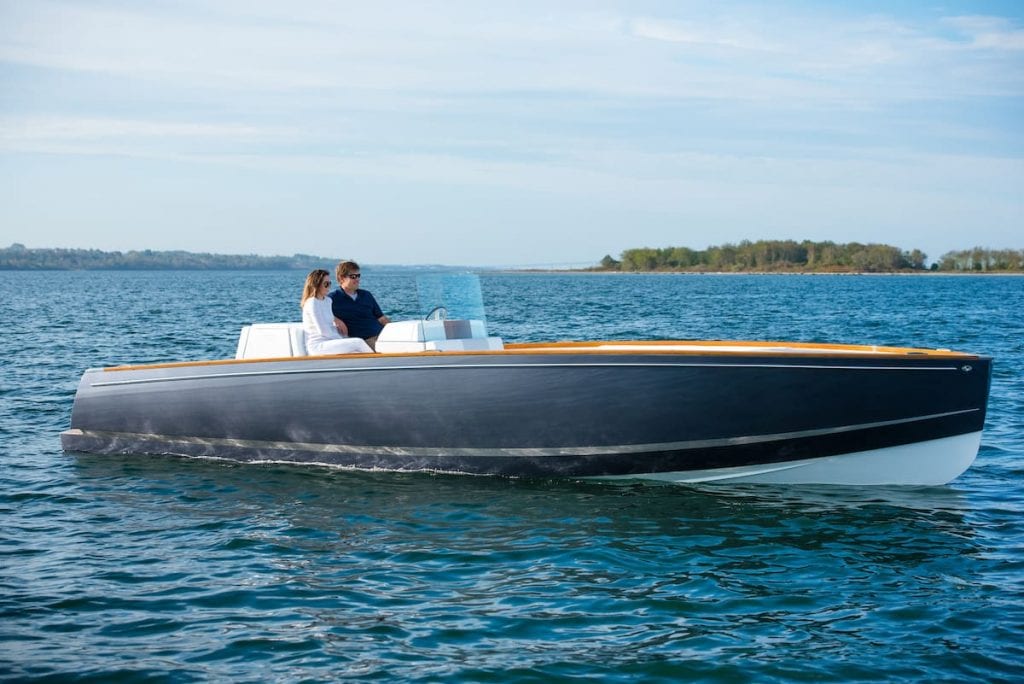
Enter Hinckley’s Dasher, the world’s first, fully electric yacht. This 28’6” (8.69 m) beauty was introduced at the 2017 Newport Boat Show. Utilizing cutting-edge technology such as 3D printing to shape finite details and a carbon-epoxy composite hull, Hinckley designed Dasher for the manufacturer’s Whisper Drive silent propulsion system.
It makes use of twin Torqeedo Deep Blue 80-hp electric motors, a pair of 50-amp dock chargers, two BMW i3 lithium-ion batteries, and is able to cruise at 10 mph with a fast cruise between 18 and 27 mph. According to Hinckley, the range for the former is approximately 40 miles and 20-25 miles for the latter. Plus, her charging system can fully restore the batteries in about four hours.
Greenline Yachts
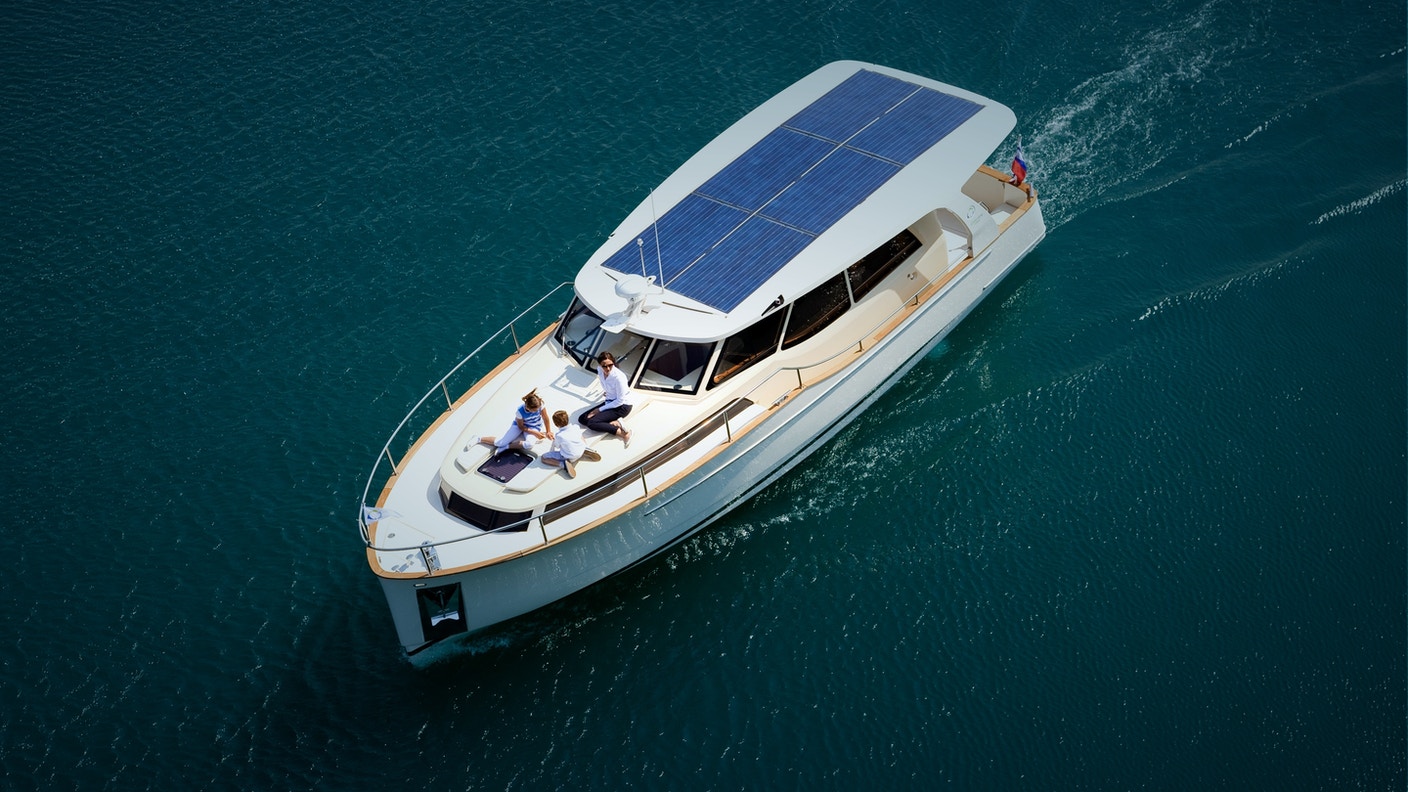
Greenline Yachts offers four of their models as hybrids; that is, its yachts utilize solar, electric and diesel power and range in size from 33’(10.06 m), 39’ (11.89 m) , 40’ (12.19 ), and 48’ (14.63 m). Its NEO model, offered in coupe, hardtop and open at 32’9” (9.98 m), is available in either traditional outboard power or an eDrive system. A pair of 80-hp Torqeedo Deep Blue engines is coupled with two high-performance lithium batteries for a total of 61kWh.
According to Greenline, this allows for a maximum range of 40 nm at an economical 6-knot turn of speed. At full throttle, NEO’s eDrive will reach a top speed of 16 knots with a range of 20 nm. As well, its larger boats make use of its Hybrid Drive.
Combined with efficient hull design, this part of the lineup combines three energy sources: inverter with lithium storage batteries, inboard diesel power with a generator and a solar roof array. The electric motors and diesel engines are both connected to the prop shaft.
Nova Luxe
New to the electric scene and willing to position himself for the upswing is Marc Hawkshurst of Nova Luxe Yachts. He takes stable, efficient catamaran hulls from builders such as Aquila, Fountaine Pajot, Endeavour, and Maine Cat and electrifies them. The Nova Luxe vision is to design and build its vessels with alternative power always in mind, which means using the latest technologies to maximize performance, including the use of strong, lightweight building materials and resin infusion.
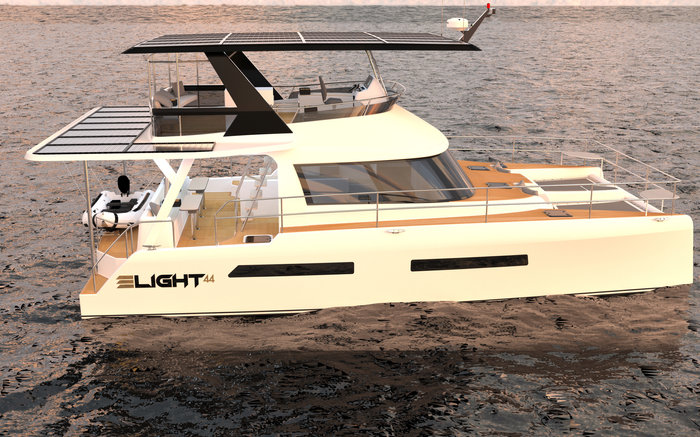
Nova Luxe used the proven Torqeedo 80-hp Deep Blue electric engines and the i3 BMW batteries, combined with a solar array and a generator, for its first entry into this sector with an Aquila 44.
The owner chose the boat for its three-cabin layout and wide beam. The vessel’s diesel engines were replaced with new electric engines. The roof now accommodates large solar panels. Once completed—a launch date in early 2019 is possible—with a pair of 30kW batteries (60kW total), she will have the ability to cruise at a 6-knot turn of speed and can run all day using 25kW.
In addition, the solar array, on a sunny day, is capable of an additional 30kW of power aboard. With the Whisper Systems DC diesel generator going directly to the batteries at the rate of 25kW per hour, the operating time can extend to a week of efficient running. While it’s not a speed demon, the yacht is the first step in Nova Luxe’s ambitious plans for the future.
The Future is Electric Power for Boats
With these examples and the many others who have already made inroads in this direction, innovators hope to go with all-electric boat designs in the future. Accomplishing this will take efforts to bring about improvements and advancements to put forward commercially viable options that are both efficient and practical for certain boaters.
While I seriously doubt we will see 40+ knot sportfish boats running offshore, the possibilities still exist for some real changes that will positively affect our industry—and the environment.