Euro This!
The True Origin of the “Euro” Craze?
I AM MAD AS HELL AND NOT GOING TO TAKE IT ANYMORE! Maybe that’s a little too harsh. I am mad as heck and I can take it a bit more. Actually, I am mildly annoyed. My beef is this: in the U.S. marine pleasure boat industry, designers, brokers, builders and magazine scribes glibly apply the term “EURO” to virtually anything that looks hot or different. What particularly gets my goat are the terms: “Euro Styling” and “Euro Transom” and I will tell you why.
First, let’s get some terms straight. When people talk “Euro” as it applies to styling, they are talking about one of my favorite countries of the world: Italy. Italy is considered the style and fashion center of the universe whether you are talking clothes, toasters, automobiles or boats. The rounded, bulbous shapes so prevalent today are attributed to the Italians. But I am here to contend that today’s “Euro Styling” and the “Euro Transom” trends did not originate in Europe but right here in our own bubba beleaguered United States of America.
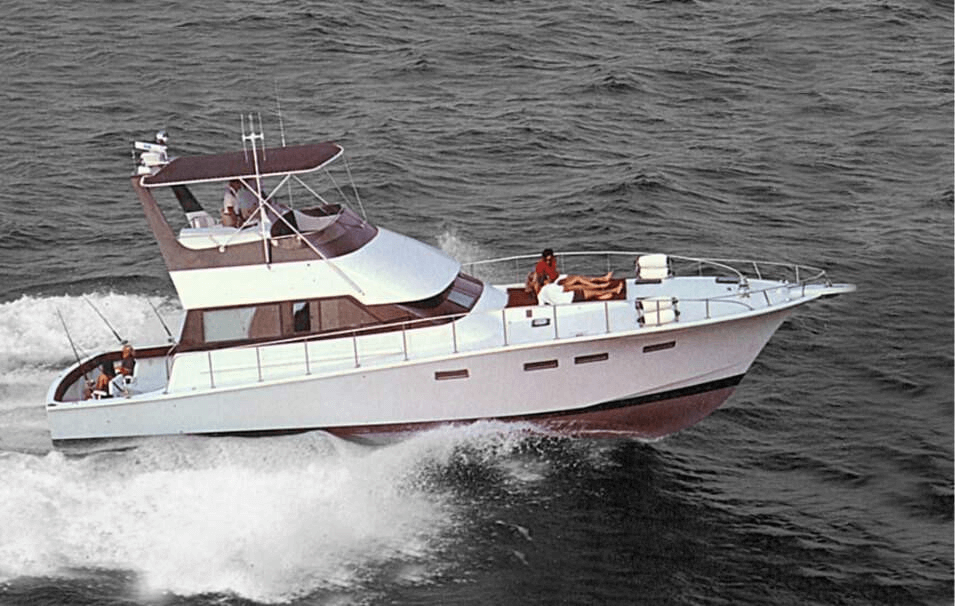
"Euro Styling?"
Up until the early eighties, boats from Italy and the United States had hard corners. Of course, the Italians went to the extreme and used really hard corners along with very weirdly shaped windows – the Picasso on Drugs School of Yacht Styling. Corners were so sharp on some Italian boats that if one ever wanted to do away with himself by slashing his wrists, he could do so on one of the many edges of an Italian boat circa 1980. A typical Italian boat of the 1980 period was not very “Euro.” American vessels were styled less radically but, again with corners. I always have been an advocate of round, organic shapes. Rounded shapes adapt well to fiberglass, are stronger, look prettier, are easier to clean and last but not least, are in harmony with Mother Nature. You’ve heard that nature abhors a vacuum? Well, nature also abhors straight lines and hard corners. Did you ever see a dammed square tree trunk or a rectangular cloud?
Back in 1978, we were commissioned with the first of many Cheoy Lee designs – a 48-foot Sportsfisherman. This was one of our first major production boat contracts and, as Cheoy Lee was kind enough to give us a “carte blanche” as far as styling was concerned, I reverted to my favorite curved shapes. The result was the radical Cheoy Lee 48 Sportfish, which debuted at the Fort Lauderdale Boat Show in 1980. Concurrently, Trojan Yachts introduced the first of their advanced new line of “international” cruisers. Both of these vessels were departures from the norm and employed considerable roundness in their contours. I maintain that these two boats – the Cheoy Lee 48 SF and the Trojan Internationals were the vanguard of “Euro Design” as we know it today.
As best I can tell from my research, “Euro Transoms” (swim steps open to the aft deck connected by stairwells) simply did not exist before 1987. Most boats had swim platforms but they were “nailed on” as an afterthought – usually with a simple ladder leading down the transom. In 1985, our office start working with a fine gentleman named Seth Atwood on a radical 126-foot custom motor yacht. Seth was (and is) a visionary. He saw early on the benefits of water jet propulsion for large motor yachts and he had some very specific ideas about the after end of his new acquisition.
Essentially, Mr. Atwood wanted a vessel with no transom or, more specifically, an open, three-tiered aft deck arrangement which included the shaded main deck area aft of the saloon, a large cockpit and a huge, open swim platform complete with custom ovoid hot tub and two fighting chairs. I must admit that when the idea was presented to me I thought Mr. Atwood was completely nuts. Up until then, all boats had transoms – after all, transoms were needed to keep the water out of the boat weren’t they? This was especially important since Mr. Atwood anticipated crossing the Atlantic on this vessel. I remember saying something foolish like: “Seth, this simply can’t be done – a beautiful boat without a transom would be like a beautiful woman without a butt.” We have two dictums in our office:
- we will never do anything that we feel is unsafe and,
- we will never do anything that we feel is ugly.
To my small, closed mind, a transomless vessel violated both these rules. So we danced around with the concept for a few weeks and I came to realize that, the boat really did have a transom – it was just located further forward than usual. The “transom” was the watertight bulkhead between the engine room and the cockpit. And so, we started making drawings and as the Atwood tri-level afterdeck became reality, we realized that we were really into something completely unique and different. I only wish I had dreamed it up.
And that, my friends, as best as I can tell, is the way the first “Euro Transom” came about. The boat, called “Time,” was launched in 1987 and displayed that fall at the Fort Lauderdale Boat Show. The following year she was at the Genoa Boat Show. The Italians had never seen anything like this and “Time” created a great amount of commotion amongst the Italian boat builders and showgoers. In 1988, she was the only vessel in the entire show with a “Euro Transom.” In the following years, open transoms started appearing sporadically in Italy until, today, virtually every boat in Italy and United States has a “Euro Transom.”
These are dark days for the USA: a bum in the White House, the stock market in the W.C. and renegade countries threatening us. We could use some good news. And so, we can hold our heads high with the knowledge that the USA pioneered the marine styling trends and transoms so prevalent today. Therefore, from now on it is “Amero Styling” and “Amero Transoms.” If anyone can dispute the above conclusions and provide documentation, I will do a full “Jimmy Swaggart” and buy that person a dinner at the soup kitchen of his choice.
(Reprinted with permission of Regina Fexas.)
If you would like to read more of Tom's pearls of wisdom, tune in next Friday -- "Fexas Friday."
Better yet, why not get a full dose of infectious Fexas whenever you need it -- and buy one of the volumes below. Better yet, why not buy all of them -- we call them the "Fexas Five." They will provide many evenings of fun reading (better than Netflix), and you'll make the widow Regina very happy knowing that Tom will live on with you the way most of us remember him.
Order 1, 2 or "The Fexas Five" --

To find the "Fexas Five" on Amazon, click here...
Tom Fexas (1941-2006) was one of the most influential yacht designers of the last quarter of the 20th century. With the narrow Wall Street commuters that were built in the 1920s and '30s always on the back of his mind, he wanted to design boats that were at once fast, comfortable, seaworthy and economical to operate. Over the years, he and his firm designed over 1,000 yachts for some of the most prestigious boat builders in the world, including Choey Lee, Palmer Johnson, Grand Banks, Mikelson Yachts, Burger, Abeking & Rasmussen and many others.
Even though toward the end of his career he only designed megayachts and superyachts, including the remarkably influential PJ "Time" in 1987, he is best remembered for his first major vessel in 1978 -- Midnight Lace -- which became a series of 44-52-footers. They were light, narrow, and fast with relatively small engines. He was also influential in the boating community because of the monthly column he wrote for Power and Motoryacht, which began in its very first issue in January 1985.