Exploring the Enchanting Abrolhos Islands of Western Australia

Lee-Anne and Anthony Yewers sat in the cockpit of their Riviera 505 SUV and marveled at another brilliant sunset over the ocean. They were some 32 nautical miles west of Geraldton in Western Australia and about a million nautical miles from care.
The couple live in Perth and have owned their Riviera named Berry Sweet for two years. They are berry fruit farmers. The period May through July is a relatively quiet time for their business so, when Riviera dealer principal Ryan Lloyd recommended a voyage to the legendary Abrolhos island group, they quickly put their hands up to join.

Ryan knows the Abrolhos and was keen to give his clients this very special experience. Initial response to his invitation to local Riviera owners was strong but work or family commitments or health left only the Yewers’s signing-on for the adventure.
Into Remote Waters
Now Berry Sweet was tied up to a timber jetty that serves a group of shacks built by rock lobster fishermen. Visitors are not allowed to stay among these islands unless they are guests of one of those fishermen, in this case Reece Newbold, a third generation “cray” fisherman. The people who work here are called cray fishermen and their craft are called crayboats. It is simply a colloquial term because they are here for the single purpose of catching the local rock lobsters. Crayfish are freshwater crustaceans.
The Abrolhos provides the largest single-species fishery in Western Australia. It has a small seasonal population of fishermen, and a limited number of tourists are permitted for day trips but most of the land area is off-limits as a conservation habitat.

Ryan had planned the excursion with Reece who would be the guide for the trip and take his 80-foot crayboat McLaughlan, affectionately known as Big Mac, to be mothership for the flotilla.
“McLaughlan was built by my father in 1992 as an offshore patrol vessel for the fisheries department,” said Reece. “She was named after a well-respected fisheries officer. She was later used as an offshore work boat until I bought her and extended and converted her to a cray boat. During Covid we put her into a passenger vessel in survey.”
Now, with one Riviera set to make the voyage, the plan changed. McLaughlan would stay at home while Ryan and Reece would join the Yewers’s on board their Riviera for the voyage from Perth to Geraldton. They left Perth at 7am, travelling at a cruise average of 18 knots and arrived in Geraldton at 5pm. The crew spent a night in Geraldton and next morning added a chef and photographer to the group. Lee-Anne and Anthony’s son and his girlfriend also joined the crew, bringing a large RIB by trailer from Perth. The larger team then headed west for a three-hour trip to the most southerly of the Abrolhos groups, the Pelsaert islands.
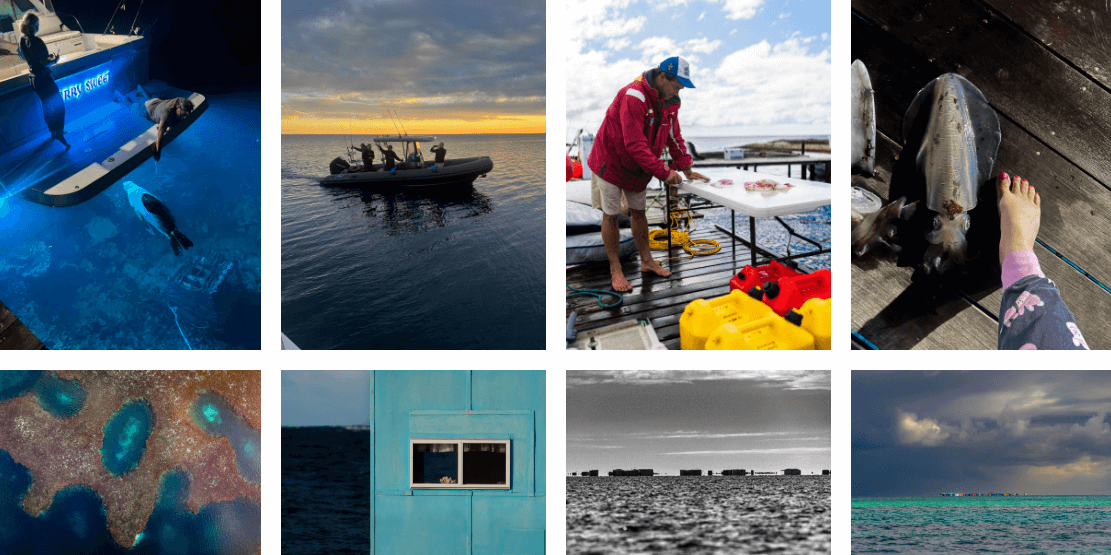
Reece explained that the Abrolhos islands could be a “scary place” for first-timers.
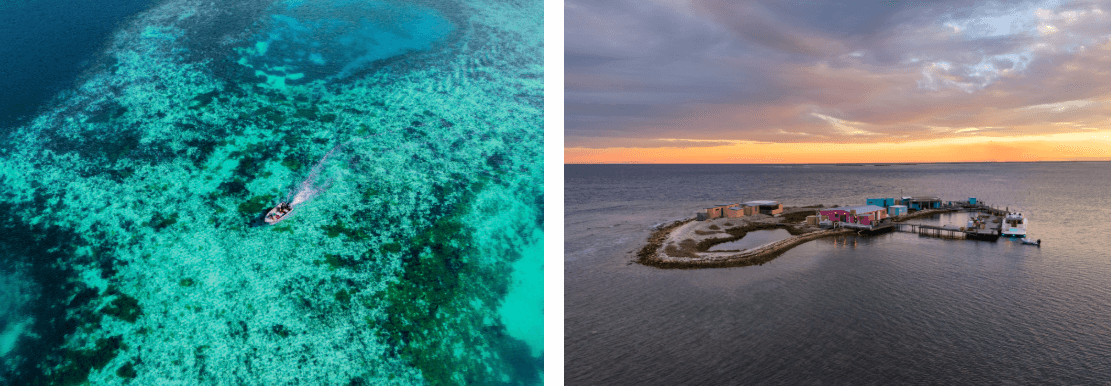
“We are in the middle of the ocean with no land in sight; just a group of small islands barely high enough to stand out from the water,” he said. “The fringing reef to the west protects the islands that are home to about a hundred shacks owned by the lobster fishermen.”
Reece was impressed with the Riviera’s handling as they approached his shack.
“We came in via a tight channel,” he said. “There is no room for error with shallow reefs on either side as we came into the jetty, but Berry Sweet proved easy handling with the joystick. We held her a meter off as we sorted out how we would tie up.
“From the moment we first saw the low-lying islands and the fishermen’s shack on them we were enchanted,” said Lee-Anne.
The Abrolhos islands encompass a chain of 122 islands and associated coral reefs in three groups in the Indian Ocean about 32 nautical miles (60 kilometers) west of Geraldton in Western Australia. Most Australians associate Abrolhos with the wreck of the Dutch ship Batavia and the subsequent massacre of more than half the crew and passengers by mutineers in 1629.
Yet, for those fortunate enough to experience these extraordinary islands, they are a magical and peaceful wonder.
Island Time Living
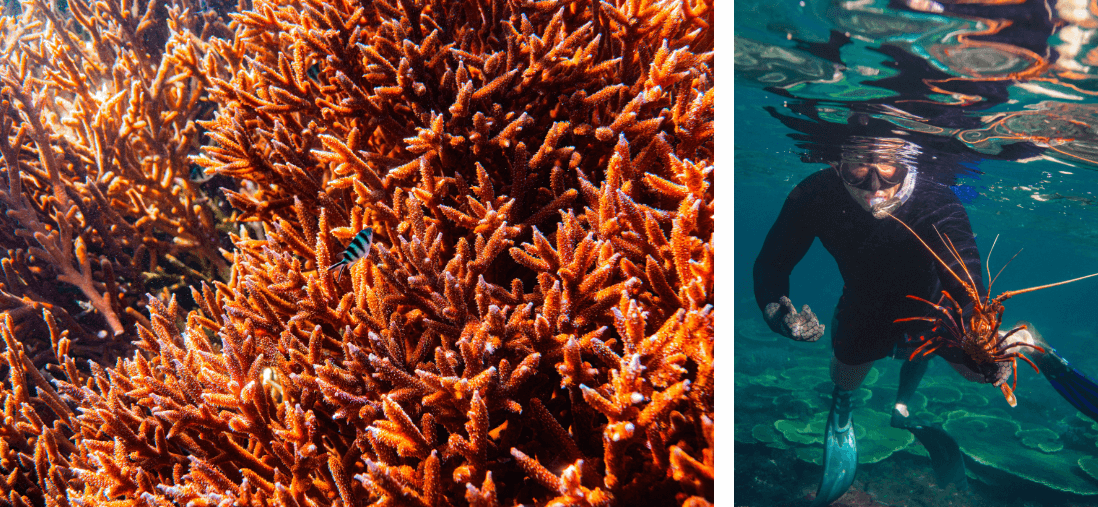
An unforgettable underwater world awaited Lee-Anne and Anthony. They dived into the coral-fringed waters, snorkeled alongside curious sea lions and giant fish.
Reece explained that it took most people a few days to slow down to island time.
“When people slow down, they notice that what they thought of as dead coral and weed transforms with life,” he said.
“There is no mobile phone coverage out there, so you need a good HF radio to communicate.”
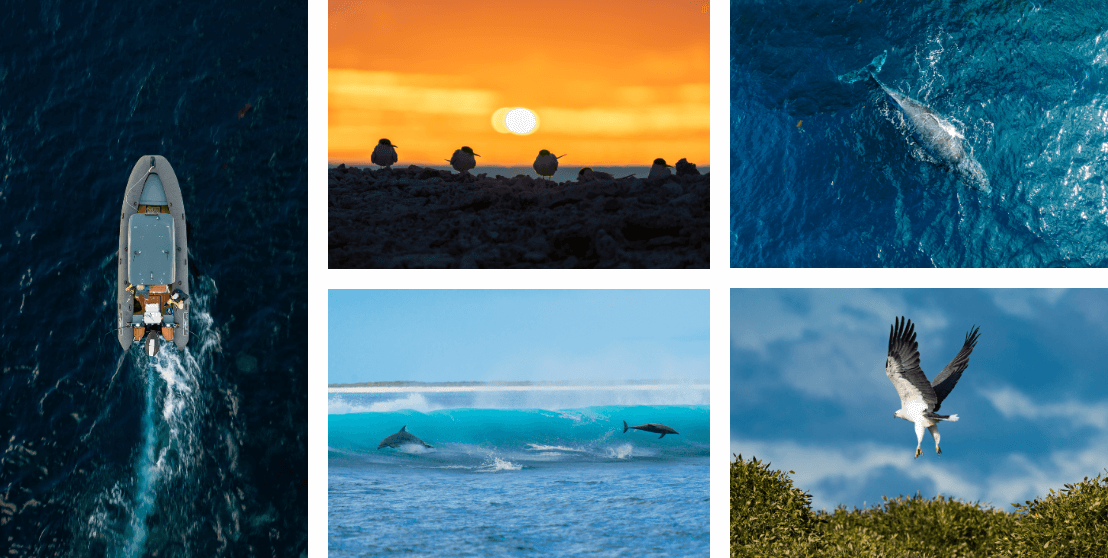
One memorable adventure was to take the RIB out to the fringing reef where the surf rolled in from the Indian Ocean.
“We saw dolphins through the waves,” said Anthony. “They were literally surfing and jumping out of the water. It was like a dolphin theme park!”
Fishing was also an important part of daily activity.
Reece recalled: “Lee-Anne and I were sitting on the boat at the jetty. Anthony and his boys were about 60 meters away, hooting and screaming – having a ball as they caught fish.”
Lee-Anne joined in the fishing adventures.
“I have always hated fishing,” she said “It is so boring, waiting half an hour for a nibble. But out there it was constant excitement. So many fish!”
Reece, the chef and photographer stayed in Reece’s shack at night while the Yewers’s hosted Ryan aboard Berry Sweet.
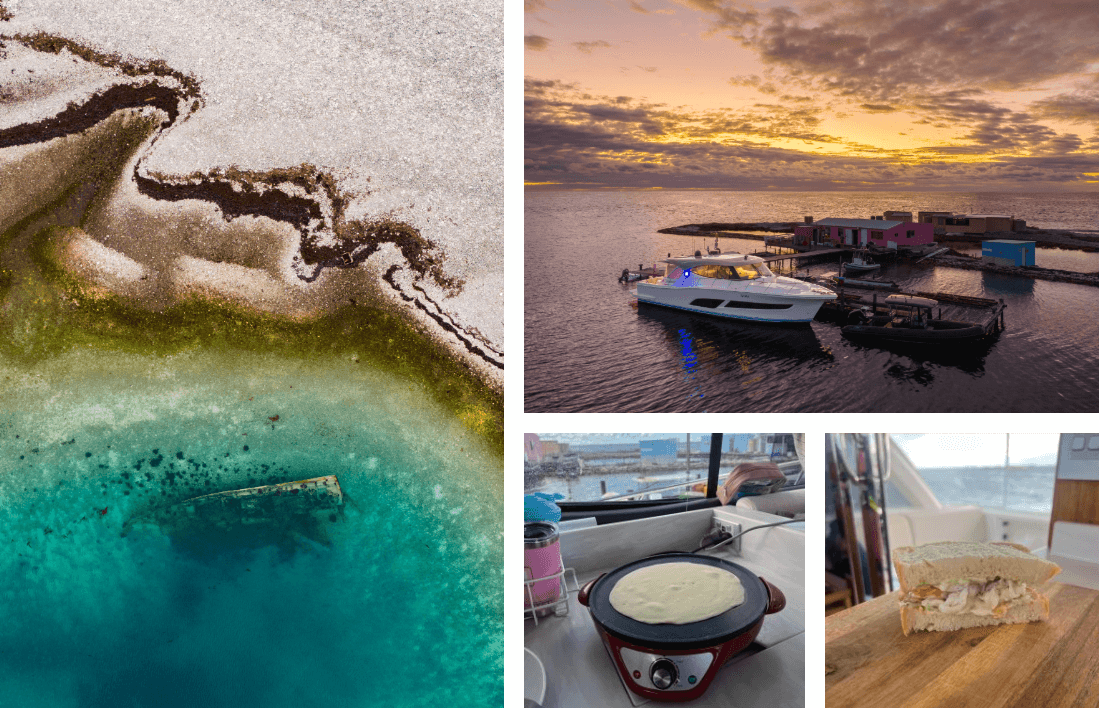
Lee-Anne often made fresh bread in the mornings. She had brought along a bread-maker, so the team had fresh sandwiches for lunch, filled with freshly caught and cooked fish or lobster. She also treated the team to crepes one morning.
Reece recalled a particular highlight for the Yewers’s. “One day I took Lee-Anne and Anthony to a wreck site. It is great diving. A few cannons remain on the bottom there. I saw something green almost buried in the sand at my feet in ankle-deep water. It was a hand-made copper nail about three inches long. It may have been hundreds of years old. That is one of the joys of these islands and diving around them.
“There are hundreds of wrecks here. The island group is appropriately named. The name Abrolhos is a contraction of the Portuguese expression abre os olhos which translates to “open your eyes – protect yourself!”
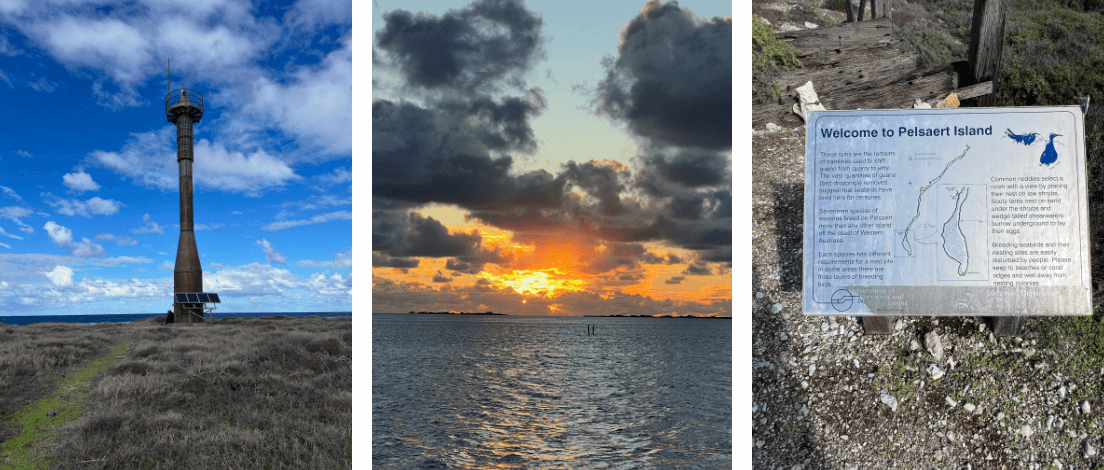
They also visited the unmanned lighthouse on Pelsaert Island. It is a slender 20-meter-high stainless steel column that was erected in 1974 and converted to solar power in 1984. The light has never been manned.
Ryan had work to do at home, so a light aircraft was summoned to land on the tiny airstrip on nearby Rat Island. The Yewers’ son and girlfriend also had to leave early so took the large RIB back to Geraldton, leaving Lee-Anne, Anthony and Reece to enjoy the final three days of their adventure alone.
Finally, they had to return to Perth. The original plan was to travel to Geraldton, spend a night there and make the run south the following day. But conditions were so good that they all decided to head straight home.
They left the Abrolhos at 3pm.
Lee-Anne said: “The weather was so good we did not need to turn on the gyro stabiliser. Reece skippered and he told stories of sailing yachts appearing out of the dark with minimal navigation lights.”
She admits to becoming a little seasick after darkness fell.
“Eventually there were no reference points,” she said. “It was scary but exhilarating.”
Reece was impressed with the Riviera’s visibility.
“There are lots of cray pots in the water, so you need to be able to see well in front. I was impressed with the yacht’s visibility on board. It offered great vision, even at sea. And the navigation system on board worked brilliantly.”
Lee-Anne and Anthony are already planning annual visits to the islands, eventually working their way further north to the other two island groups including to Morning Reef near the Wallabi Group where the Batavia was wrecked.

The Abrolhos Islands
Officially named the Houtman Abrolhos, these islands are the southernmost true coral reefs in the Indian Ocean, and one of the highest latitude coral reef systems in the world.
The Abrolhos includes three groups of islands made up mainly of corals and sand. The Wallabi Group to the north comprises some 30 islands, the Easter Group has 28 and the Pelsaert Group to the south includes 38 islands.
The Abrolhos are best known for the infamous wreck of the Dutch ship Batavia during her maiden voyage from Europe to the East Indies (now Indonesia) in 1629. Batavia was wrecked on Morning Reef near the Wallabi Group on June 4, 1629. While the commander, Francisco Pelsaert, and a number of crew set out for the East Indies to seek help, a group of the crew remaining on the islands mutinied and murdered many of the survivors.
Discovery of the islands is credited to Captain-General Frederick de Houtman who, in 1619, encountered and narrowly avoided a group of shoals which are now named the Houtman Abrolhos.
It is estimated that up to 50 vessels may have been wrecked on the Abrolhos. The most famous are the Batavia and the Zeewijk in 1727. It’s no wonder some of the islands are considered to be haunted. Many wrecks’ remains are now favored dive sites, including the Batavia which lies in clear, shallow water, making it accessible to divers of various skill levels.