Foundation Zero Protects Electric Yachts from Lightning Strikes
As yacht builders begin to move away from fossil fuel propulsion, so the electrical systems become vulnerable to being wiped out by lightning – but there is a solution.
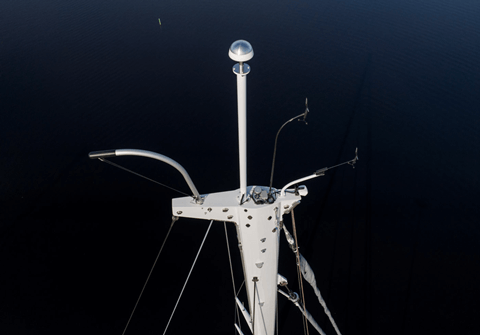
Foundation Zero is a not-for-profit organization of researchers who are seeking to build the sustainable yachts of the future. In development is Sailing Yacht Zero, an experimental sailing yacht that will be powered entirely from renewable energy. However, the team soon realised that one direct hit from a lightning bolt could fry the entire electrical system, from batteries to chargers, including all the control boxes. Although there are off-the-shelf solutions available, such as the DDCE inhibitor system from Dinnetco, the research team wanted to take protection even further.
The problem is the sheer energy held in a lightning strike, and its huge variety of current and voltage. Physicist Bob van Somerson is one of the scientists helping to build Sailing Yacht Zero and summed up the issue.
“A lightning strike is often between 20 to 200 kiloampere (kA), sometimes even reaching 300kA,” he said. “However, the average is around 30kA. That’s a lot of variability. The voltage, on the other hand, can range from 100 million to 1 billion volts. This is a large amount of power, but one that only lasts for 10 to 20 microseconds. Because it’s a short burst of high voltage, the amount of energy isn’t huge, potentially several hundreds of kilowatt hours (kWh). A large part of this energy (around 95%) is dissipated in the flash and thunder. The lightning protection system itself, as we designed it, therefore must deal with far less energy, specifically in the range of a few kWh.”
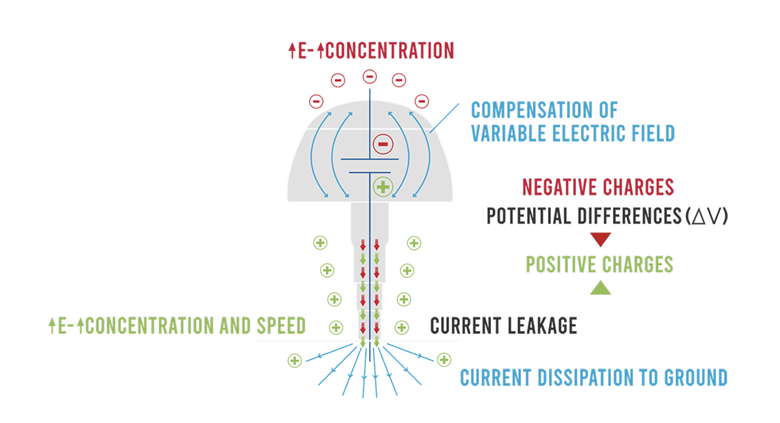
The industry standard for dissipating lightning is to direct it from the masthead to the keel, or to a nearby earthing plate. However, this also means a large electromagnetic pulse (EMP) can affect the sensitive electronics inside the boat as the current passes down the copper strap. One motorboat IBI knows of still has a magnetic anomaly in the galley, even after all the damaged electrics were replaced.
Somerson and the build team decided to use the proven protection method of the Faraday cage, which uses a metal frame to direct the charge outside the hull and into the sea. This involved working closely with the Swiss company Carbo-Link, a specialist in composite manufacturing, especially of advanced masts. They created a system whereby the current was enticed overboard from the base of the mast, rather than carrying on down through the accommodation.
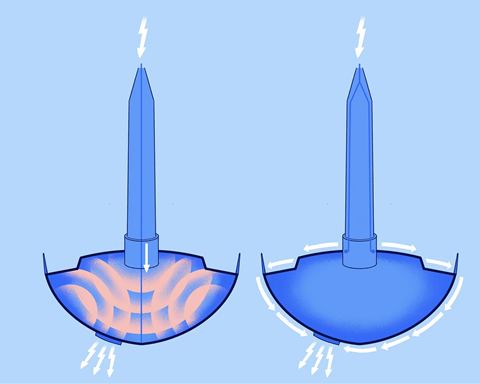
So far, the solution is still a theory, and will only be proven at the first strike, but the Foundation Zero team is as confident as it can be that this new method will soon be protecting electric yachts of all types from a circuit-frying EMP.
“Lightning strikes are a constant in seafaring, but fossil fuels aren’t,” the team concludes. “We need to deal with the former before the latter is left completely in the past.”
You can read more details of the installation at www.foundationzero.org/insights/protecting-electric-yachts-from-lightning-strikes.