Grady-White Canyon 456 with Sharrow Props

With a 14’ (4.27 M) beam and a weight of 24,500 lb. (11,113 kg) without the four Yamaha 425 XTO’s on the transom, the Grady-White Canyon 456 is a lot of boat to push with outboard power.
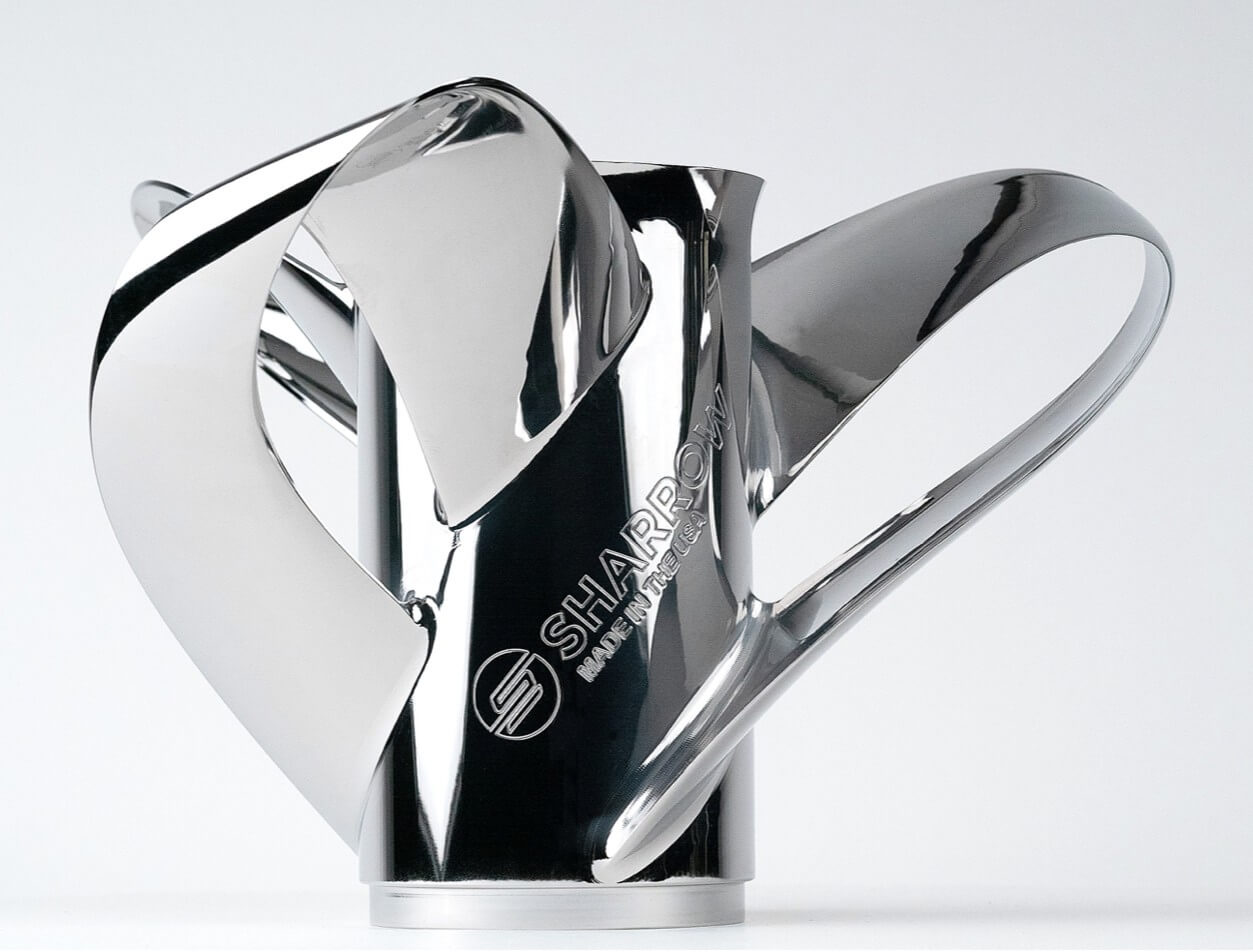
However, Sharrow’s engineers found their True Advance continuous blade propellers up to the task, improving considerably on the standard Yamaha XTO 16.375 x 21 three blade propellers in both range and top speed.
Both More Efficient and Faster
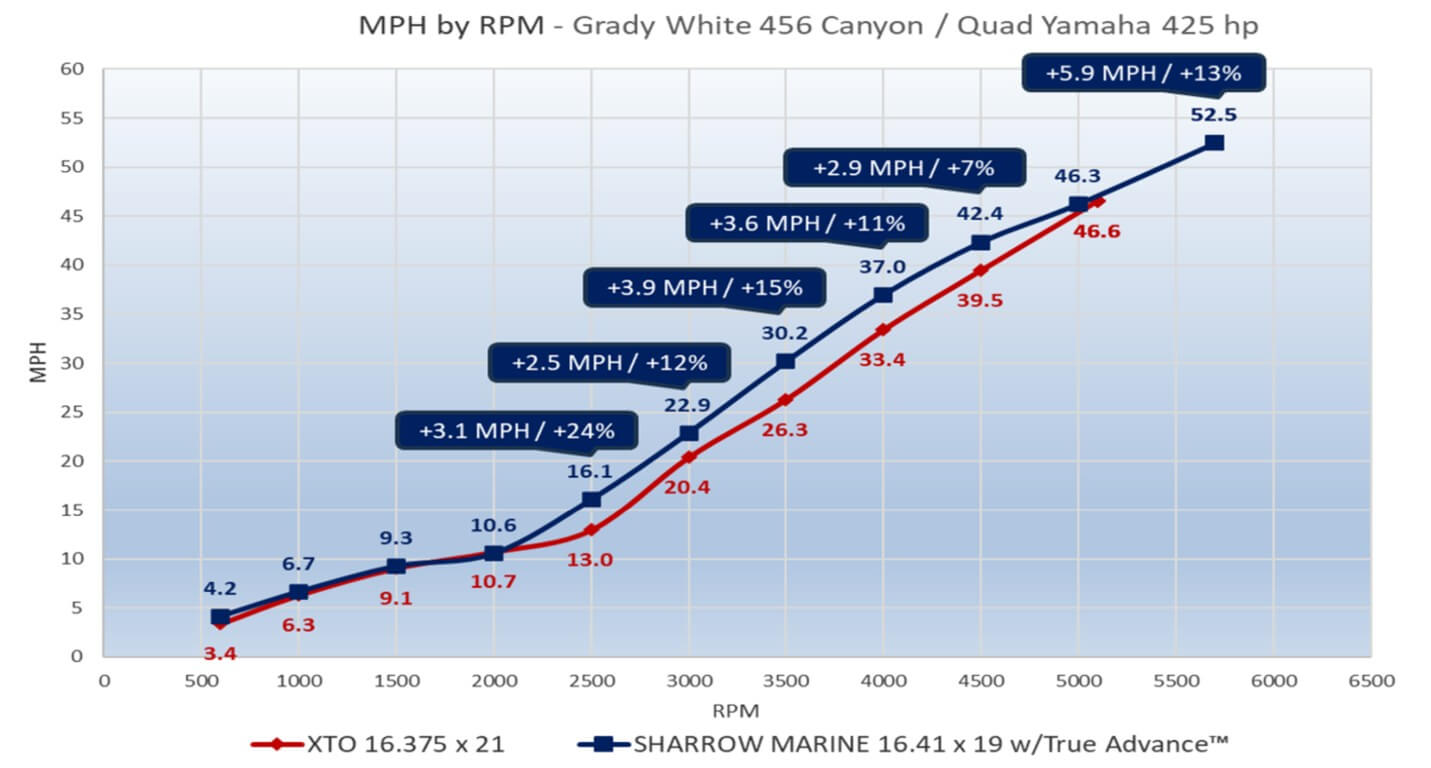
Surprisingly, the Sharrow propellers that produced this performance, 16.41 x 19, were actually lower pitch than the XTO’s, yet top speed with the Sharrow continuous blade propellers was 52.5 mph, compared to 46.6 mph with the XTO’s.
Sharrow’s unique design, also known as a loop-blade propeller, was first marketed by inventor and company president Greg Sharrow in 2012 and since then has proven its value on everything from pontoon boats to large diesel-powered catamarans suitable for ocean-ranging travel. Company engineers regularly conduct tests to prove the efficiency versus a wide variety of competing propellers, and thus far the Sharrow’s have excelled in most measures.

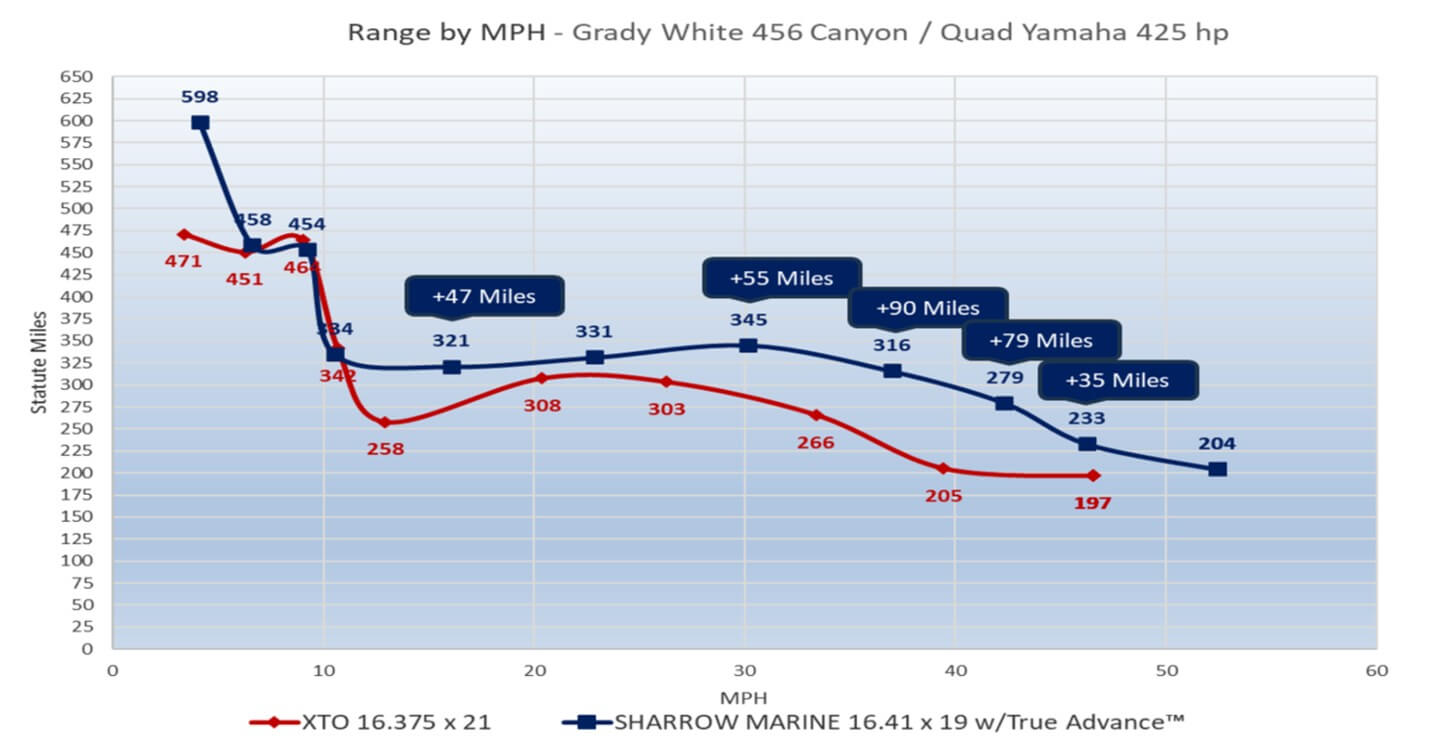
When it comes to range as measured by miles per gallon, the Sharrow True Advance propellers were more or less equal to the XTO’s at displacement speed but quickly showed their advantage as the boat accelerated to above 15 mph. At 35 to 40 mph—the likely preferred speed in moderate sea conditions, the Sharrow’s were 39 percent better in fuel economy.
This sort of advantage takes away concerns during long runs offshore, all-day high-speed trolling and inter-island travel where local fuel supplies may not be dependable.
Extending Range, Ending Range Anxiety
As this chart shows, with the Sharrow propellers, the Canyon 456 extends range as much as 90 miles at 30-40 mph cruising speeds, and maintains an advantage all the way to WOT. This can put more distant locations within reach, as well as taking away low fuel concerns at the end of a long day far offshore.
Greater Efficiency Can Mean Longer Engine Life
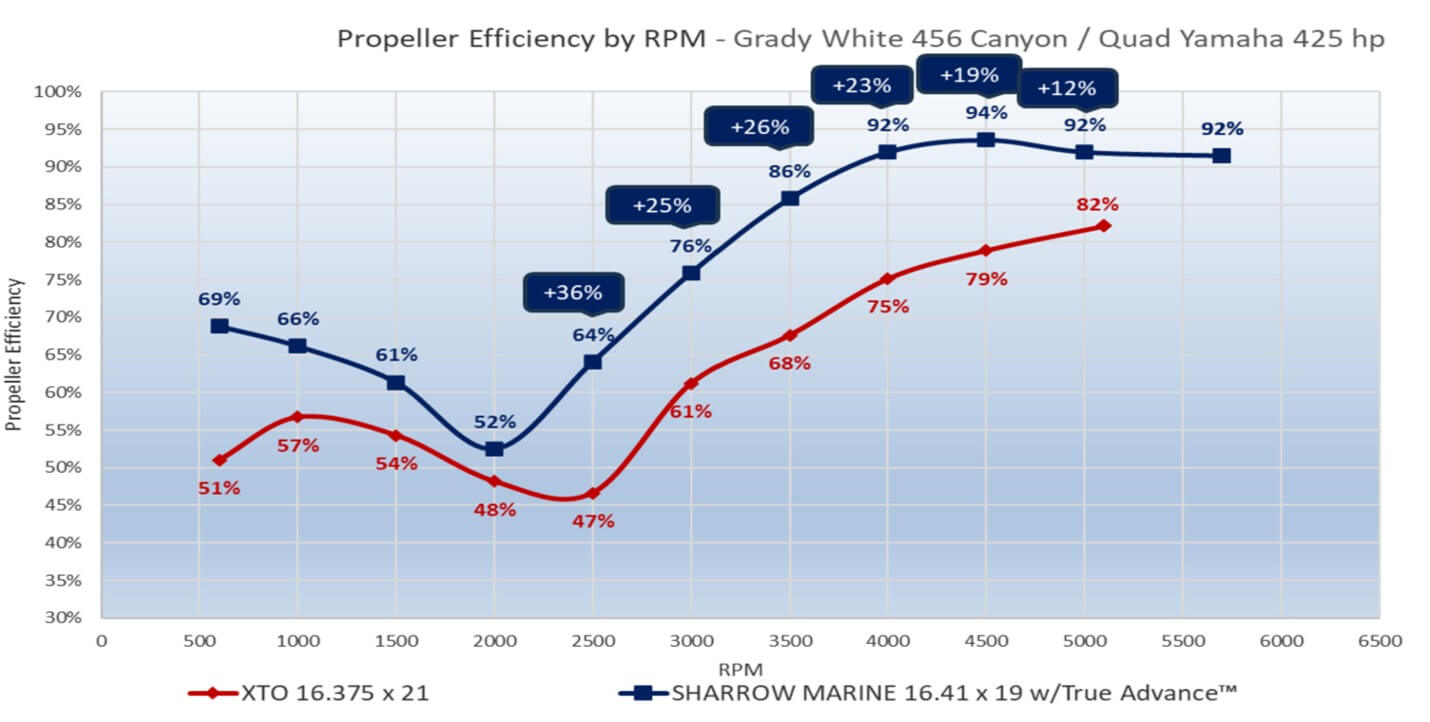
The highly efficient Sharrow propellers mean engines can run at lower rpm while still maintaining speeds right for sea conditions and boat loading.
Over the lifetime of an outboard, it can add significantly to the time between overhauls or replacement.
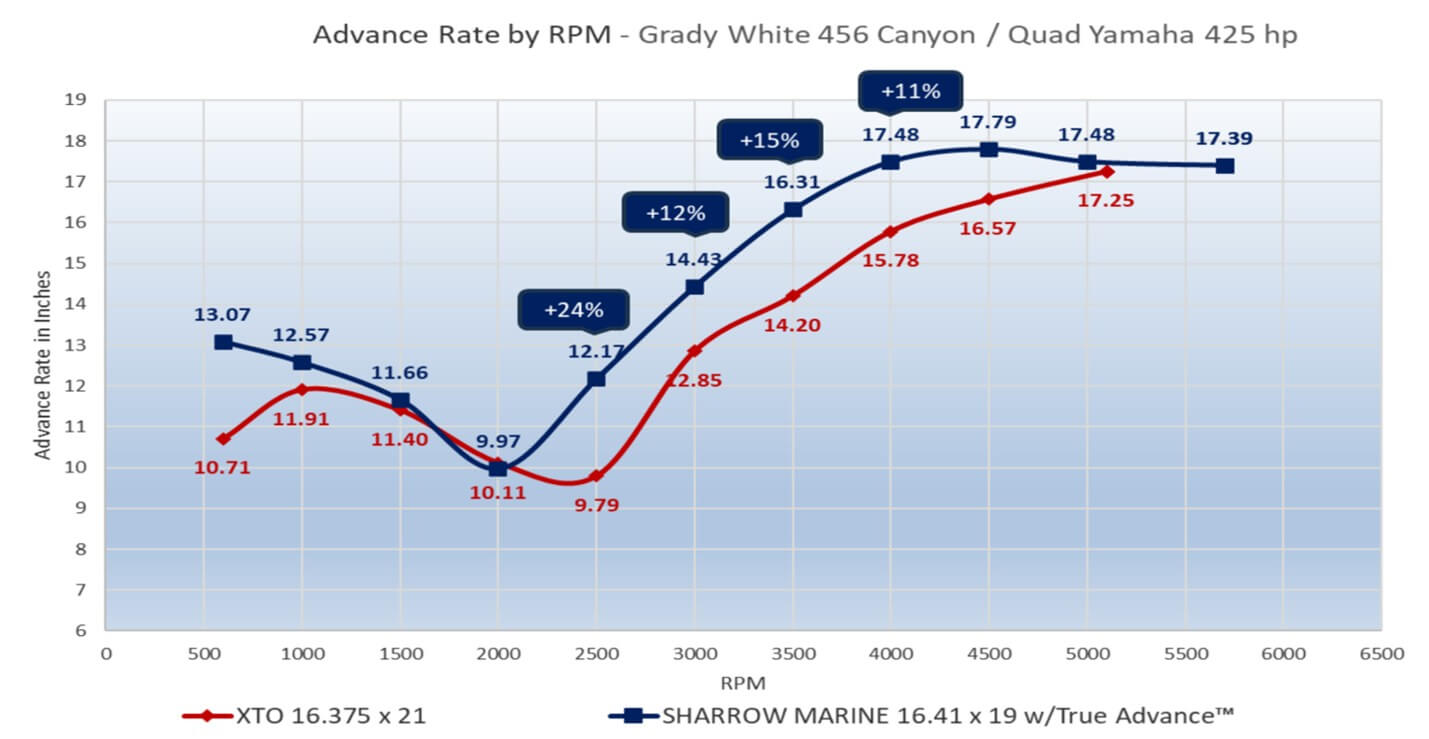
The advance rate is the distance a propeller pushes a boat per revolution. While no propeller is 100% efficient, the Sharrow continuous blade design is significantly better in this measure than conventional designs.
Note that at 4500 rpm—where many outboards are most efficient--the Sharrow advance rate is 17.79” per revolution, surprisingly close to its engineered pitch of 19”.
Get Home Fast—And Save Fuel
While Sharrow propellers are not engineered to produce maximum speed, they sometimes excel in this measure as well. Note that in this test, even though the Yamaha XTO propellers had a 21” pitch, the Sharrow Marine propellers, with a 19” pitch, were considerably faster at WOT, topping out at 52.5 mph vs. 46.6 mph for the XTO’s.
While most of us don’t often run our engines at maximum speed, the capability of getting home faster is sometimes appreciated when a storm is approaching.
Overall, however, the biggest reason to consider investing in a set of Sharrow propellers is improved range and reduced fuel costs. Users also report considerably less vibration and noise, another plus in long term operation.