How to Choose the Right Center Console Boat for You and Your Family
A Comprehensive BoatTEST Guide to Buying a Center Console
Introduction
Selecting the perfect boat is one of the most important decisions you'll make as a boater. If you are thinking about a center console, your task is doubly difficult because there are so many models to choose from over 50 different builders. Whether you're a weekend angler looking to chase redfish in the shallows or a serious offshore enthusiast targeting tuna and marlin, or are more of a cruising boater looking for a comfortable family boat – in all cases you have plenty of models at all price points to choose from.
At BoatTEST, we've evaluated hundreds of center consoles across every size range and price point, over the last 25 years. We've learned that the right boat for you depends on careful analysis of how you'll actually use it—and who you'll use it with.
The First Question: Is a Center Console Right for You?
Before diving into center console selection, ask yourself: Is a center console design the right type of boat for you in the first place? The answer for many people—perhaps as many as half—is no.
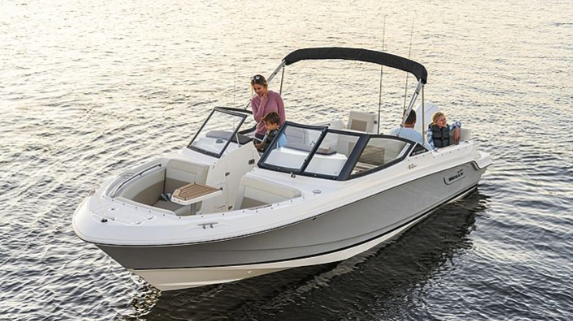
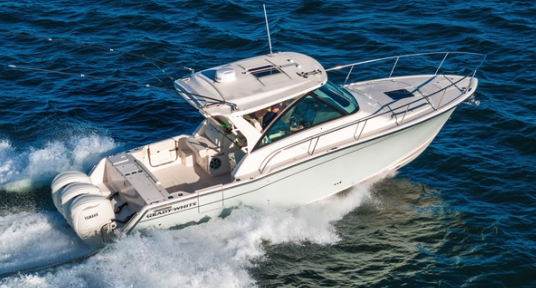
Other boat types may better suit your needs, including sportboats, dual consoles, express cruisers, dayboats, commuters, weekenders, wakeboats, jet boats, and many others. Remember: center consoles were originally designed for active fishermen to work fish 360-degrees around the boat in coastal situations—not as family cruising boat.
Nevertheless, the center console has become America's second most popular boat configuration (after pontoon boats) for good reason. The fishability, excellent visibility from the helm, and versatile layout make these boats equally capable for offshore fishing, family entertainment in coastal locations, diving, or serving as all-around utility vessels.
What Can You Afford?
Price will impact 75% of people buying a center console, so let's address it first. Prices vary wildly by brand, power, electronics, and options. Here are realistic new boat price ranges using current public listings as guideposts for new boats:
Under 19 Feet
Price range: $25,000 to $70,000+
- Mako 15 Skiff with 40 HP engine and trailer: $23,959
- Carolina Skiff E18 JVX: ~$30,790
- Bayliner Trophy T18: $32,420
- Boston Whaler Montauk: $60,476
- Parker 18SE: $65,460
20 to 29 Feet
Price range: $60,000 to $450,000+
- Robalo R222: $83,000
- Yamaha 255 FSH Sport H jet boat: $112,000
- Everglades 285 CC: $300,000-$450,000
30 to 39 Feet
Price range: $250,000 to $850,000+
- Edgewater 340 CC: $450,000-$650,000
- Grady-White Canyon 336: ~$550,000+
- Pursuit S 358: $550,000-$850,000
Over 40 Feet
Price range: $800,000 to $2,000,000+
- Boston Whaler 420 Outrage: ~$1,400,000
- Formula 457 CC: $2,181,000
Buying Tip: When buying any boat, if you don’t have a trade in, tell the dealer up front. That will immediately lower the price in most cases. Dealers do not want to take boats in trade because they must guess what they can sell it for, so when they do, they typically build in a cushion with the new boat price.
Center Console Categories: Quick Reference
Below is a general reference with typical characteristics of boats in each general category. There is no formal demarcation of where one boat type stops and another starts, which is intentional, as builders want to appeal to as wide an audience as possible with each of their models. It is up to the buyer, who knows where he/she plans to go boating -- and when -- to decide which boat is best for any given application. Keep in mind that even relatively protected water can be challenging in severe conditions.
| Feature | /Flats | Coastal | Offshore |
| Deadrise | 11-16° | 16-21° | 20-25° |
| Freeboard (bow) | 20-32" | 32-40" | 40-60"+ |
| Cockpit Depth | 12-20" | 24-32" | 28-35"+ |
| Fuel Capacity | 30-75 gal | 120-175 gal | 250-700+ gal |
| Range (planing) | 75-150 mi | 150-275 mi | 200-450+ mi |
| Engine HP | 40-250 | 115-350 | 300-1200+ |
| Hull Weight | Light | Moderate | Heavy |
| Self-Bailing | Often no | Yes | Yes |
| Max Conditions | 2-3 ft | 5-6 ft | 10-12+ ft |
Understanding the Three Tiers of Center Console Pricing
When browsing boats at shows with wide offerings, you'll quickly discover that center consoles fall into three basic pricing levels: budget, mid-range, and premium. The differences between budget and premium are usually self-evident; it's the mid-price range that leaves consumers in a quandary.
Finding good value is the game for many consumers, and mid-priced products cater to that concept. However, boats aren't commodities like televisions or appliances. They're hand-built by companies with different cultures and work ethics. Further, their after-sale service runs the horizon from non-existent to superb. Different brands stand for different things and the prices reflect that in most cases.
Boat buying is as much about matching a consumer's personality and psychological needs to a brand as it is about meeting functional requirements. Proof: Two of the highest-priced center console brands are in the top six brands in unit sales, and seven of the most expensive brands are in the top 20 – out of over 60 companies. This indicates many buyers seek excellent value and outstanding experiences beyond just low price.
Know Thyself: Choosing the Right Category
Sadly, about 75% of first-time boat buyers and 50% of second-time buyers purchase the wrong boat—one that doesn't fulfill their dreams of what a good boating experience should be. All boats are expensive, so the only way to save money is to buy the right one first.
Critical Self-Assessment Questions
- Do I want the best of everything, no matter the cost?
- Do I search for the best value for money spent?
- Do I usually buy the least expensive brand in a category?
- Do I love amenities and like showing them off to friends?
- Do I want just the bare essentials in a boat?
- Do I want all the creature comforts available?
- Am I a serious fisherman who doesn't plan to use the boat for family activities?
- Do I want a boat for serious fishing and cruising to distant locations?
- Do I plan to use the boat mostly for inshore family entertaining and cruising?
- Do I plan to use the boat only for fishing or casual cruising in protected water?
- Am I overly concerned about bad weather?
- Will I trailer the boat or keep it in a slip?
- Am I handy with tools and fixing things?
- Am I meticulous about maintenance and want it done by professionals?
- Am I sure the center console is best for me and my family, or should I check out other boat types?
Analyze your answers to determine the type of center console—inshore, coastal, or offshore—you need, as well as the price point where you'll be most comfortable.
Confirming Your Decision
Once you've identified your type and price point, confirm your decision by considering:
1. Where will you boat 90% of the time?
- Protected bays, flats, rivers → Bay/Flats
- Large bays, occasional nearshore → Coastal
- Offshore fishing grounds → Offshore
2. What's the worst conditions you'll intentionally venture into?
- 2-3 feet, protected waters → Bay/Flats
- 4-5 feet, nearshore ocean → Coastal
- 6-8+ feet, open ocean → Offshore
3. How far from inlet/shore will you typically go?
- Wiithin sight of land (1-3 miles) → Bay/Flats
- 5-20 miles → Coastal
- 30-100+ miles → Offshore
4. What's your primary use?
- Sight fishing, flats fishing, casual use → Bay/Flats
- Versatile fishing, family trips, mix of activities → Coastal
- Serious offshore fishing, family outings, entertaining → Offshore
CC Type #1: Bay, Flats, and Inshore Boats
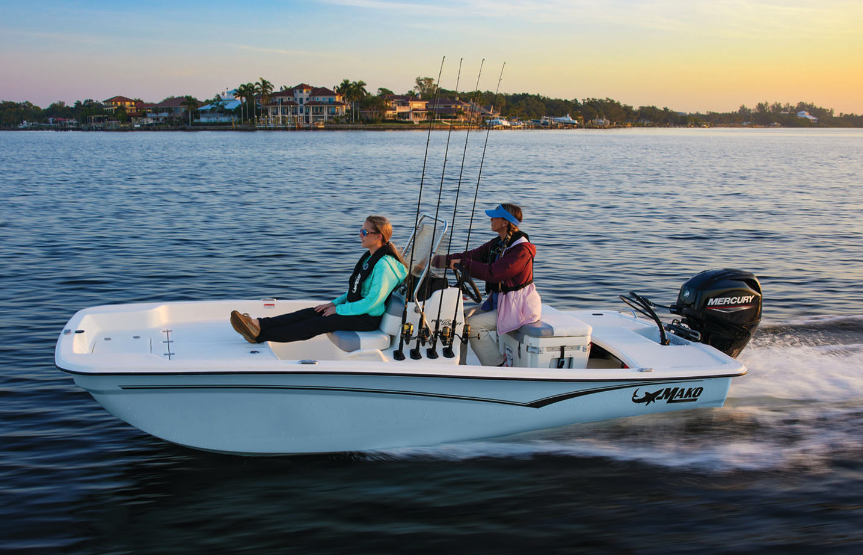
These center consoles are designed for protected waters—shallow flats, mangrove-lined channels, and calm bays where water depth might be measured in inches. These boats provide stable platforms for sight-casting with bow and stern casting decks. Low freeboard makes fish easy to net and facilitates cast-net fishing – and keeps the price of the boat down.
Key Characteristics
- Low deadrise: 11-16 degrees (or cathedral hulls)
- Lower freeboard: 10-20 inches at bow
- Lightweight construction
- Low horsepower engine: typically 50-200 HP
- Economical to operate
- Can run in extremely shallow water (12-18 inches)
Important Considerations
Low deadrise means these boats will pound noticeably in chop when going fast. Because freeboard is low and cockpit soles are often below waterline, many bay boats are not self-bailing. These boats should not be left on moorings or in slips unattended—heavy rain can swamp them. Ideally, trailer or dry-stack these boats after use.
Features to Look For
- Absence of tripping and snagging hazards on deck
- Large fore and aft casting areas with toe rails
- Fold-down jump seats on stern platform
- Factory wiring for trolling motors and power poles
-
Windshield on console with protective rail
Dedicated place for carry-on cooler
In-deck livewell plus insulated fish boxesTackle box storage and lockable rod storage
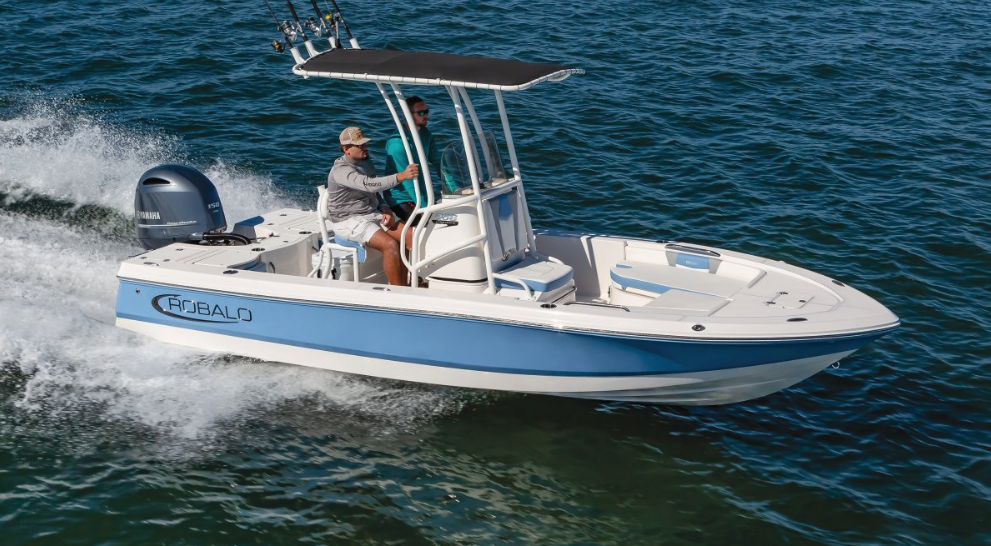
This Robalo Cayman 206 is designed for protected bays and flats fishing where the owner plans on casting in shallow, protected water.
Accessories to Consider
Serious anglers may want electric trolling motors with long shafts at the bow— so, ensure factory wiring is installed. Power poles for anchoring are less intrusive to fish and bottom structure than traditional anchors. Again, have the factory do the wiring. For extremely thin water, consider adding a jackplate to raise the outboard. Most bay boats don't come with T-tops; but we advise adding a lightweight canvas T-top or wearing protective clothing due to UV danger.
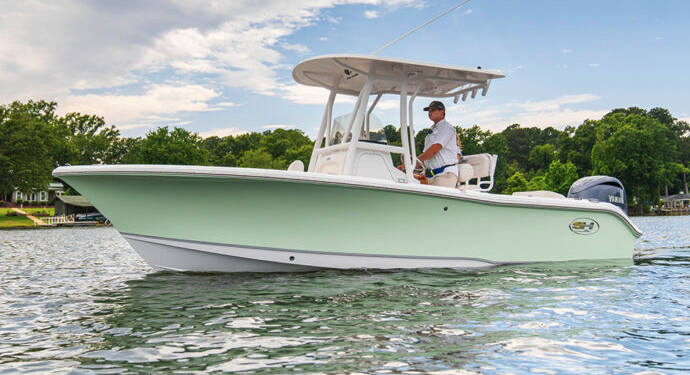
CC Type #2: Coastal and Nearshore Boats
Coastal center consoles occupy the middle ground between rugged offshore boats and lightweight bay boats. These versatile vessels are suitable for coastal waters where you might venture a few miles offshore on calm days but primarily fish protected bays and sounds. They are more expensive than bay boats, but a lot less expensive than offshore boats in most cases.
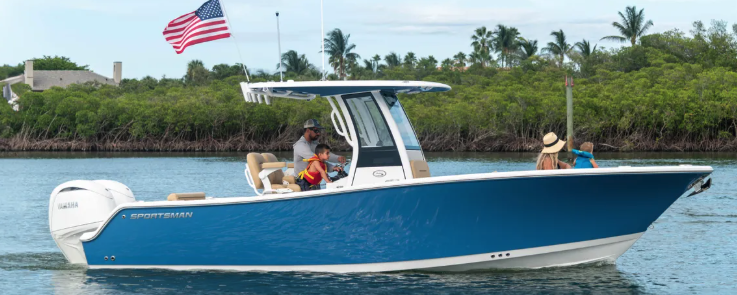
Key Characteristics
- Deadrise: 16-21 degrees
- Freeboard: 32-40 inches at bow, 22-28 inches at stern
- Cockpit depth: minimum 24 inches recommended (self-bailing)
- Weight: 4,500-7,500 pounds
- Fuel capacity: 120+ gallons minimum
- Power: 150-350 HP (single or twin)
- Can handle light chop while running efficiently
Buying Considerations
Determine what percentage of use will be family cruising versus fishing. If 60%+ family use, look for boats with comfortable seating. Consider an electric head—ensure adequate sitting headroom in the compartment. A T-Top or Bimini top is a must for UV protection.
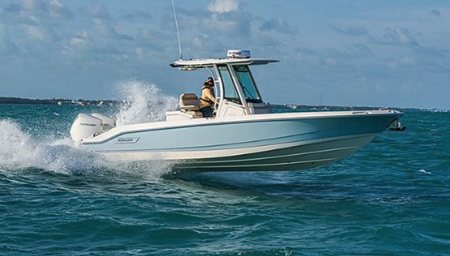
One Engine or Two?
Coastal boats around 25 feet or less can manage with single engines, but once weight approaches 6,000 pounds, consider twins. Use 20-22 pounds per horsepower as a rule of thumb to determine how much horsepower you’ll need. Remember, two engines are better than one, because two props get available torque to the water better than one. Then, there is the advantage of redundancy.
Example: A 6,800-pound boat (dry) with fuel, guests, and gear totaling 8,500 pounds needs approximately 387 HP for decent performance. A single 400 HP engine works, but twin 200s will perform better, go faster, burn less fuel, and provide redundancy.
As boats approach 5,500 pounds total weight, twins should be considered. Generally, 25-26 feet is the dividing line between single and twin engines.
Finding Coastal Models
Few builders specifically label coastal models. Boston Whaler offers Dauntless (coastal) and Outrage (offshore) lines. Everglades has Offshore and Offshore Hybrid series. Look at the largest boats in a brand's smaller range, such as Scout 240 XSF, Grady-White 257 Fisherman, or Pursuit 246 in order to find the coastal model.
Key Coastal Boat Characteristics
- Length: 23-28 feet
- Deadrise: 17-20 degrees
- Weight: 4,500-7,500 pounds
- Cockpit depth aft: minimum 24 inches
- Self-bailing cockpit with 2×2-inch scuppers minimum
- Fuel capacity: 120 gallons minimum
- Head compartment with portable or fixed toilet
- Good weather protection at helm
- Sturdy T-top
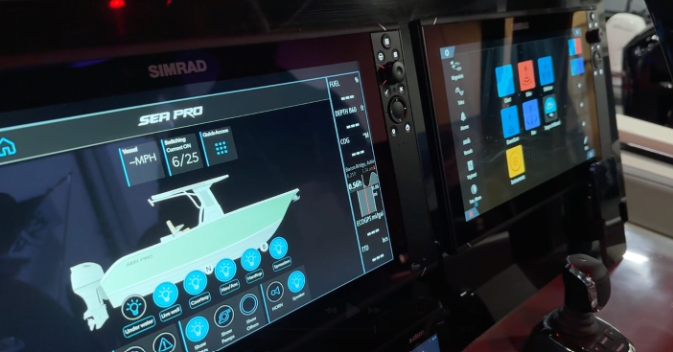
- Helm dash large enough for two screens
- Comfortable seating for 7-8 people
CC Type #3: Offshore Center Consoles
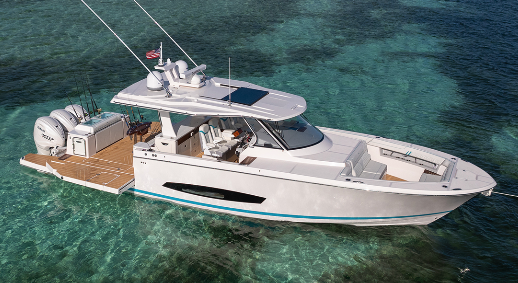
Offshore center consoles are purpose-built for rough seas. They need to provide dry rides in head seas and maintain stability while trolling or drifting in ocean swells. These boats feature deep-V hulls with 20-25 degrees of deadrise, substantial freeboard, and often extreme bow flare. The large models offer all manner of amenities, and some European versions morph into express cruisers; however, true center consoles remain an American phenomenon.
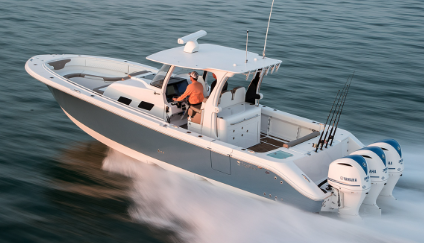
Understanding Deadrise
Deadrise is the angle from keel to the primary chine port and starboard. The industry measures this at the transom for consistency. In the early days of the Deep-V era in the 1960s-70s, deadrise was constant from bow to stern. Today, most designers "warp" bottoms from as much as 65 degrees at the bow stem to 21-25 degrees at the transom. A typical Deep-V is 24-degrees.
The most critical sections of most boats are amidships where the bottom cuts the water (and waves) when on plane. This is the “stagnation line” where the oncoming flow of water hits the boat and is split, going around the boat. This line moves aft on planning boats as the boat goes faster. On most planning center consoles it may be 30% to 40% of the way abaft the bow.
Typically, the deadrise at this point is 40-50 degrees on a warped deadrise boat. This is where cushioning is most effective when running through chop. The faster a boat goes, the flatter the deadrise is at the stagnation line, the harder the ride. If the sharpest area of the hull is where the stagnation line is, the ride will be the best. But as boats plane, the stagnation line moves aft into flatter sections, and the ride becomes rougher.
The higher the deadrise is at the transom, the more likely it is to be more acute further forward where the stagnation line can be found. That’s the major reason why Deep-V hulls are considered better riding when planing.
Construction and Weight
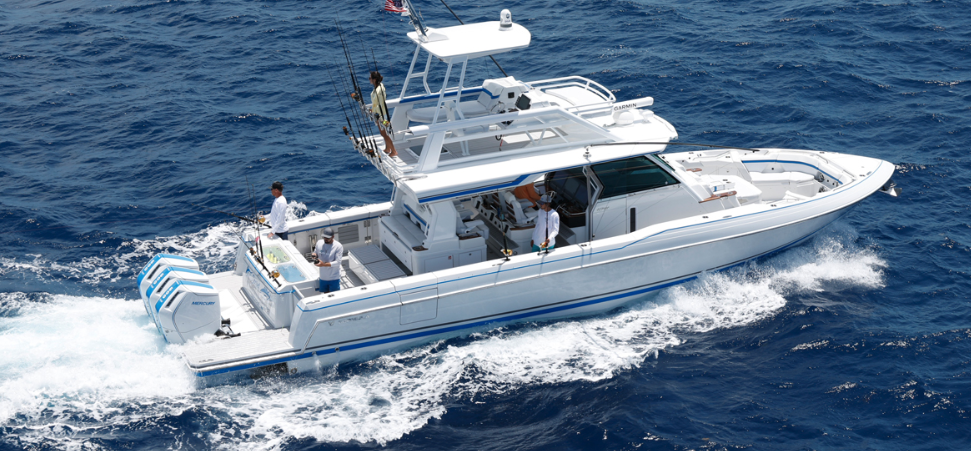
Offshore boats are heavier than coastal center consoles due to added freeboard and robust stringer systems to handle pounding at speed in rough conditions. Longer boats are also typically beamier, adding still more weight. These boats have larger fuel tanks and structures supporting demanding offshore requirements.
Premium offshore boats feature extensive amenities, such as generators, gyros, large battery systems -- all adding weight.
An Important Offshore Safety Caveat
For serious offshore fishing or cruising where conditions get nasty, or may be unpredictable, consider an express cruiser design instead of a center console. Several companies make relatively small express cruisers specifically for serious offshore work. In addition to a covered foredeck, they usually have some accommodations below. Most quality center console builders offer express cruisers on the same hulls for this reason.
However, ask yourself: How often will you truly go offshore? Buying for the "once-a-year hero run" can saddle you with a boat that's bigger, thirstier, and harder to manage for the 95% of trips that are sandbar, harbor, and family cruising. That can be a costly mistake for budget-conscious buyers.
| Feature | /Flats | Coastal | Offshore |
| Deadrise | 11-16° | 16-21° | 20-25° |
| Freeboard (bow) | 20-32" | 32-40" | 40-60"+ |
| Cockpit Depth | 12-20" | 24-32" | 28-35"+ |
| Fuel Capacity | 30-75 gal | 120-175 gal | 250-700+ gal |
| Range (planing) | 75-150 mi | 150-275 mi | 200-450+ mi |
| Engine HP | 40-250 | 115-350 | 300-1200+ |
| Hull Weight | Light | Moderate | Heavy |
| Self-Bailing | Often no | Yes | Yes |
| Max Conditions | 2-3 ft | 5-6 ft | 10-12+ ft |
Materials and Construction Quality
There is wide discrepancy in materials quality among boat builders. Premium builders seek the best materials available worldwide. Budget builders find the least costly materials to remain competitive, though occasionally surprise us with some quality materials or equipment.
Core Materials
Resin, fiberglass, and gelcoat are most important. All builders apply at least one coat of vinylester resin to prevent blistering. Better builders apply 2-3 coats; a few build their entire boats with costly vinylester. Some semi-custom builders use epoxy—the best and most expensive option.
Polyester resin grades vary. Premium builders choose the best available, of course, and most center consoles consist of polyester resin. The same applies to gelcoat. Cheap gelcoat oxidizes faster and is more vulnerable to cracking. Most glass fiber comes from China; while the glass is similar, weaves vary greatly in price. For example, E-glass is among the most expensive.
Hardware and Soft Goods
All stainless steel should be marine-grade 316. Most builders use it on important components; premium builders use it exclusively. But even this grade can rust or weep and require maintenance. Budget boats typically use inferior bolts or screws that weep rust.
Through-hull fittings and seacocks vary in quality. The most important detail is installation and location – you must be able to reach all through-hull shot offs with being an orangutan. ABYC standards are quite clear on this point.
Upholstery quality varies widely. UV degrades cheap vinyl quickly. Premium builders use the best available vinyl materials and UV-resistant threads. For example, Tenara thread doesn’t rot or mildew and is resistant to UV and saltwater. Even highest-quality upholstery degrades with UV and salt air; keep covered when not in use. Smart buyers choose lighter shades for outdoor fabrics and vinyls.
Electrical Systems
Wiring and electrical systems cause more boat problems than anything else. Right-spec wires must be high-grade and installed with proper sleeves and corrosion protection. Premium builders excel here; budget producers are the most deficient, generally. Nevertheless, we are sometimes surprised that a few premium builders don’t take more care with bilge pump installations. Just because you’ve paid a lot of money for a boat doesn’t mean it was built right, or with the best material or installations.
Installation Quality and Company Culture
Expert, repeatable systems installations are the hardest aspect of a boat to check on. Usually, we only discover them after operating a boat for a few months or so. Installation quality of all components and systems is probably more important than materials grade. This is the Achilles heel of all builders because every boat is hand-built with no practical way to monitor everything hundreds of workers do.
For that reason, we think the most important aspect of a brand’s build can’t be seen at all – it is company’s culture. A certain way of thinking, respect for the customer, and protection of the brand’s good name, starts at the top and filters down to shop floor foremen and individual assemblers. This culture is hard to see at boat shows. It requires knowing the management’s attitudes, because that will affect the attitude of the managers, the shop foreman and the workers on the shop floor.
BoatTEST captains have been touring factories worldwide for 25 years. The best-built boats come from caring cultures—caring about every detail from start to finish. Some companies have presidents on shop floors daily who know every worker's name. Others subcontract building to the lowest bidders.
Capacity, Seating, and Reality
Every powerboat 26 feet and under has a Coast Guard capacity rating based on an arcane formula quantifying volume from deck to gunwales, calculating weight the boat can hold and remain relatively safe. The metal USCG capacity plate gives both a weight capacity and the number of maximum persons that should be aboard that should not be exceeded.
Our advice: use the weight figure.
Example: A 23-foot boat's USCG plate says "12 persons or 1,725 lbs. capacity." Dividing 1,725 by 12 equals 143.75 pounds average per person, in this real example. Fine for groups of mixed teenagers, small children, and adults. But with 220-pound beer-drinking friends, capacity is reduced to about 7 passengers. Then ask: where will they sit?
Seating Matters
The USCG capacity plate has no relationship to available seating—the major Achilles heel of many center consoles, particularly small ones. Typically, adequate, comfortable, or safe seating exists for only a few people on many center consoles. While a 23-footer might rate for eight people, taking eight adults fishing creates what is likely to be an overcrowded, uncomfortable experience.
We recommend thinking about your typical crew size plus two, then selecting boats that comfortably accommodate that number without feeling cramped. Consider common scenarios, such as fishing with one or two buddies? Think about all the members of your family on the boat, and a friend or two of one of your children. A 21–24-foot center console can provide adaquate room for three anglers to fish reasonably comfortably together. Family outings with four to six people, especially with kids, generally require 26–30-foot boats for adequate seating, storage, and moving-around room.
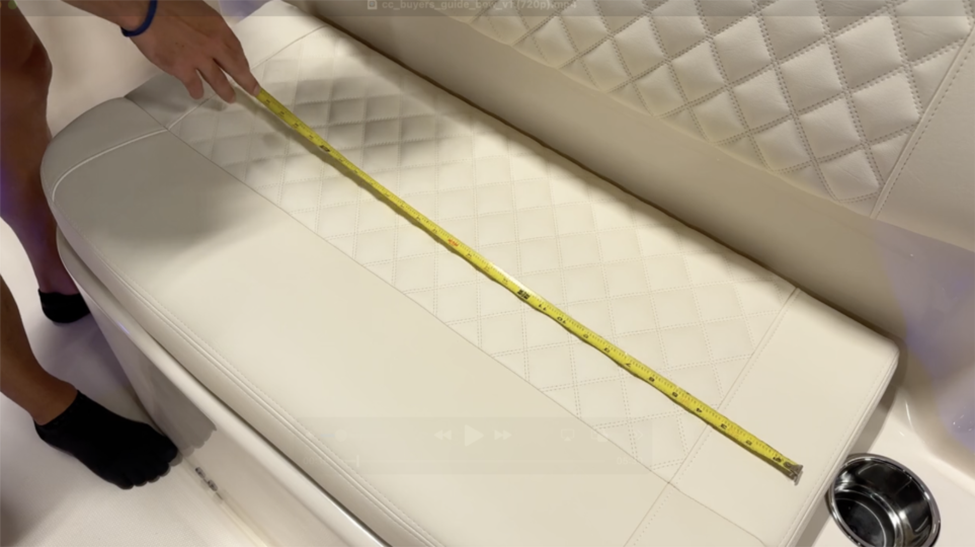
When it comes to the seat themselves, you should ask yourself how many bottoms you need to accommodate -- and how wide are they? Actually, shoulder width is greater than that of the bottom, but it's good to think of both. The width of most peoples' hips runs from about 12" (30.48 cm) (5th percental) to 16" (40.64 cm) (95th percentile) according to NHANS (National Health and Nutrition Survey). Shoulder width runs from 18" (45. 7 cm)to 22" (55.8 cm) for most American male adults 50 to 59 years old.
In seats such as jump seats at the transom, bottom breadth is the key consideraton, because thee is plenty of shoulder room. With leanding posts and settees, shoulder width is the controilling factor for comfort.
Seating Configuration
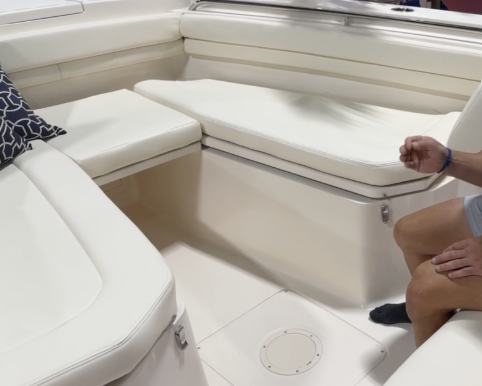
Virtually all modern center consoles have port and starboard bow bench seats. "Family-friendly" models often have backs permitting forward-facing lounge-style seating with legs forward. These seats work fine in smooth water or light chop—however, sitting there at 30 mph in 2–3-foot chop can be uncomfortable or dangerous, particularly for small children. We have seen videos of small children being bounced out of a center console’s bow seating.
The most comfortable place in any center console or small boat is at or behind the helm. Count seats or leaning positions at and behind the helm to know how many passengers can be comfortable offshore.
Seating is where many buyers make critical mistakes by undervaluing its importance. For fishing-focused boats, you want sufficient seating for two to four people without sacrificing fishing space or adding unnecessary weight. For family-oriented boats, comfortable seating becomes paramount—where many center consoles are not optimal for the intended use.
That is why the new breed of large center consoles that a few American builders have introduced the last several years are full of seating.
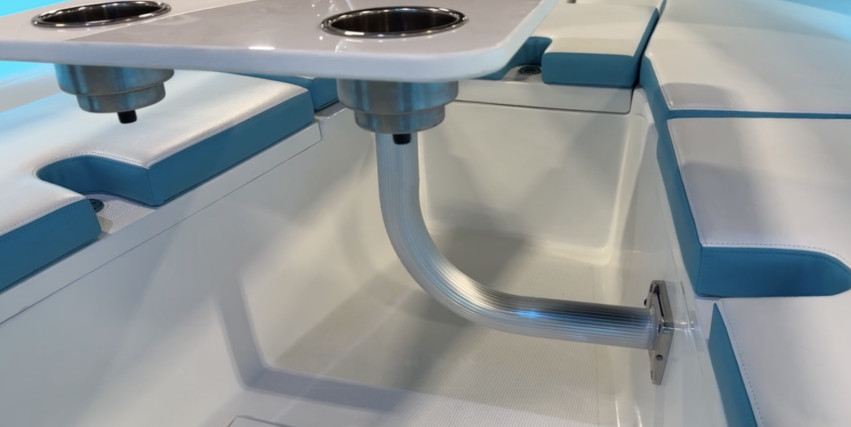
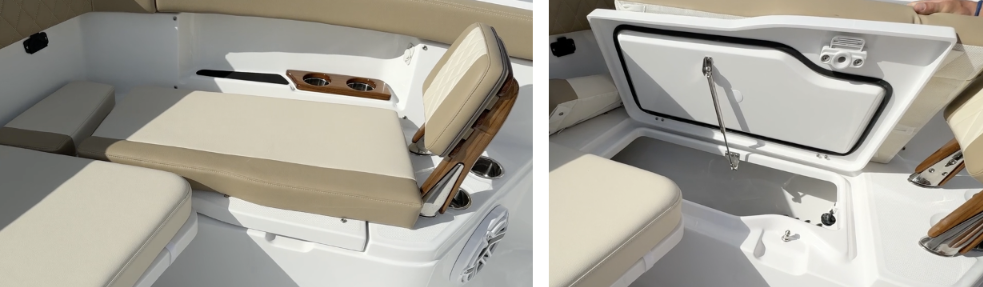
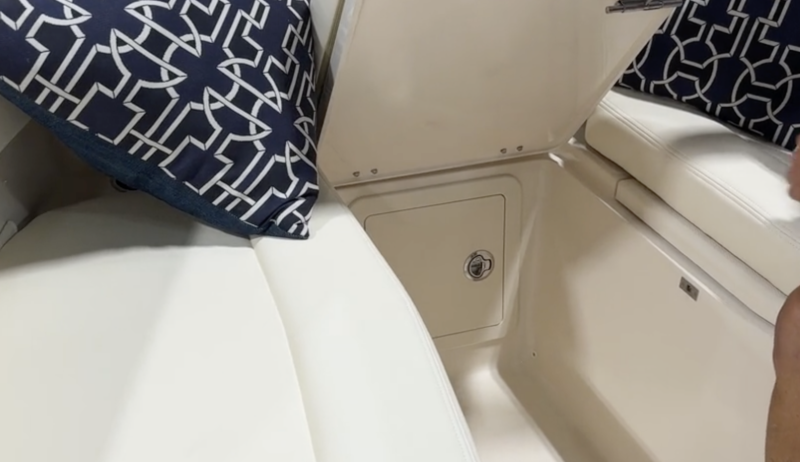
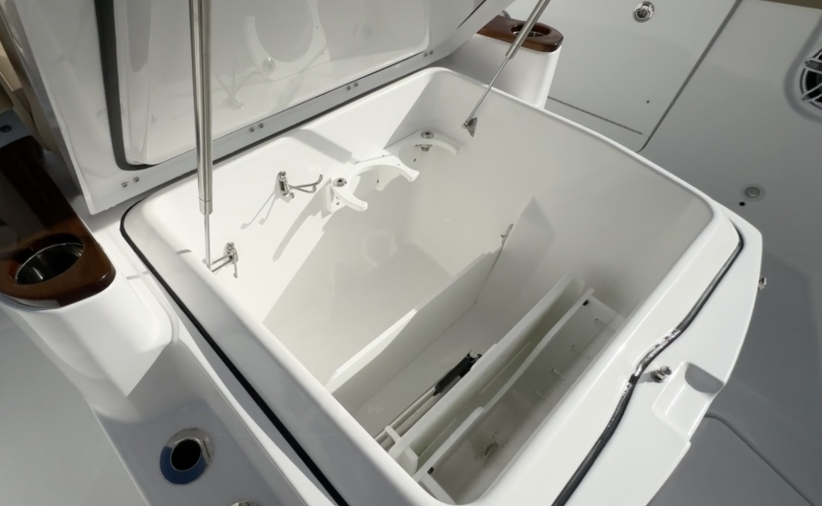
This bow seating latch is one the best one ever seen because of its ease of unlatching. Note the rubber gasket to keep water out, and the insulation in the bottom of the seat which allows this compartment to be used as a fish box.
Quality and Comfort
Quality matters as much as quantity. Look for seats with adequate cushioning (at least 3 inches of closed-cell foam), proper internal drainage, and secure mounting. Flip-up bolsters at the helm are essential for standing while running in rough conditions, and forward-facing lounges should have bolsters or backrests adequate for offshore running. Make sure the bolsters are comfortable to lean or sit upon – many are not.
Hand Holds: ABYC standards call for hand holds in every seating location—but that doesn't mean you'll find them by every seat in every boat. ABYC standards are just that—standards, not USCG or industry requirements. There should also be hand holds on the back of helm seating, as well as on T-top support structures.
Power-to-Weight Ratio and Performance
Over 25 years of testing, our experience is that 95% of the boats have the right power for the job. In a few cases of bay boats the boats were so over-powered to be dangerous, and in a couple of cases the boats were too heavy for the power provided. But mostly, the builders get it right. Further, with the power available, altering the prop geometry can make the boat go faster, or get on plane faster, whatever is needed to fix a perceived problem.
Understanding the relationship between power and weight is crucial for achieving desired performance. To reach 45 mph with two people aboard, a boat needs approximately one horsepower for every 17 to 25 pounds of total weight (boat, fuel, gear, water, passengers), depending on beam, deadrise, bottom design, and other drag factors. We commonly use 18-22 to 1 as a rule of thumb. Be suspect if the ratio is at either extreme.
BoatTEST Case History
Example: A 23-foot center console we tested weighed 4,700 pounds dry with engine. With two 200-pound occupants, 90 gallons of fuel (540 lbs), 9 gallons water (72 lbs), carry-on ice chest with beverages (40 lbs), plus 50 pounds gear, total weight was nearly 5,800 pounds—typical for 22–24-foot center consoles.
Test Results: Powered by 250 HP single engine with standard 3-blade prop:
- Top speed: 48 mph
- Most economical cruise: 26.8 mph at 3,500 RPM
- Fuel consumption: 9 GPH
- Fuel economy: 2.98 mpg
- Range: 268 statute miles with 10% reserve
- Weight-to-power ratio: 23.2:1
The boat could carry several more passengers and still travel at 40 mph or so top speed, and over 20 mph at best cruise. We would say this boat was dialed in for economical overall operation. But if the owner wanted to carry more people on full tanks, more horsepower would be needed to be comfortable getting on plane easily.
Is There a Need for Speed?
Relatively low-priced fuel in the U.S., a competitive culture where owners want to go faster than peers, plus outboard makers selling horsepower, have always made speed important for center consoles. Starting about 15 years ago, engine makers built ever-higher horsepower outboards to propel express cruisers, large dayboats, and ever-larger and heavier center consoles.
The new, large outboards make boats more expensive to buy and maintain. Before deciding on how many engines and horsepower you need, determine how fast you really need to go, and how many passengers you will regularly carry. The order the appropriate horsepower.
The Proper Prop
Most modern center consoles reviewed by BoatTEST in the last couple years have been powered and propped to achieve top speeds of 45-65 mph range, depending on boat size and type. For that reason, props are typically 3-blade high pitch units. These boats also sometime struggle to get on plane at 3500 RPM.
If top-end speed is not your thing, consider propping to get on plane faster, and loping along in the 25 to 35 mph range, with better fuel economy.
Caveat: Some builders, in an effort to keep the price of their boats down, will power on the “edge.” That is to say, the power is adequate for a few passengers in the beginning, but over time the boat will get heavier, and the engine will lose some of its power, and overall performance will drop. Then the boat will be under powered at resale time.
The Helm
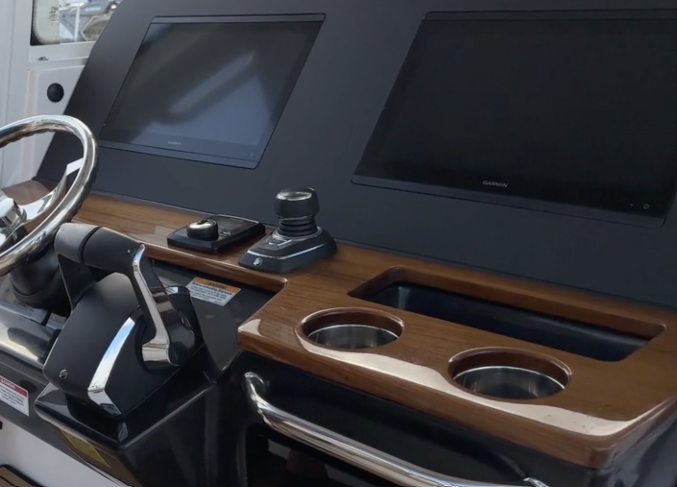
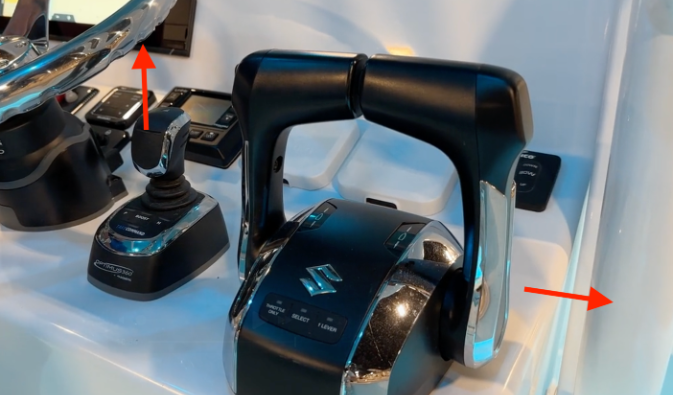
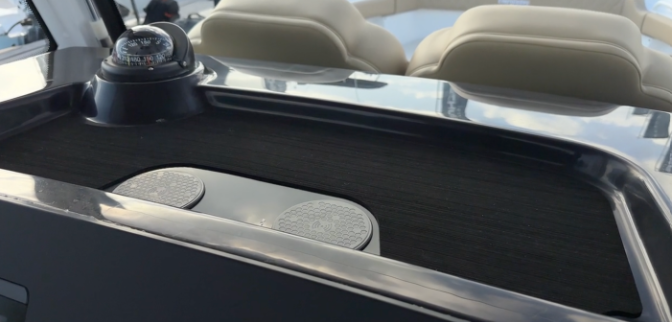
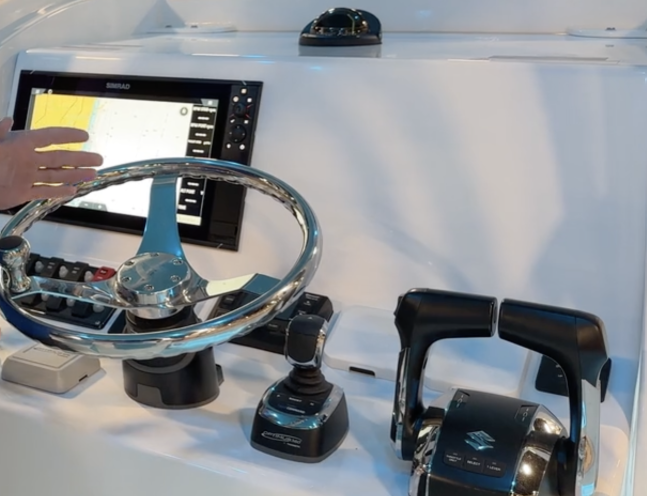
Like everything else in any boat, the helm in a center console is a compromise, and not all builders take the same path -- therefore consumers must study the console itself before buying. First, the beam of the boat is the most controling factor. The standard beam for most trailierable boats is 8'6" (2.59 m), because boats with this beam can be trailored in all 50 U.S. states without a spoecial permit.
Bay and flats boat will often have less beam, more on the order of +/- 8'0" (2.43 m), while 45' (13.71 m) may have beams as wide as 14' (4.26), or more. Moving inboard from the rubrail, the gunwale cape rail, side deck width, and whether or not the T-top supports are bolted to the deck outboard of the console, will determin helm console width. will determin how wide the helm console can be, side-to-side to side.
While boats can be longer or beamier, adult human beings' physical deminsions are not so diverse, particularly in the U.S. where they tend to be on the large size. According to the National Health and Examination Survey (NHANES), the average height of an American male 50 to 59 years old, is 5'8-1/2" (174.2 cm), and his weight is 203.0 lbs (92.1 kgs.) -- in the 5th to 95th percentile. These averages stay the same for a human on a 16' (4.87 m) bay boat with 7'6" beam (22.8 cm) to 14'0" (42.6 cm) luxuary center console crossover.
And, that's the rub: How to fit a small boat to a relatively large 50-59 year old American male. The smaller the boat, the harder it it is.
The shoulder width of our average NHANES made stretches from 18.07" (459 mm) for a person in the 5th percfentile to 22.32" (567 mm) for a male in the 95th percentile. That means -- ideally -- that the two symetrical side decks of a center console, should be 22" x 2 = 44" (1117 mm) wide in order to comfortably be able to handle 95% of the boat buyers. With 1' (254 mm) on each side for the rub rails, and 3"( 762 mm) on each side for the cap, on an boat with an 8'6" (2.59 m) beam, and 22" (558.5 mm) for each of the side decks, we have exactly 50" (1270 mm) left for the width of our helm console.
Where is the compromise -- in the side decks, or the helm width? BoatTEST's experieince after measuring hundreds of center console boats, is that side decks are where the compromises occurs. That makes sense, because the width of the side decks only is crucial when an angler is working a fish and must go forward or aft. In the big scheme of boat usage, that won't be often -- while the owner/operator, and a companion will be seated or leaning, at the helm most of the time.
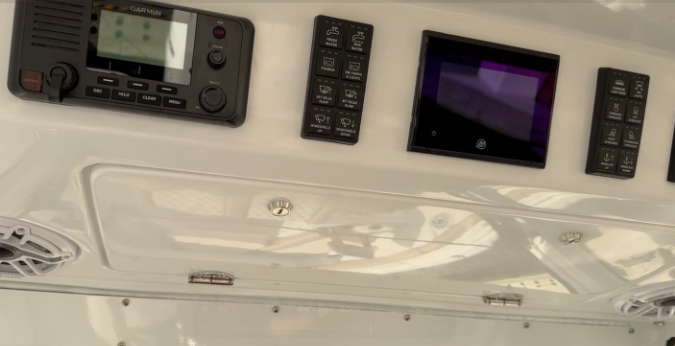
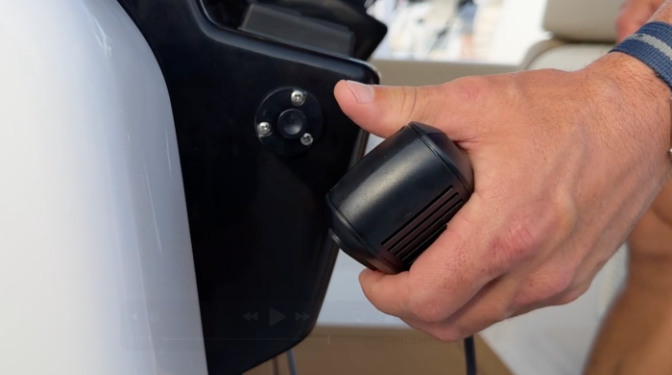
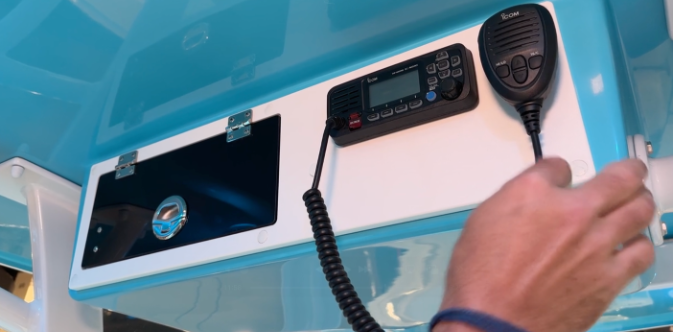
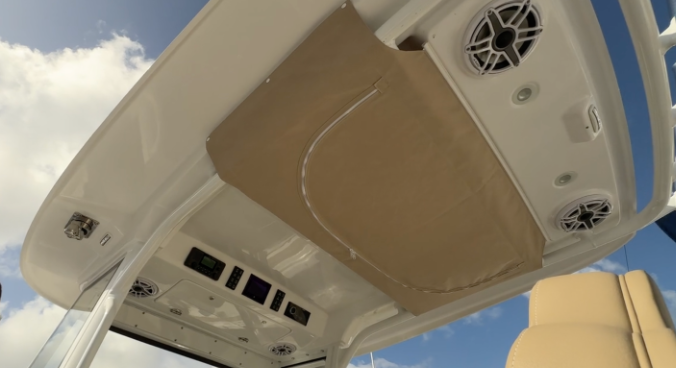
More compromises: Virtually all center consoles must have T-tops to protect against UV, and to some degree, rain. Integrating the aluminum support structure into the helm console is very expensive, and generally only preium builders do it. It is far less costly to anchor the four support legs of the top on the deck. And, that's what virtually all of the lower priced boat builders do. These structures cut down on the side deck clearence during those brief moments when they are fighting a fish around the boat.
Trouble is, that some builders simply just screw the supports into the fiberglass deck and core material. This is trouble waiting to happen, and consumers should satisfy themselves that the T-top suppoort legs are through-bolted to the deck.
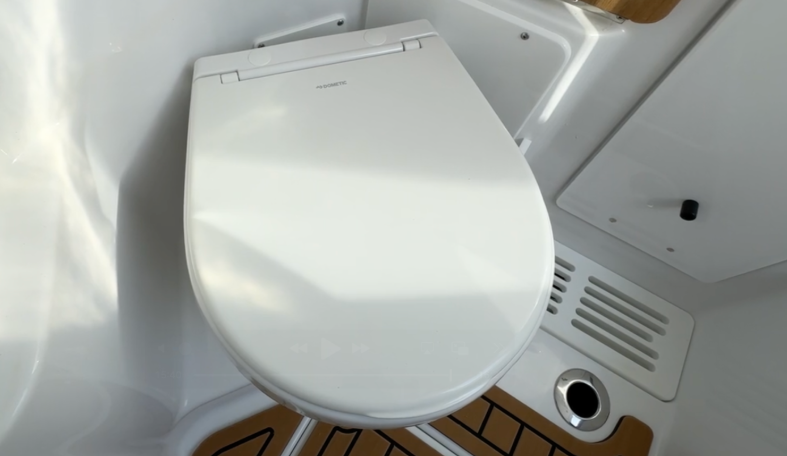
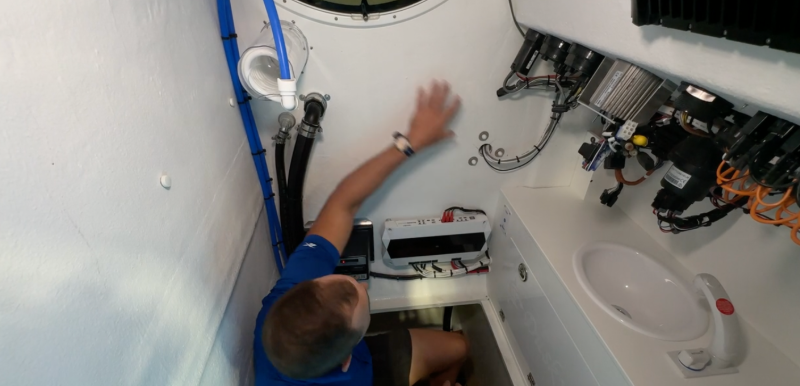
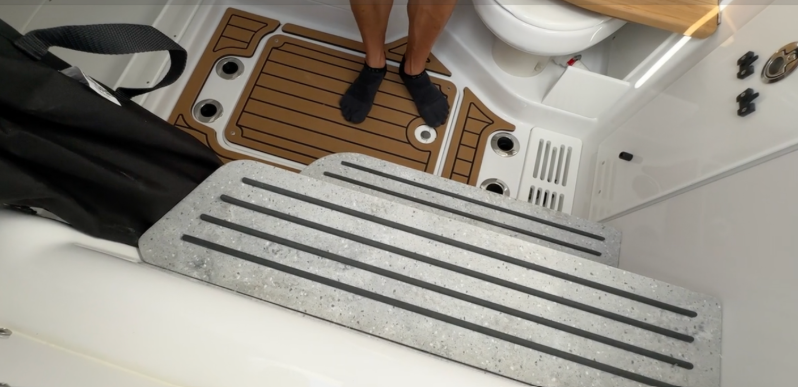
The Head Compartment: Essential Considerations
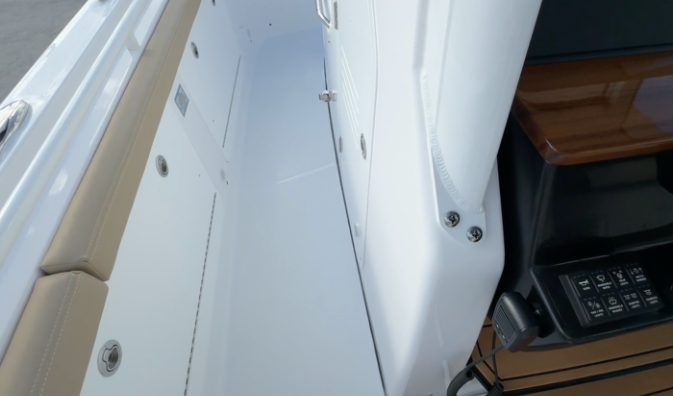
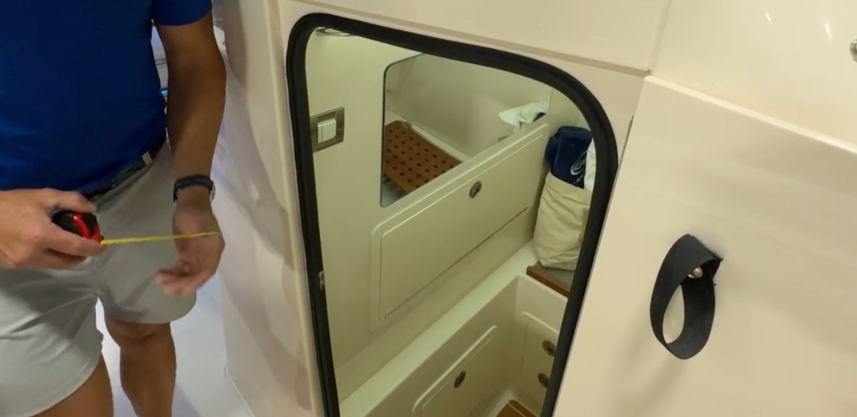
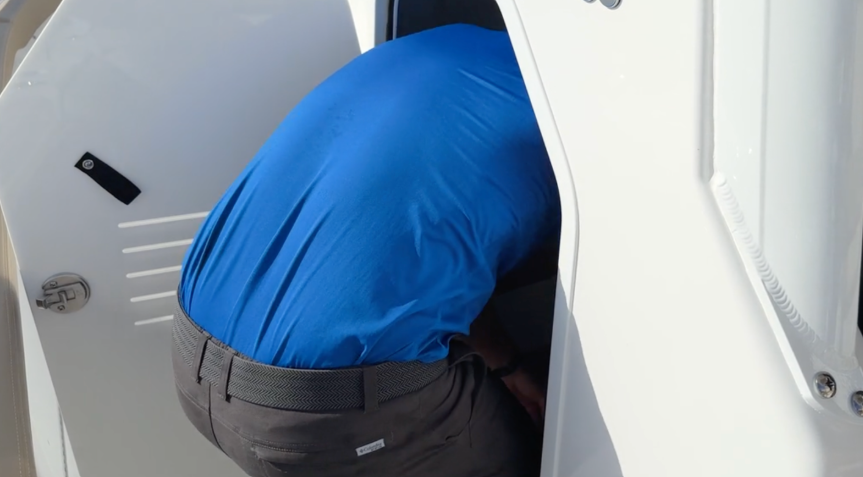
Virtually all center consoles over 20 feet have compartments in the center console. In all cases these are used for storage, but as boats get larger, console space takes on added utility. For boats under 25 feet, head compartments often have portable toilets available—adequate for emergencies but not comfortable for extended use. Once used, they must be dumped and cleaned after every outing.
Once you move into the 26–30-foot range, compartments usually have optional flushing electric toilets with holding tanks. This feature greatly enhances boat utility, and we think it's a must for truly "family-friendly" vessels.
A properly designed head compartment should be at least 30 inches wide and deep enough that an average adult can sit on the toilet without hitting their head on the overhead. Better installations may include shower systems.
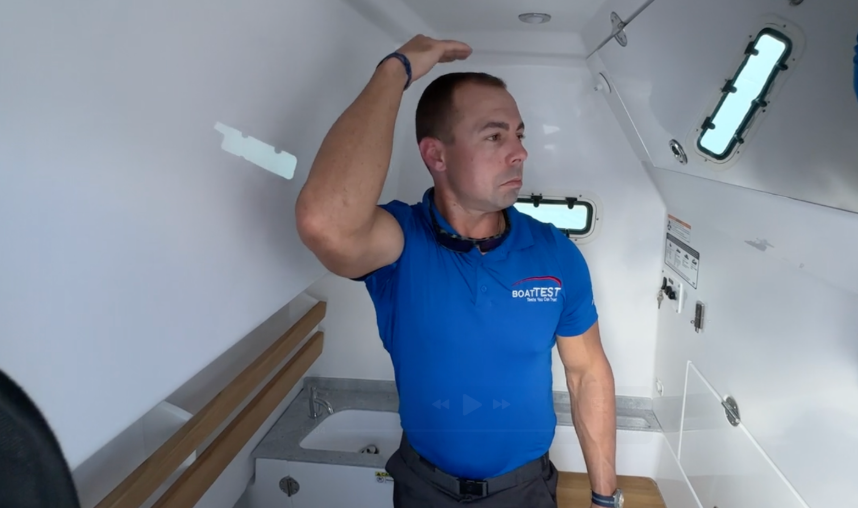
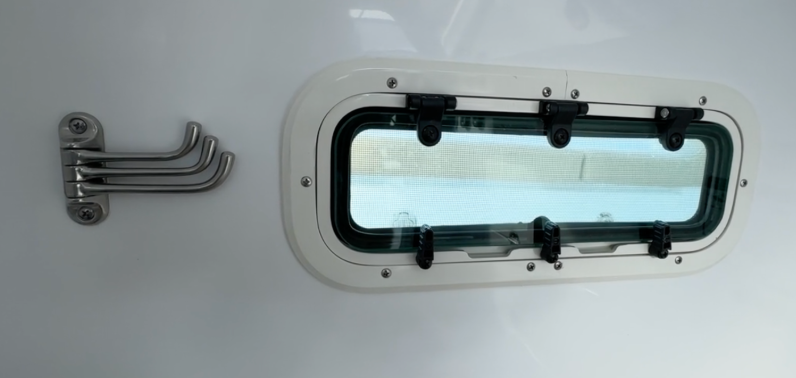
Premium center console compartments will have door locks, sinks with freshwater, lighting, mirrors, small shelves or cubbies, opening ports, extraction fans, protected toilet paper holders, storage compartments, deck drains for showers, and access to back of electronics panels.
Caveat: Getting into and out of head compartments is a detail that separates better designs from just adequate. Side doors on center consoles are notoriously hard to get through. Before buying a boat, make sure you can easily get into and out of the head.
Ground Tackle Considerations
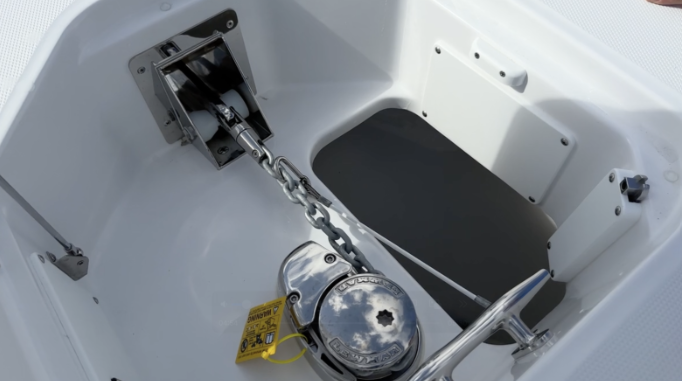
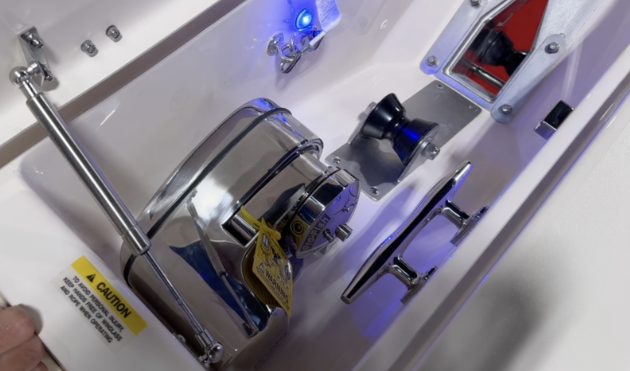
Virtually all boats should have an anchor and line, for safety reasons, but usually only builders of premium boats make ground tackle part of the basic boat. Anchors and line are safety gear to keep boats from being blown onto a lee shore, or out to sea. Anchors should be chosen based on the weight of the boat, and the bottom conditions where the owner plans to anchor most often. Whether rope of chain or a combination of both will depend on each application.
Increasingly, bay and flats boats are using power poles for becoming stationary in skinny water. Buyers planning on installing a power pole in the aftermarket should make sure the boat is wired from them at the factory. But a power pole does not eliminate the need for a conventional anchor – remember it is a safety item.
“Fishability” – Important Details for Anglers
“Fishability” refers to the functionality of the design, features and equipment to aid anglers in quest of their prey. These are the most basic elements of center console design, and all well-found boats, no matter what their price point or size, will have most of them. They are—
1. Bow and Stern Casting Decks
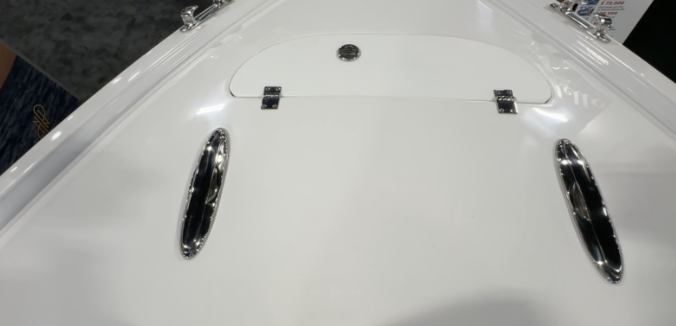
The center console was first conceived as a fishing boat in which an angler could work a fish 360-degrees around the boat. After that basic functionality, the next most important are the casting decks – bow and stern. In bay and flats boats these will usually be a large foredeck that is relative flat and large and a stern platform, often made up of seats that fold down to make a continuous fiberglass casting area.
In coastal and offshore boats the forward casting platform is typically composed of port and starboard bench seats with a fiberglass filler between them to create a trapezoidal platform that is raised off the deck. Typically, there is no stern platform and the aft cockpit services as the casting platform.
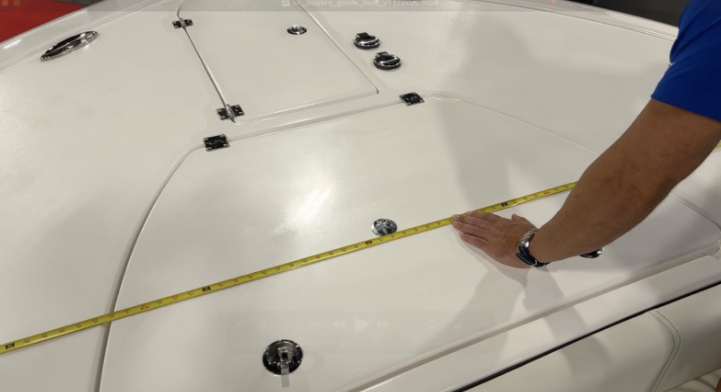
2. Bow and Stern Cockpits
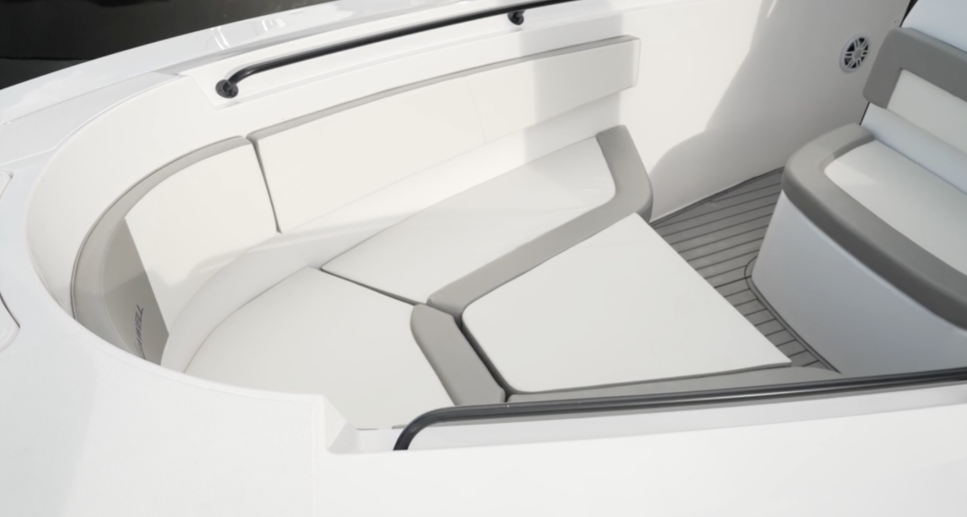
Coastal and offshore center consoles use their stern cockpit as the primary casting. That is why its size is vitally important. While the beam of the boat will dictate the width of the cockpit, the fore and aft dimension of the cockpit is equally important. As more seating and creature comforts are added to the boat, typically they will creapinto the fore and aft length of the aft cockpit. Buyers must be careful to make sure there is enough fore and aft room in the aft cockpit for anglers and crew to pass buy without disturbing an angler with a fish on.
Coastal and offshore center consoles usually have the ability to use either a raised platform between the forward seats or the cockpit deck as a casting deck. Whether one or the other is chosen is up to the angler involved, the sea conditions, the specie of fish being sought, sea conditions, and the degree of comfort want by the angler. Safety is of primary concern in all cases, because it is easy to fall out of a boat in certain sea conditions,
3. Rod Holders in the Gunwales
The number of in-gunwale rod holders is up to the boat’s owner and how many anglers will be aboard and the aggressiveness wanted. Most bay and inshore anglers will be casting their lines, so only a few rod holders are needed for storage as much as anything. Coastal and offshore anglers will generally want to present as many baits as possible without tangling lines. With spreaders, it is not unusual to see as many as nine lines in the water, therefore their must be at lease 9 rodholders.
4. Rod Racks in the Gunwales and Elsewhere
Traditionally, many center consoles have been designed to have racks for fishing rods in the gunwales of the boats. Typically, they are on both sides and number six in total. The advent of side doors now eliminates the racks on boats with them. Other locations for storing rods are often vertically in the center console compartment, or under the foredeck, in a coffin box and sometimes even in some of the seat compartments.
5. Livewell(s)
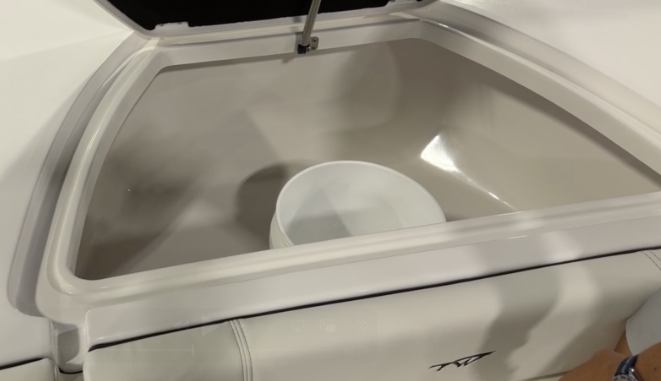
Livewells are installed for keeping bait alive and have evolved over time to be larger, pressurized, and even to have “picture windows” in the side so anglers can keep an eye on the baits. Bait wells come in all different sizes and anglers should be sure that the boat they buy has livewells are large enough for the bait they plan to use. Some boats have two livewells in order to be able to have different species of bait. Most all builders make sure their livewells are blue with rounded corners and are aeriated. All must be able to drain, and many builders fit the drains with macerators.
6. Fishbox(s)
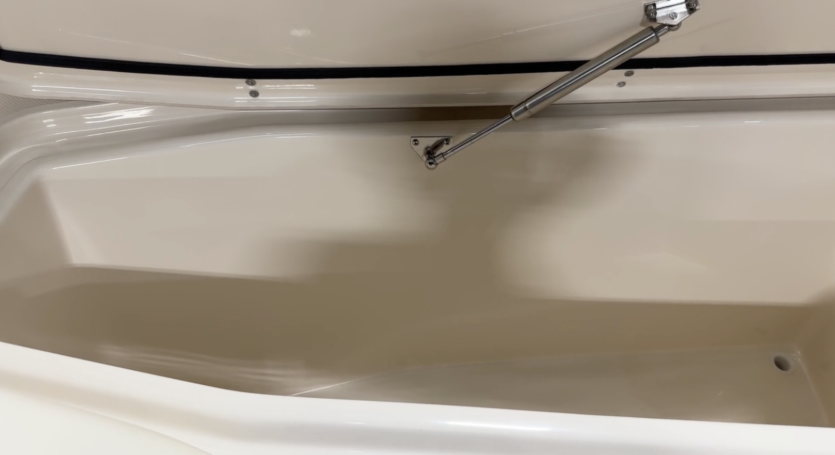
Fish boxes built into the boat eliminate the need for anglers to bring aboard ice chests in which to keep captured game. Fish boxes may be located in numerous places in the boat, and should be insulated and self-draining. Some builders put macerators in the drains.
7. Rocket Launchers
Rocket launchers are typically mounted on the aft edge of a T-Top, on the T-top supports or even on larger boats, in a pedestal-mounted horizontal rack placed in the cockpit. They also double as storage racks.
8. Tackle Box Storage
Carry-on tackle boxes have never been popular with center console anglers, and builders have been carful to create compartments that will hold standard plastic tackle boxes. Buyers should make sure that there is enough space for the tackle they want to use.
9. Bait Prep Boards or Counters
All center consoles used for fishing, even casual fishing, should have a horizontal surface on which to prepare baits. Some builders have been quite creative in making transom hatches serve double duty as cutting boards.
10. Storage for Gaffs, Brushes, Retrieving Nets, Casting Nets, and Tools
When buying a boat, it’s easy to forget that there is more to catching fish than just the rods and reels. For large gamefish, gaffs are needed along with nets for all other size fish. Virtually all fishing boats need a place to stow nets, brushing to clean the deck and a dedicated place for tools.
11. Provision for Spreaders
Most serious offshore anglers rig their boats with spreaders mounted on the T-Top. Virtually all builder mold in pads for the mounting of Taco spreaders. Spreaders should be the telescoping kind so that they can be lowered and placed out of the way when not fishing.
Live Wells: Capacity and Configuration
Livewell requirements vary dramatically based on target species and fishing style. Tournament bass fishermen need large, well-oxygenated wells to keep catch alive for weigh-in, while offshore anglers might need only small wells for keeping baits lively or may skip wells entirely in favor of frozen bait.
For serious inshore fishing, plan on at least 24-30 gallons of total livewell capacity. Some anglers will want two baitwells of a large one with a partition in order to keep two different species of bait. Each well should have dedicated pumps (minimum 800 gallons per hour), timer systems, and both fill and drain capability. Round wells are superior to rectangular ones as they create better circulation and have no corners where fish can become trapped.
Offshore boats often feature smaller livewells (15-25 gallons) primarily for keeping bait alive. In some cases, pressurized raw water washdown systems serve double duty, allowing you to fill a bucket or cooler as temporary bait well when needed. Some hardcore offshore boats skip livewells entirely, instead maximizing fish box capacity.
Fish Box Capacity and Design
Fish box size should match target species and fishing style. A 23-foot inshore boat might have a single 40-gallon fish box adequate for a day's catch of redfish or speckled trout. Offshore boats in the 30–40-foot range often feature 150-300 gallons of total fish box capacity spread across multiple boxes.
Location matters as much as size. In-deck fish boxes are preferred over transom boxes as they're easier to access, drain more efficiently, and don't affect boat running attitude when loaded. The best installations include dedicated overboard drains and macerators, thick insulation to keep ice from melting quickly, and dividers to separate different species or create slush areas for immediate icing.
A critical but often overlooked factor is insulation coefficient. Quality fish boxes use at least 2 inches of closed-cell foam insulation on all six sides. Lesser boxes use thin insulation or leave deck undersides uninsulated, meaning ice might melt in hours rather than lasting all day.
An alternative in larger boats are cold plates. These require generators or banks of lithium-ion batteries and are costly. For most anglers, ice and proper fish boxes are most economical and trouble-free.
Tackle and Rod Storage
Inadequate rod and tackle storage is one of the most common complaints from boat owners. Typical boats have too few rod holders, forcing anglers to lay rods on decks where they get stepped on or be a tripping hazard.
A well-designed center console should have horizontal rod storage under gunwales for four to six rods, with individual tubes or channels to prevent tangles. Vertical rod holders (minimum of six) should be positioned around cockpit perimeter for active fishing. Additional rocket launchers on T-tops or hard tops accommodate another six to eight rods for trolling or storing rigged rods.
For tackle storage, look for a minimum of two dedicated tackle centers with multiple drawers and adjustable dividers. These should be positioned where they're accessible while fishing but protected from spray. Additional storage compartments for leaders, terminal tackle, tools, and spare parts should be part of the design.
And don't forget a place to prep baits. This can be as simple as cutting boards placed on transoms, or as elaborate as dual-use bait prep counter and food prep areas with grills.
Safety: Design, Flotation, and Dewatering
Virtually all boats built today, regardless of size, have hulls that won't fracture, delaminate, or otherwise fail. That is the last thing consumers should be concerned about.
Premium boats tend to have more and stronger stringers, allowing hulls to take more punishment with reduced deflection and less gelcoat cracking. But cases of lightweight, budget fiberglass boats failing are almost nonexistent.
Critical Caveat. All center consoles are open boats. All open boats going offshore risk shipping water in challenging conditions. This doesn't mean they're unsafe, but it does mean they're vulnerable in rough water, particularly with inexperienced or inattentive operators.
Two Rules for Safe Open Boat Operation
Rule #1: Keep water out of the boat.
Rule #2: If water gets in, get it out quickly.
Level Flotation (Under 20 Feet)
The USCG requires all powerboats 20 feet or less with 2+ HP engines to have level flotation if swamped—supporting their own weight plus rated passenger capacity. This doesn't mean boats will float right-side-up (free surface effect causes turtling), but occupants (wearing PFDs) can cling to overturned hulls until help arrives.
Caveat: Builders self-certify that boats 20 feet or smaller meet USCG level flotation requirements. Sadly, we've read of several boats sinking that shouldn't have happened, meaning they weren't actually compliant. A consumer's only safeguard is ultimately builder integrity—and that is why we recommend only name brands.
Level Flotation (20 Feet and Over)
We know of only three builders of boats over 20 feet that place enough foam in boats, and in the right places, to allow them to float level if swamped. Historically, those brands have been Boston Whaler, EdgeWater, and Everglades. But with advent of gyro-stabilizers and required generators, some of their models may no longer have foam capacity required for level flotation. Check with builders before buying to find out.
Why don't all boats have enough foam flotation to float level? The reason is that to displace the cubic feet necessary with foam -- space equivalent to cockpit volume to point of lowest coaming height -- would have to be found and filled between hull and deck or boat liners, plus account for engine weight.
That means interior storage space would be greatly reduced, and open space below deck for mechanical equipment would be largely curtailed. This causes other problems and limits boat utility in other ways, such as the gyro-stabilizer example. For these reasons, in addition to added cost, most builders, including premium boat builders, do the best job they can with "basic flotation."
Basic Flotation
This type of flotation means boats are buoyant enough to support all their own weight, including engines, and if swamped, still have some part of hulls above water. This is not a USCG or ABYC requirement or standard, but it's generally considered "best practice" by the boating industry. Reputable builders ensure their boats have basic flotation, and they self-certify.
There are enough examples of center consoles being swamped and having parts of boats poking above water for us to believe this is generally done by nearly all major U.S. builders.
Freeboard Matters
Freeboard is the distance from the water’s surface to the top of boat’s coaming. It's always higher forward than at stern. There are no direct requirements for freeboard height, but to be sold in Europe, center consoles must meet stability standards outlined in ISO (International Standardization Organization) standards required for CE (European Conformity) approval.
ABYC standards of 24-inch cockpit depth and requirements that self-bailing cockpits have scuppers at least 1 inch above waterline mean freeboard aft on center consoles should be at least 25 inches. But in practice, most bay, flats, and inshore powerboats have cockpit depths less than 24 inches for practicality reasons. Because these boats are "inshore" where conditions are essentially flat to non-threatening, and these boats are more for light-tackle anglers, low freeboard on these boats is typical.
Cockpit depth in boats going offshore is another matter. Here, we subscribe to ABYC minimums which are 24 inches on "weather decks." This height also makes it safer for young children when aboard. The larger the boat, the farther offshore it goes, the deeper cockpits should be in our book. We like cockpit depths in these size boats of 26 inches, with 28-30 inches being ideal, more up forward, depending on vessel mission.
Dewatering Matters
The second part of the equation is getting water out once it comes in. Typically, center console boats have drains in port and starboard quarters of aft cockpits. Usually drain pipes are 1.5 inches in diameter, but flow is restricted by openings in plates. Most boat scuppers are intended simply to drain rainwater and freshwater during washdowns. Larger, better-built boats from premium brands have 2-inch drains and often two in each quarter. These boats are more likely to meet ABYC standards for time it takes cockpits to drain.
The ABYC H-27 standard states: "The cockpit shall drain at a rate such that with all drains open, the level of water in the cockpit will not rise when water enters at a rate of 5 gallons per minute per square foot of cockpit deck area."
Five gallons of water per square foot means water would be almost 8 inches deep all over the deck, and that would have to completely drain out through scuppers provided in aft quarters of cockpits in one minute to meet ABYC standards. Think about it.
Many center consoles, particularly larger ones, have transom doors, which can be good ways of quickly dewatering boats in emergency conditions. However, most transom doors open in, not out. Those that open out can be unlatched quickly if green water comes aboard for quick dewatering. Thankfully, need for such extreme dewatering is rare.
Bilge Pumps
Bilge pumps on most center consoles are designed for light work, such as handling rainwater, washdown water that seeps through deck hatches, or weeping hoses or plumbing joints not properly tight. Bilge pumps in center console boats ideally should be in sumps, something often found in very best boats, and certainly in lowest parts of bilges in any case.
Float switches are notorious for getting stuck open or closed, so pay attention to what the builder has done to ensure proper operation of bilge pumps. If an automatic bilge pump is not working, a boat can sink from rainwater seeping in through hatches and other locations in the deck.
Choosing the Right Tow Vehicle
Buying a center console boat is only part of the process—how will you move the boat, and will you need a tow vehicle? In addition to determining how much boat you can afford, you must also decide how much tow vehicle you can get into your budget. Or, if you already have a truck or large SUV, perhaps you should limit your new boat purchase to vessels with a weight your current vehicle is suited for.
If planning on towing a boat to launch ramps, be aware of how much your boat weighs loaded, and how much weight your tow vehicle is rated to tow.
Expert Recommendations for Tow Vehicles
1. Never Max Out Your Truck's Capacity
The 75% Rule is Not Optional. We've seen too many situations where trucks towing at maximum rated capacity experienced problems: overheating, brake fade, excessive wear, and dangerous handling. Operating at 75% of maximum provides crucial safety margins and extends vehicle life.
2. Buy More Truck Than You Think You Need
Boat owners typically upgrade boats every 5-7 years, and they usually go larger. If you're towing an 8,000-pound boat now, you'll likely be towing 10,000-12,000 pounds in five years. Buying trucks that can handle your next boat saves you from needing to upgrade twice.
3. Diesel Makes Sense Above 9,000 Pounds
Below 9,000 pounds, gas engines are adequate and more economical overall. Above 9,000 pounds, diesel's torque advantage, better fuel economy, and superior towing characteristics justify higher cost if you tow regularly.
4. Don't Neglect Trailer Maintenance
We've seen more towing problems caused by trailer issues than truck issues. Bearings, brakes, tires, and lights must be maintained religiously. Budget $400 per season for trailer maintenance.
5. Weight Distribution Matters
Above 10,000 pounds total weight, weight distribution is a must. Proper setup (ideally by professionals) is critical. Don't rely on generic instructions—every truck-trailer combination is unique.
6. Factor in Payload, Not Just Towing Capacity
We see this mistake constantly: buyers focus on towing capacity while ignoring payload. With four adults, gear, and 1,500 pounds of tongue weight, you can easily exceed payload on trucks with adequate towing capacity. Always check both numbers.
7. Test Drive Loaded
Don't buy tow vehicles based on how they drive empty. If possible, test drive while towing boats similar to yours (some dealers arrange this). The difference between how trucks drive empty versus towing 12,000 pounds is dramatic.
Tow Vehicle Matching Chart
| Boat Weight (lbs) | Minimum Tow Vehicle | Recommended Tow Vehicle | Engine | Notes |
| 3,000-5,000 | Midsize SUV (5,000+ lb capacity) | Half-ton truck or full-size SUV | V6 or turbo-4 | Family-friendly, good MPG |
| 5,000-7,000 | Full-size SUV (8,000+ lb capacity) | Half-ton truck with towing package | V8 preferred | Truck offers better control |
| 7,000-9,000 | Half-ton truck (10,000+ lb capacity) | Half-ton truck with max tow package | V8 or strong turbo V6 | Requires max tow package |
| 9,000-11,000 | Half-ton max tow or HD truck | 3/4-ton HD truck | Diesel preferred | Transitional weight class |
| 11,000-14,000 | 3/4-ton HD truck | 1-ton truck for payload | Diesel recommended | Payload often limiting factor |
| 14,000-17,000 | 1-ton truck | 1-ton dually | Diesel required | Weight distribution hitch essential |
| 17,000-20,000 | 1-ton dually | 1-ton dually with max capacity | Diesel required, max torque | Upper limit conventional towing |
Service and Warranty
In reality, the most important aspect of any boat is having it operate when owners want to use it. With so many systems on modern boats, it's not uncommon for owners to arrive for day’s outings to discover that something isn't working properly. Sadly, this happens with new boats as well as older ones.
For that reason, we put availability of dealer service at the top of our list when buying new boats. If dealers are understaffed in service departments (most are), trying to get something fixed quickly usually leads to disappointment. The best way to avoid service problems is to buy the right premium boat in the first place, and to have your own private mechanics lined up.
You can increase your boat's reliability by:
- Limiting gadgets on it to minimum needed
- Buying premium brands
- Personally maintaining boats so you're on top of all boat systems at all times
- Having redundancy in a few key systems—2 engines instead of one, 2 GPS chartplotters, 2 bilge pumps
Warranty
Generally, premium boat brands have the most all-inclusive warranties—but they're not all the same. The best one we know of is 5 years from stem-to-stern, covering all equipment. To our way of thinking, this is the Holy Grail of warranties, and our advice is get as close to it as you can with whatever boat you buy.
The minimum for virtually all brands is one year on hulls and factory-built components. From there, warranties vary widely. Engine makers provide their own warranties, and you must ensure yours covers hydraulic pumps and digital steering gear. Read the fine print. Engine warranties vary greatly; most are 3 years, but Suzuki goes to 7 years and is factory-backed. That's what you want: factory-backed warranties, as extended service contracts administered by third parties can be problematical for both engines and boat equipment.
Virtually all outboard engine makers have "specials" from time to time with longer warranties, and to our mind, getting factory-backed engine warranties of five years or longer is good reason to buy that brand. Today, all outboard engine makers build reliable equipment.
Bringing It All Together
Selecting the right center console requires balancing multiple factors: boating environment, typical crew size, fishing style, family-friendly features (if wanted), and budget. Start by honestly assessing where you'll boat 90 percent of the time, then size boats to comfortably accommodate your typical crew plus two extra people.
Choose power appropriate for your performance goals while remembering more isn't always better. Pay attention to details manufacturers often gloss over in marketing materials. How much insulation is in fish boxes? What's actual usable storage volume? Can an adult comfortably use the head compartment? Are scuppers adequate for offshore use? These practical considerations separate boats that look good at shows from those that perform well season after season.
Finally, buy the best boat you can afford from a reputable builder. Quality construction, superior materials, and thoughtful design cost more initially but deliver better performance, greater reliability, higher resale value – and a more satisfying owner experience. A well-chosen center console becomes more than just a boat—it becomes the platform for countless memories and adventures with family and friends.
At BoatTEST, we've learned that the right boat isn't necessarily the biggest, fastest, or most expensive—it's the one that best matches how you'll actually use it. Take time to carefully consider each of these factors, test multiple boats in real-world conditions, and make an informed decision. Your perfect center console is out there waiting.
The Magnificent Eight: Premium Builders
Now that you have a good handle on the considerations you must make before selecting a center console for purchase, it’s time for you to start digging into the models available from each brand. Most premium center console builders do excellent work. Here's our take on what we call The Magnificent Eight:
Boston Whaler
Arguably the best engineering staff in the business. A Brunswick division offering big company advantages—owning Mercury and many component makers—without public company downsides. Second-largest selling center console brand despite being one of the highest-priced, testifying to factory team excellence and the brand’s enduring value and reputation.
EdgeWater
Founded by Bob Dougherty in 1990 after 30 years at Boston Whaler, incorporating his unsinkable foamed designs. Now owned by Nimbus (Sweden's most prominent builder) under serious American management that recently expanded the factory. Expected to grow with increased dealer supply.
Everglades
Founded by Bob Dougherty in 1995 after splitting from his EdgeWater partner, refining level flotation with RAMCAP manufacturing—molding high-density foam outside before glassing for quieter ride and solid feel. Now owned by veteran center console builders, arguably the most innovative production center console builder in the field.
Grady-White
Still owned by Eddie Smith, who occasionally visits to see how things are going—and they go very well, thanks to one of the professional teams in the business. This brand is probably the best aftermarket customer service in the business. Loyal dealers keep sales near the top of the 60+ builder list, despite premium prices.
Pursuit
Founded 1977 by master builder Leon Slikkers, sold 2018 to Malibu Boats (the luxury wakeboat brand that also owns Cobalt). Current president worked at Pursuit since 2006; as an engineer, he knows boats inside-out. Management maintains Slikkers' high standards and culture.
Scout
Founded 1989 and still owned by design visionary Steve Potts. Known for signature tumblehome and reverse transom designs. Leads the center console industry in carbon fiber and epoxy resin use, embracing lithium-ion battery technology to eliminate generators. A year ago launched the 670 LXS, claimed as the world's longest outboard-powered center console.
World Cat
Andrew Brown is founder and president—the only catamaran center console builder on our list. With partner Chris Brockway, World Cat acquired several premium cat builders, creating an extensive line from 23-40 feet. They pioneered the cat concept among anglers, gaining owner respect and spreading the catamaran gospel.
Valhalla
Newest premium brand (started 2019), though the Healey family (Viking Yachts owners) considered the concept for years. Viking is the premier U.S. sportfishing convertible builder, known for high quality, fit and finish, and customer service. Smallest of the Magnificent Eight at under 150 units yearly but growing fast. The brand has taken advantage of the trend of its convertible owners down-sizing.
Following is a list of all major builders of center consoles. They all have their own unique stories.
Follow BoatTEST’s daily newsletter to find out more about them.
• Albury Brothers
• Blackfin
• Blackjack
• Blackwood
• Blue Fin
• Blue Wave
• Boston Whaler
• Buddy Davis
• BullsBay
• C-Hawk
• Cape Craft
• Cape Horn
• Carolina Cat
• Carolina Skiff
• Caymas
• Century
• Cobia
• Contender
• EdgeWater
• Everglades
• Fountain
• Formula
• Freeman
• Grady-White
• Invincible
• Intrepid
• Jupiter
• Key West
• Mako
• Maverick
• Midnight Express
• NauticStar
• Nor-Tech
• Phenom Yachts
• Pursuit
• RedFish
• Regulator
• Release Boatworks
• Robalo
• Sailfish
• Scout
• Sea Born
• Sea Chaser
• Sea Fox
• Sea Hunt
• Sea Pro
• SeaVee
• Shallow Sport
• Solace (SŌLACE)
• Southport
• Sportsman
• Tidewater
• Twin Vee
• Valhalla
• Wellcraft
• World Cat
• Xpress
• Yellowfin