How to Select the Right Outboard Engine
By BoatTEST Capt. Dave East

A boat owner looking to purchase a new outboard, either on the transom of a new boat or to re-power his old reliable craft, should not rely solely on the Coast Guard capacity plate. Just because a boat has a maximum horsepower rating doesn’t mean that you should simply buy a new motor based on that rating. The old adage of buying more motor and using less of it may apply to some boats while other boats actually run better with less than the maximum rated horsepower.
Can You Choose the Outboard Brand You Want?
Once upon a time you could choose almost any brand of outboard you wanted to put on the transom of your new boat. Those days are long gone. Today, Mercury and Yamaha have signed exclusive supplier agreements with most boat brands. There are a few brands that are still independent and give boat buyers a choice of three or four brands.
If you care more about the outboard brand than the boat brand, then visit the outboard brand and find out what brands accept their engines.
You Have a Brand Option When Repowering
If you are repowering a boat that was built before the four-stroke outboards hit the market, you’ll want to take into consideration the weight of the outboard motor over the horsepower rating. The transom of your boat may not be able to handle increased weight of the outboard motor(s) of a four-stroke engine compared to the two-stroke that you may be replacing.
Check the Boat’s History to Zero-In on the Best Solution
If you are repowering a boat built before, say 2005, it can pay off for you to find out when you boat was designed and whether the builder was putting on 4-stroke or 2-stroke engines at the time. Going back to the 1980s designers of boats built for Yamaha engines took the extra weight of 4-stroke engines into consideration. Other builders intended their boats for 2-stroke engines.
Two-stroke engines had/have tremendous low-rev torque that lifts the stern and get the boat on plane quickly. 4-Stroke engines must get the revs up much farther to be able to create the same amount of torque. This is why some boats squat when beginning to accelerate.
Beware of Under-Powered Boats
In some cases, a manufacturer may be trying to hold a price point on a boat, motor, trailer package. The boat may carry a maximum horsepower rating of 175, but to keep the price low, the builder installs a 115. The boat will still perform well with the smaller motor, but you will have to operate it at the top of its max RPM range.
By opting for a larger 150 horsepower outboard, you could get the same fuel efficiency at cruise as the 115 due to the fact that the 150 can be operated at a lower RPM. Just as you should pick a category and style of boat that best fits your needs, you should also pick an outboard motor that is the best match for your boat and style of fishing.
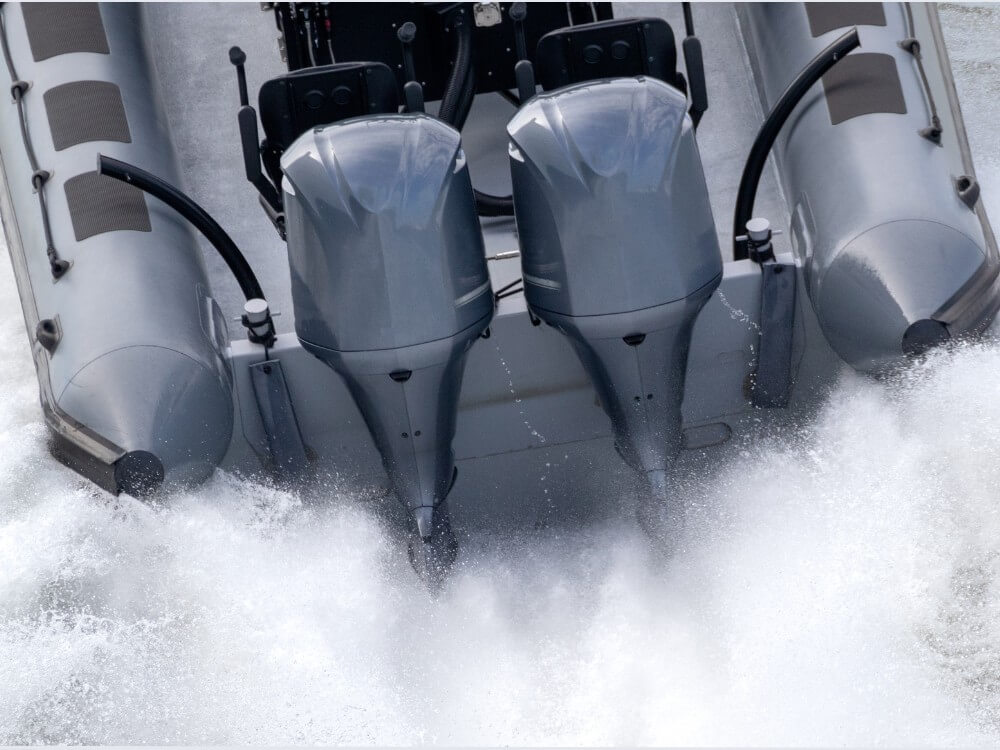
More Power for Offshore Glory
For an offshore boat, maxing out the horsepower rating is typically a good choice. These boats tend to be heavy, and anglers like to load them down with an insane amount of gear. In this instance, you want as much horsepower as you can get to plan off the boat and propel the weight. Especially in rough conditions, it takes horsepower to climb the face of a towering head sea.
Optimizing Power for Bay Boats
With a mid-sized bay boat, you’ll have the option of an in-line four-cylinder engine or a V6. Here hull design, length and overall weight will be a determining factor for which amount of displacement is right for your particular boat. A four-cylinder engine will be smaller and weigh less, when compared to a higher horsepower six-cylinder engine.
The smaller four-banger may get the job done but if you look solely at fuel economy, the larger six-cylinder engine may have the same fuel burn numbers at cruise due to the fact you’re running at a lower rpm with the larger displacement engine to maintain the same speed of the smaller engine at a higher rpm. If you buy more motor and use less of it, your fuel economy will be optimized.
(Editor: On the other hand, outboard engines have gotten very pricey. Our experience is that boats 25’ to 29’ or so, have plenty of power with twin in-line 4-stroke 200-hp engines. The money you save in fuel efficiency over the time you own the rig will probably not pay you back for the upcharge in engine iron.)
Flats Boats Are Another Matter
With a flats boat, a lightweight engine is important, especially for a technical poling skiff. Shallow draft and the ability to get into really skinny water is the mission of a true flats boat. In this application you’ll want to consider the factors of engine weight verses horsepower. Giving up a few miles per hour, at the top end, may allow the boat to float in a few less inches of water.
The weight of the outboard has to be overcome for the boat to plane off, this also contributes to how much the boat squats when you apply throttle. Up on the poling platform, the heavier the boat is, the harder it is to push around on the flats. In this case, it may not be the best choice to max out the horsepower rating.
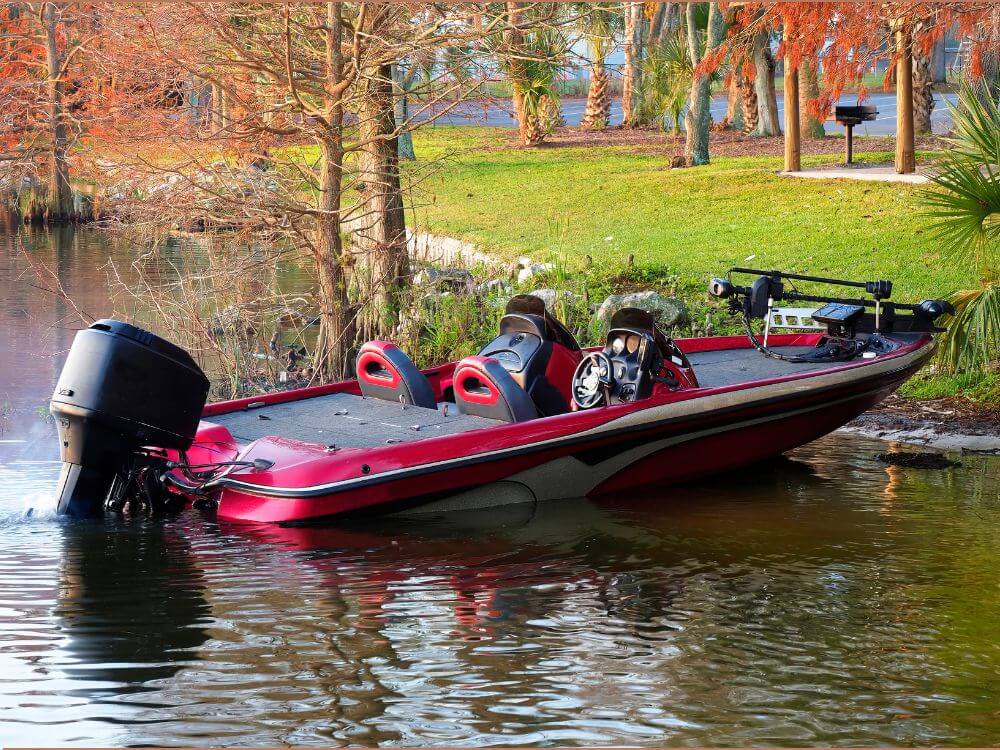
Bass Boats are in a League of their Own
Most tournament pros or pro wannabes want a rocket fast hole-shot plus eye watering top end speed. Bass boat hull designs typically have a running pad at the transom, which allows the boat to run mostly out of the water with little drag. Here, horsepower is everything.
Most bass boats squat to plane off, to the point where you lose sight of the horizon. (This is because the breed was designed in the heyday of 2-stroke engines.) You want to have the ability to power through this transition to plane as fast as you can and that takes torque. As we have pointed out, this takes lots of horsepower in a 4-stroke engine.
Most bass boat owners want also to achieve the blistering top end speeds that bass boats are capable of running. Maxing out the horsepower rating, in most cases, will be the best option. (Editor: Running bass boats at high speed may be hazardous to your health. In a recent tournament, three people were killed when a bass boat slammed into another boat at high speed. The tournament was cancelled, and no one won the $115k prize money.)
Which Brand to Buy?
When it comes to choosing which brand of outboard is best, there’s no way to answer that question without a lengthy debate. All of the major brands of outboards have similar qualities and warranty support. My advice would be to consider the dealer you would be buying from. What does their facility look like, distance from your home, and brand or brands of outboards he sells and supports?
(Editor: In this day and age, all of the brands build reliable, fuel-efficient engines. Each brand has some features that others might not have, but these advantages are often at the margin – except for warranty, and we would go for the longest one that is transferable. We are particularly impressed with the Suzuki 300 and 350 hp engines because they are the only engines in class that have dual counter-rotating props which do a far superior job of getting the torque to the water than engines with single blades.)

Dave recently retired after a 30-year career in the boating industry as a boat builder when he sold Eastern Boats after a successful run building fishing catamarans. He co-founded Twin Vee and was a designer for several other boat manufacturers and is still a marine industry consultant. He is a former boating magazine editor and has written hundreds of articles on boats, how-to guides, DIY and safety. For four years, he hosted Florida Sportsman’s Best Boat TV. Capt. Dave is a lifelong fresh and saltwater fisherman. He is a private pilot with multiple ratings and is an Open Water PADI-certified SCUBA diver. He currently owns a 22' bass & freshwater fishing boat.