Hull Vanes Can Improve Performance
By Robert Wielaard
Hull Vane BV of the Netherlands has completed a pilot project with TotalEnergies, installing its transom foils on the French energy giant’s Fast Support Vessels. (FSVs). The project, lasting several months, cut CO2 emissions by 11%.
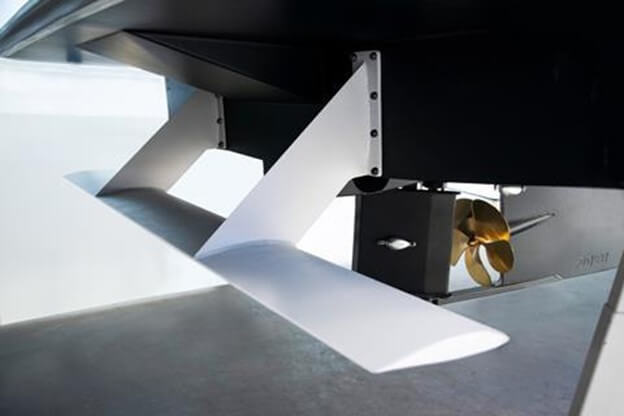
The Hull Vane is a submerged wing under the transom that cuts the overall pressure resistance of vessels. Hull Vanes go on many vessel types, from 10m to 108m – patrol and supply craft, passenger ships, recreational motor craft, naval ships, and superyachts. Some 85 Hull Vanes are in use. The ratio between new and retrofit units is about 50:50.
The pilot project was done on the Ava J McCall, a 59m (194ft) Fast Support Vessel. It transports goods and personnel to oil fields off Nigeria and is propelled by five waterjets with a combined power of just over 10,000kW. Before the project, hydrodynamic studies showed the Hull Vane would save around 10% in fuel use at 15 to 25 knots.
The Hull Vane is a submerged wing under the transom that cuts the overall pressure resistance of vessels
Transforming Vessel Efficiency
In its first decade, Hull Vane sold about 100 units, 60 on commercial and 40 on recreational craft. The Hull Vane is a horizontal wing that generates lift and forward thrust. The company said 2024 “was a banner year”.
The Hull Vane sits underneath the waterjets and does not extend the vessel’s draft, beam or length.
Upon completion, the trials on the Ava J McCall showed no effect on the ship’s Dynamic Positioning capabilities. The Hull Vane is a patented wing from the company that marked its 10th anniversary in 2024. It called 2024 “a banner year”.
On the Ava J McCall, the Hull Vane was placed beneath the waterjets and did not increase the vessel’s draft, beam or length. The fuel use data was compared with measurements after the last dry-docking, a year earlier, to erase the effect of cleaning and repainting the hull. Ava J McCall now uses 14% less at 16kt and 9% at 21kt, saving at least 250,000 litres of diesel per year.
“We are constantly looking for ways to reduce the carbon footprint of our operations, so the Hull Vane raised our interest,” said David Flajolet, marine specialist at TotalEnergies.
“The pilot project was a success. Contrary to most decarbonizing systems, the Hull Vane requires no active crew management, which is our key point. Its ability to be retrofitted for a limited cost and technical complexity make the solution a quick win for TotalEnergies.”
Worldwide, six FSVs are equipped with a Hull Vane. “All show fuel savings exceeding 10% over their operational profile,” says Hull Vane BV CEO Niels Moerke. “Hull Vanes have short payback periods ranging from one to three years for these vessels.”