Humpback Whale Spotted Breaching Inside the Potomac River
By Meg Walburn Viviano
There is a lot of marine life to see in the rivers of the Chesapeake Bay. It’s fun—but not that unusual—to catch a glimpse of river otters, rays, beavers, or even dolphins on our rivers. But it is unusual to see a humpback whale breaching the surface of the Potomac River.
Tom D’Alleva, a one-time commercial captain and sailing instructor, and his daughter, the content creator known online as Captain Boomies, were delivering a boat from Baltimore’s Inner Harbor to the D.C. Boat Show in late April when they saw something surprising.
They were traveling just inside the mouth of the Potomac at about 30 knots aboard a 43-foot Pardo yacht. D’Avella says they saw a group of birds at the surface of the water. “Then we saw this whale come charging out right where the birds were, and then falling over,” he says. “We were so shocked by it!”
D’Avella was at the helm of the boat, but his daughter quickly pulled out her phone to record. See the video above (we’re showing it to you in real time, then in slow motion to make the apparent whale more visible).
We sent the video to experts at the Virginia Institute of Marine Science (VIMS) and the Potomac Riverkeeper Network, who passed it on to Naval Facilities Engineering Systems Command (NAVFAC) and a Georgetown University biologist who studies marine mammals.
Dr. Janet Mann, a biology and psychology professor at Georgetown, launched the Potomac-Chesapeake Dolphin Project in 2015. She believes the animal seen breaching the surface in the video is a small humpback whale. “The pectoral fin and shape give it away,” she tells us. “Very, very cool!”
At VIMS, several staff members agree that it appears to be a juvenile humpback. A contact at NAVFAC, which manages the U.S. Navy’s Marine Species Monitoring program and specifically tracks humpbacks, came to the same conclusion. The NAVFAC staff member notes that the whale in the video is likely a yearling, migrating back north from the Dominican Republic.
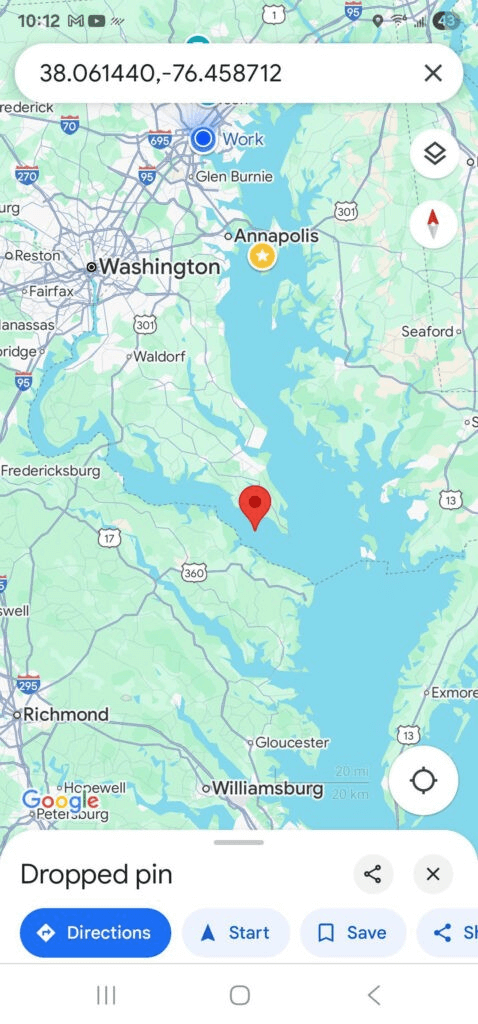
“We knew a whale didn’t belong there, it was really unusual,” D’Avella tells us. “I had seen them off the coast of Florida and in the British Virgin Islands [in the past].”
NAVFAC says they do see humpbacks as far north as the Potomac on the Chesapeake Bay from time to time.
During the thousands of hours Mann’s team has spent in the lower Potomac studying dolphins, she says they have never seen a humpback whale inside the river. It’s not uncommon for humpbacks to be spotted at the mouth of the Chesapeake Bay or just off the coast of Virginia during their migration. She wonders if the menhaden might be attracting them to come closer.
In 2016, WTOP News reported on a possible humpback caught on camera by a charter captain in the Chesapeake Bay, east of Solomons, Maryland, near the mouth of the Patuxent River.
Humpbacks migrate along the East Coast from their winter home in the Caribbean, sometimes traveling 5,000 miles.
NOAA asks that boaters stay at least 100 yards away from most whales (and 500 yards from the endangered Atlantic right whale). If you see a whale in the Chesapeake Bay, especially if it appears injured or deceased, you can report it to the Virginia Aquarium’s Stranding Response Program by calling 757-385-7575.