I Learned About Boating From That - Overboard and Alone
by Capt. Gregg Clark
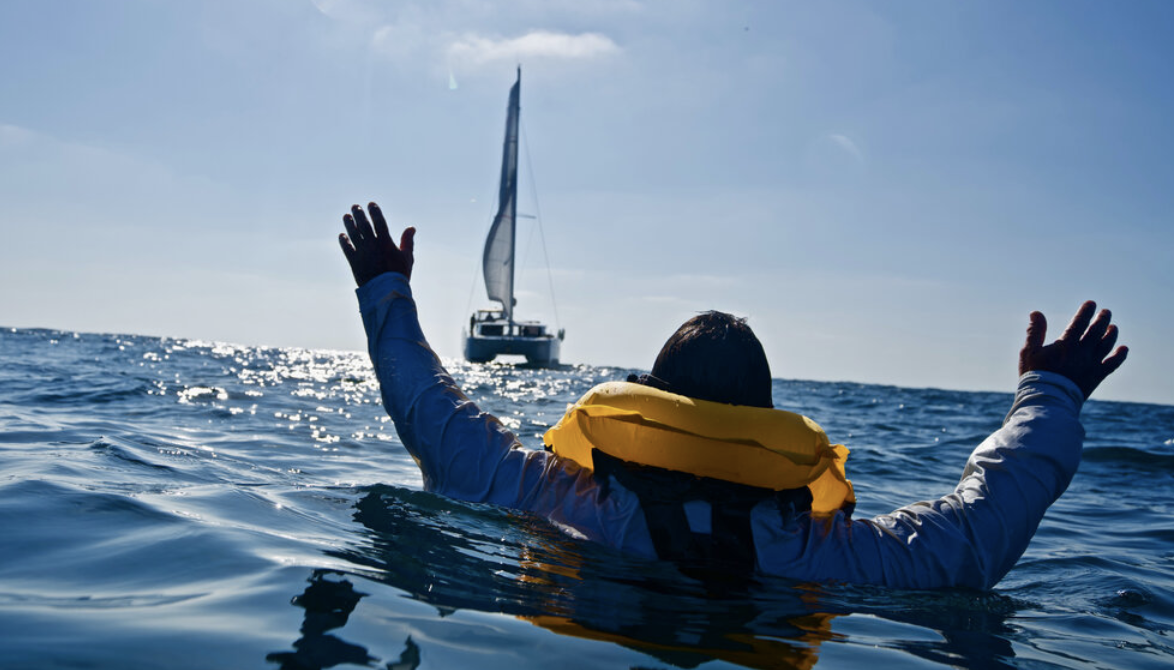
I watched in disbelief as my hands seemed to melt into the water. Was I hallucinating? The decreasing effectiveness of each frantic stroke was starkly apparent in my racing mind. The surprising pain from the cold of what I thought was the warm water of early June was now almost gone – another sign that time to solve this urgent dilemma was drawing very short.
How could I have allowed myself to get into this situation? Oh how I wished I could do it all over again.
Luckily, I can. The opening tale is one I’ve lived in my mind many times, but thankfully never had to deal with in real life. The urgent dilemma to which I refer? Going overboard without a PFD while alone on a small boat that has either no or an insufficient re-boarding device. Sound unlikely?
Well, the statistics say otherwise.
Drowning by the Numbers
The United States Coast Guard analysis of 2023 accidents show –
* 75% of all boating fatalities were by drowning.
* 87% of those cases, the victim was not wearing a life vest.
* 80% of drownings happened in boats under 21’ in length.
* 35% of all drownings occurred when only one person was on board.
* 60% of all drownings on boats under 26’ happened when only one person was aboard.
The USCG only requires reboarding devices in boats with freeboard more than 4’. As such, almost all 26’ boats or smaller are not required by Federal statute to have reboarding devices. Canada has regulations on re-boarding devices, but only if the freeboard of the boat is in excess of .5 meters, or about 1.6 feet.
Happily, the American Boat and Yacht Council (ABYC) standard H-41 mandates that all boats, regardless of size, be equipped with a means of unassisted reboarding. This requirement applies to both power and sailboats. The reboarding device must be accessible to, and deployable by, a person in the water without assistance.
The ABYC standards are strictly voluntary and are not required by law. Powerboat builders religiously follow this standard; sailboat builders, not so much.
However, there are specific exceptions to this requirement:
1. Manually propelled boats: Boats powered solely by human effort, such as rowboats or paddleboats, are exempt.
2. Aquatic toys: Devices intended primarily for play in the water, not for transportation, are not required to have reboarding means.
3. Canoes, kayaks, or other boats with a beam less than 3.6 feet (1.1 meters): These narrow vessels are also exempt from this requirement.
Hardly a week goes by without BoatTEST’s “Accidents of the Week” report in the Saturday newsletter recounting a death after falling out of a canoe or kayak.
Facing In-Water Reality
Just for reference, in the United States, most code calls for the pool deck to be less than 12” (30 cm) above the waterline. Hop in a pool fully clothed and see how easy it is to get out without the steps. I’ve done it. You might be surprised.
The issue is that, even if there is a re-boarding device, they can be difficult or impossible to use. There is a big different between getting out of calm, 70-degree water with just a swimsuit on, and doing the same in 55-degree water in an unknown sea state fully clothed.
Until just a few years ago, the ABYC required only one step on a reboarding device, that had to be 12” (30 cm) below the waterline. But a few years ago the ABYC changed its standards to require that all boats except those exempt (see above) have reboarding devices that extend 22” below the waterline.
The Re-Boarding Problem
Unfortunately, having someone else with you doesn’t ensure safety. Another 30% of drownings occur in boats under 26’ with two people on board. I have read of short-handed boats being reached by the USCG or other rescue party or returning to port with a body tied to the hull as the combined effort of the person in the water and the person aboard couldn’t save the person overboard.
Sadly, in the 2022 Bermuda Race the overweight owner of one of the boats with a crew of eight, was washed overboard. The boat got back to him in about 5 minutes, got a Lifesling to him, but the crew was unable to get him back aboard with the jib halyard. He subsequently floated face down, after more than an hour they were finally able to get lines around his lifeless body and hoisted him on deck with the main halyard.
So how can we all avoid the nightmare that befalls hundreds of boaters every year?
Here are some suggestions:
1. Develop a plan for your boat to deal with the situation of a single-handled person overboard. Think through what you would do if you end up in the water all by yourself and then test that plan to the best of your ability.
2. Test reboarding gear and yourself annually. You can do this in the boat yard, at the dock or on a trip out when you have at least two other people to help you back aboard should you need it. If your plan relies on a boarding ladder, test it. (I know of more than one person whose first ever attempt to use their boarding ladder ended in a shocking detachment.)
3. Wear a life vest. I strongly suggest anyone operating a boat solo should be wearing a PFD of some form. I use a self-inflatable waist pouch as my go-to. Self-inflating chest PFDs are unobtrusive and even better. The vest-type pioneered by Stearns years ago are both unobtrusive and warm. Spinlock makes a model called the Deckvest Lite 2 that is the most comfortable I’ve worn. Spinlock also makes several models with integrated harnesses for use by sailors.
4. Hook-up the kill lanyard. If your boat has a kill lanyard, use it. Every time! Consider getting an electronic fob you keep in your pocket.
5. Stay on the boat. Of course the best plan to avoid this situation is to stay on the boat! This means taking extra precautions when running solo. Be deliberate about your actions. Think through any procedure you plan to execute. Avoid sudden reactions to anything. Remember seemingly silly phrases like “one hand for the boat and one hand for yourself” when conditions warrant.
6. Stop the boat. If you must move around or put yourself in any increased risk of going overboard, stop the boat and kill the drift.
7. File a float plan. Any boat owner should consider filing a float plan anytime taking a boat offshore. Anyone boating alone at any time should most definitely file a float plan. The plan should have the description of your vessel, where you plan to use it, when you will return, and the numbers of rescue agencies for the holder of the plan to call.
There are a lot of reasons why people don’t file a float plan, or check their gear to make sure they can get back aboard, or not be hooked up to a kill switch, or not wearing a PFD. But none of those reasons are good reasons.

Capt. Gregg Clark is a test captain for BoatTEST. He holds a 200 GT master license and has boating and yachting for 40 years. He owns a 56’ Vicem and is co-owner in a 40’ high-performance racing sailboat. He can be reached at [email protected].
Want To Be Featured Alongside Capt Gregg and our other Test Captains?
If you have a captivating story about what you learned from that boating moment, we want to hear it! Share your "I learned about boating from that..." tale with us, and it could be featured in our popular weekly column. Send your story, along with a high-quality photo if possible, to [email protected]. Your experience might just inspire, entertain, and enlighten our community of fellow boating enthusiasts! Don't miss this opportunity to see your name in print and share your unique perspective on the incredible world of boating.
Want to tell us your story through social media? We'd love to hear from you there, too! Share your boating insights and learning moments with us on your favorite platform, using #ILearnedAboutBoatingFromThat, tag us, and we'll share your wisdom with our online community. We can't wait to hear how the water has shaped your life!