I Learned About Boating From That - Stuck in Reverse
by Capt. Gregg Clark
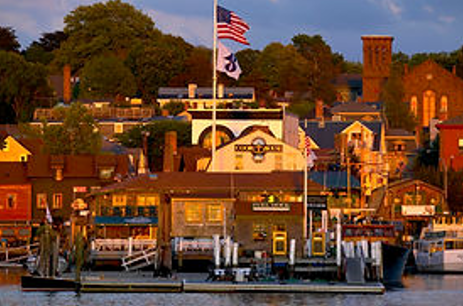
I love Newport, RI. It is my absolute favorite harbor in the world. For me, it has everything a great harbor should have, including the iconic marina and fuel dock at Bannister’s Wharf, right in the heart of Newport’s historic waterfront.
Facing a Close Call
I had just completed taking on a load of diesel at the Bannister’s Wharf fuel dock. After paying the not insignificant tab, I fired up the yacht I was operating and prepared for departure. I sounded one prolonged blast followed by three short blasts on my horn to signal my departure operating astern as the friendly dock staff and my crew slipped and hauled the dock lines.
I bumped both the bow and stern thrusters simultaneously to slowly move the yacht off the dock and towards the channel. After a few seconds of drift, I put the port transmission in reverse to pull the stern from the dock and begin backing into the channel. When the yacht was about 45° to the dock, I put the starboard transmission in reverse to pull me further into the channel. Once mid-channel, I was ready to initiate a turn of the yacht to starboard to point her squarely down the channel facing south.
To initiate the turn to starboard, I moved the port shifter to neutral then to its forward notch. Nothing happened. The boat kept moving astern on both screws. I immediately put both shifters in neutral. The starboard transmission went into neutral, but the port kept backing. I put the port shifter in forward, then reverse and back to neutral. Absolutely nothing happened, the boat was still backing on her port screw.
My heart rate accelerated as we began approaching boats in the mooring field, about 100 yards off the Bannister’s fuel dock. I uttered a few choice words. I am a sailor after all and certainly know how to swear like one. I had to think fast.
I decided to shut down the port engine. I pressed and held the stop button for what seemed like an eternity. She finally shut down and the drift aft began to diminish. But I wasn’t out of the woods yet as our distance to a beautiful sailboat in the mooring field had rapidly evaporated.
I shifted the starboard transmission into forward, which had the desired effect of reducing the way astern. But it also started to turn me the exact opposite direction from where I wanted to go AND it was propelling me towards the dock with a breeze blowing me the same way. I decided not to attempt the lengthy process to restart the port engine in hope things would reset as I felt there simply wasn’t time. It was clear our trip for the day was going to be cancelled.
I now had to determine my immediate and short-term courses of action. I could have returned to the fuel dock, but it was a tight landing between a super yacht and a smaller boat that had pulled up to fuel immediately after my departure. So, I decided to attempt to return to the yacht’s permanent slip a little further south in the harbor as it was quite easy to get in and out of. I would give it one shot and, if that didn’t work, I would head to the nearest anchorage to try and sort the issue.
I put the starboard transmission in reverse to kill my headway. I then used the thrusters – bow to starboard, stern to port – to get her pointed in the desired direction. To track straight down the channel, I had to put in about 20° of starboard rudder to counteract the thrust coming only from the starboard screw. I bumped the shifter in and out of neutral to go as slow as possible, taking rudder out as I slowed and putting it back as I sped up all to keep the yacht tracking straight.
I had to execute a 90° turn to port to get into the yacht’s port-to slip. Luckily this was easy given that starboard thrust was all that was available. I executed the turn and then moved forward towards the slip using much more thruster input than I normally would to keep her lined up appropriately for approach. I went as slow as I possibly could. When lined up close to the dock I put the starboard shifter in reverse to kill the minimal headway and pull the stern to port towards the dock. I used thrusters to cover the remaining few feet. My crew secured the dock lines, and I sat down to breathe.
Key Lessons from This Near Disaster
1. Assume things won’t work as planned: While I can’t say I was expecting one of the transmissions to not act as planned, I was thinking about the distance and time available to me if I had a power failure.
2. Always have an escape plan: Before getting underway, think about how you would escape from a tight situation. In this case, with the wind blowing me on the dock, I wanted to make the stern out first maneuver off the dock to give me options should I experience any difficulty. I had to unexpectedly and quickly develop another escape plan as we approached the boats in the mooring field.
3. Go slow: There is a saying that “slow is pro.” Not only does this prevent you from hitting anything hard, but it also gives you more time to react if things start to go south.
4. Communicate: I let my crew know immediately what had happened. They were quick to get out a roving fender if required to soften any impact.
5. Practice operating in emergency configurations: If you have a twin screw boat, practice operating it (in open water of course) on only one screw to see how it behaves. I had done this many times on a few different twin screw boats so I had a pretty good feeling of how this yacht would react.
6. Keep equipment in good working order: Make sure shifter cables are properly lubricated and that control valves are free of corrosion and move smoothly. The issue in this situation was the failure of a computer control board on the port transmission (it had electronic shifters/throttles), so there was really nothing that could have been done proactively.

Capt. Gregg Clark is a test captain for BoatTEST. He holds a 200 GT master license and has boating and yachting for 40 years. He owns a 56’ Vicem and is co-owner in a 40’ high-performance racing sailboat. He can be reached at [email protected].
Want To Be Featured Alongside Capt Gregg and our other Test Captains?
If you have a captivating story about what you learned from that boating moment, we want to hear it! Share your "I learned about boating from that..." tale with us, and it could be featured in our popular weekly column. Send your story, along with a high-quality photo if possible, to [email protected]. Your experience might just inspire, entertain, and enlighten our community of fellow boating enthusiasts! Don't miss this opportunity to see your name in print and share your unique perspective on the incredible world of boating.
Want to tell us your story through social media? We'd love to hear from you there, too! Share your boating insights and learning moments with us on your favorite platform, using #ILearnedAboutBoatingFromThat, tag us, and we'll share your wisdom with our online community. We can't wait to hear how the water has shaped your life!