Jupiter 43F Tested with Sharrow Props
The Jupiter 43F with triple Yamaha 300’s is a formidable offshore fishing machine as well as a fast weekender. She’s no lightweight, at 26,797 lbs (12,150.4 kg) ready to head out the inlet, but she gets to the fish fast at 50 mph and more.
Naturally, any buyer will be interested in keeping the fuel use to a minimum while getting the desired performance—and as is usually proven in these tests, Sharrow’s innovative True Advance propellers delivered a significant advantage in MPG as well as mid-range performance over stock three-blade propellers.

For a boat likely to be used frequently in low-speed trolling, the first significant advantage showed at displacement speeds, where the Sharrow’s produced more velocity at lower rpm. This means less fish-spooking engine noise, as well as lower fuel use, significant when trolling may continue for many hours.

Much Faster in the Mid-Ranges
Because the patented design of the Sharrow Marine propellers put the boat on plane at lower RPM, there’s a significant speed advantage from 2500 to over 4000 rpm.
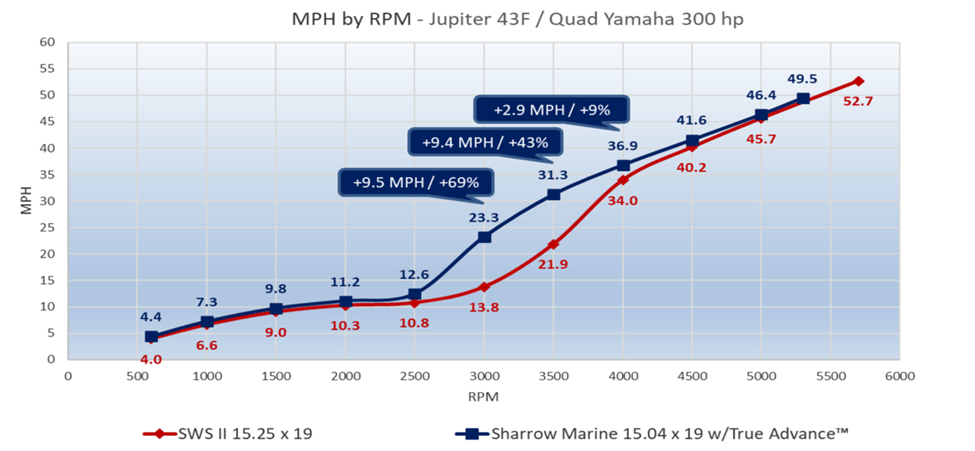
The advantage was greatest at 3000 rpm, where the Sharrow’s were almost 10 mph faster, a 69% advantage over the stock propellers.
The Sharrow’s maintained the advantage all the way to their max at around 5300 rpm—more speed at lower rpm despite having the same nominal pitch as the SWS II propellers. The SWS II propellers proved to be a bit faster at WOT, 52.7 vs. 49.5 mph.
Better Fuel Economy at Most Speeds
Fuel economy is one of the major selling points of Sharrow Marine propellers, proving significantly better than conventional propellers at most rpm in every test run.
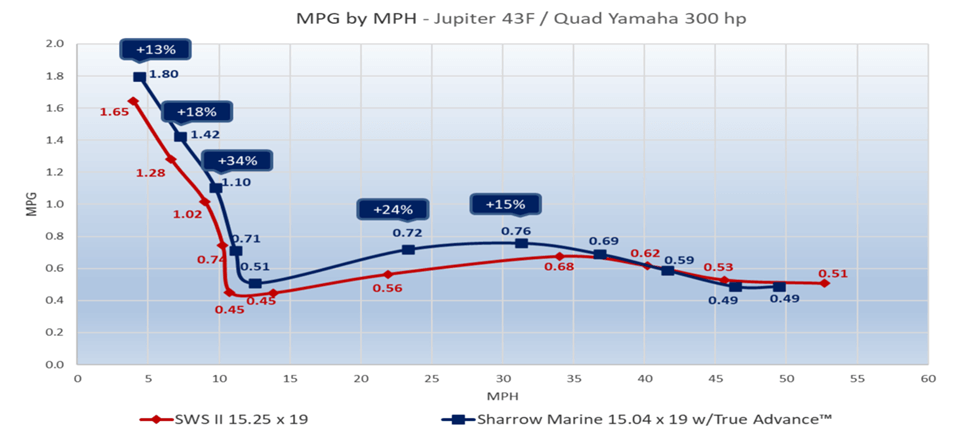
In the Jupiter 43F, the Sharrow’s were 34% better at 10 mph, 24% better at around 22 mph and 15% better at 30 mph. This results not only in big savings on fuel costs over long days on the water, but also allows for extended range without “range anxiety”.
Advance Design Produces Greater Advance Rate
The advance rate is an indication of how nearly a propeller comes to matching its pitch, measured in inches. The continuous-blade Sharrow’s usually show considerable advantage over conventional propellers in this measurement, and did so in this test.
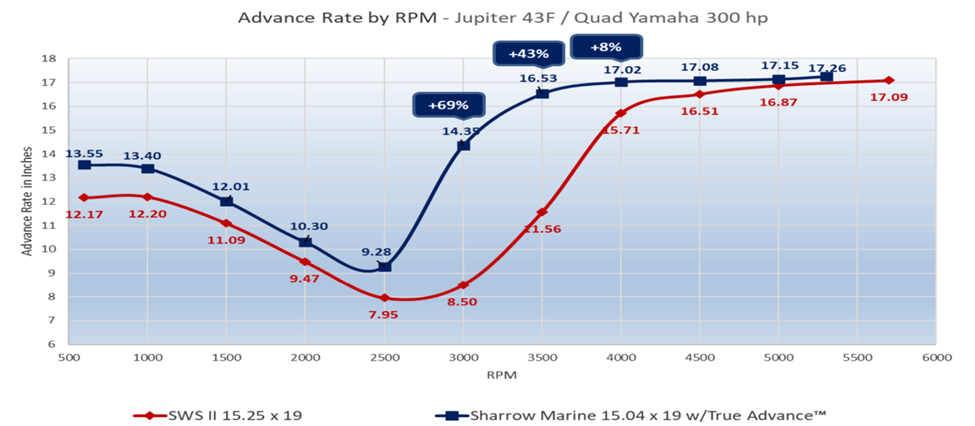
The Sharrow’s pushed the boat 14.35” per revolution at 3000 rpm, while the stock propellers could manage only 8.50” with the boat still struggling to get out of the hole. This large gap only begins to close at 4000 rpm as the stock props finally bring the boat to a full plane.
Less Slip, Better Grip
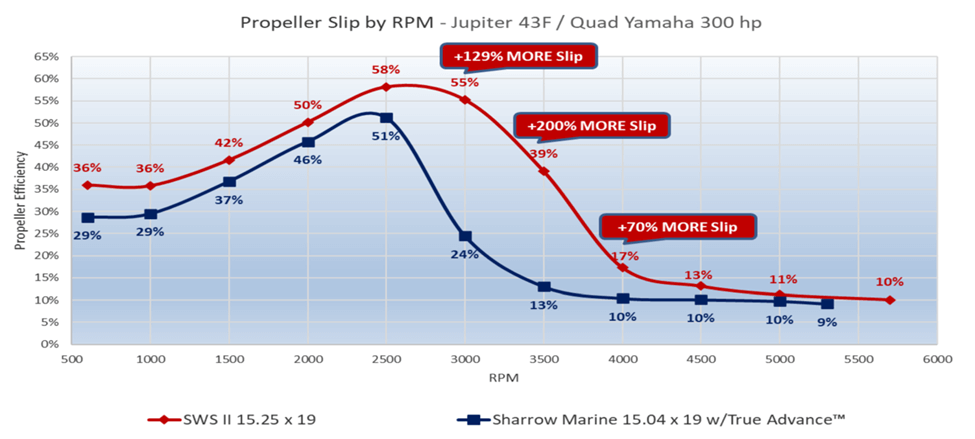
Propeller slip is essential as a boat powers up toward planing—otherwise, the engine would probably stall due to excessive load. But once the boat begins to plane, less slip means the boat goes farther on each revolution of the propeller, so fuel efficiency or MPG increases.
As shown in the chart, the conventional SWS II propeller had a whopping 200% more slip at the critical 3500 rpm level, 70% more at 4000.
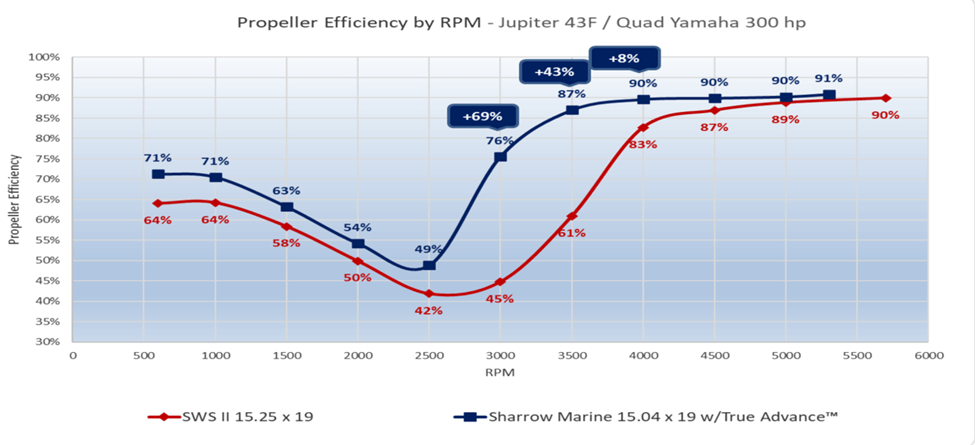
Propeller efficiency follows directly from propeller slip, with less slip equaling greater efficiency. Particularly in the mid-ranges where most owners run their boats most often, the precision machined Sharrow’s show a dramatic advantage.
Bottom line is that from idle speed to nearly WOT, Sharrow True Advance propellers produced more efficient propulsion in the Jupiter 43, putting the boat on plane more quickly, holding it there at lower rpm, and increasing the operating range through greatly improved mpg.
Because the outboards can be operated at lower rpm while still maintaining good performance with the Sharrow propellers, less wear and fewer maintenance issues are also likely.