The Knockdown, Sinking and Resurrection of Bayesian – Part II
But Bayesian rests at 45 degrees for a few moments before slowly heeling further and foundering sideways and sinking leaving all those on deck in the water in the dark. This series of events took place event between 03:56 and 04:05 with the vessel heeling and sinking in an estimated 90 seconds.
No one will be wearing a life jacket because, only moments before, this large vessel would not be considered to be in danger. But the crew are young and fit and stay afloat long enough in the dark night and rain to see a large life raft emerge among them from the depths activated by an automatic hydrostatic system. Within minutes they haul each other aboard, including the owner’s wife and baby who by some miracle, were on deck at the time.
Meanwhile, in the guests’ sleeping cabins a deck below the saloon six people are trapped. In seconds as their world turns ninety degrees. They have been plunged into complete darkness with a torrent of cold water flooding around them. In this time everything not secured in the cabin has fallen across the space or become a missile, including the people. The event takes less time than it takes to type it out.
Imagine your bedroom turning 90 degrees, flooding and consider what items would fall on you. A vision of hell with no time to think. In a few moments the survivors are trying to stay afloat in an air pocket with no idea of which way is up or out.
Witness to the Tragedy
A steel schooner of 250 tons anchored nearby, the Sir Robert Baden Powell, witnessed the sinking and managed to launch her tenders to carry out a rescue operation for survivors. The video her captain took of the incident illustrates the conditions of rain and poor visibility but also demonstrates the local nature of cunim gusts because, if the same gust had hit the Powell, she would probably have had problems of her own. Her experienced skipper is reported as using the engine to take the strain off the anchor.
Gathering in the Salon
In the short time before the capsize, in the early hours of the morning, guests and the owner may have gathered in one cabin somewhat alarmed at the motions of the vessel and the noises of the storm with the yacht rolling 10 or 15 degrees in the gusts due to the height of her rig, and the obvious activities of the crew on deck. The owner may have reassured them that, in the three years of ownership, he had experienced similar storms and that the captain and crew would be capable of ensuring their safety. In any case the builders, Perini Navi claimed that Bayesian was ‘unsinkable’. (And where have we heard that statement before.)
The sea remains a place of dangers which have not diminished in centuries. When you talk to most experienced sailors the word they use is ‘respect’. My friend in Lloyds Insurance reminded me that marine accidents are a daily occurrence and, sadly, the only stand out for Bayesian was the identity and storyline of the victims.
“Act of God”
It would be a small claim relative to the recent Baltimore Bridge disaster with a similar death toll which is currently out at $3billion and rising. Accidents occur all the time sometimes for no reason other than an ‘act of God’. The Tsunami 2004 or Valencia 2024. Man overwhelmed by the elements. But the modern media instantly plays the blame game.
In 1878 HMS Euridyce, a 140 foot 26 gun sloop with a full Navy crew, foundered close to the Isle of Wight when it was hit by an unexpected squall leaving only two survivors. The stringent Navy inquiry “found that the vessel had sunk through stress of weather and that her officers and crew were blameless for her loss” But it was also stated that “There was some adverse comment on the suitability of Eurydice as a training ship because of her extreme design, which was known to lack stability.”
Acts of Ego
Ego has been a consistent feature of marine accidents. The unsinkable Titanic had insufficient life boats because its owners believed she was unsinkable. The Captain was bullied into imprudent speed among known icebergs because the owner, Lord Ismay, sought publicity for his shipping company. This attitude goes back through the centuries. In 1628 the Swedish king wanted the biggest battleship and interfered with its construction in a way that compromised its stability because he wanted higher and bigger. After it capsized and sank within minutes on its first voyage in modest conditions, the inquiry stated that “the king's subordinates lacked the political courage to openly discuss the ship's problems”.
The superyacht industry has shadows of this mind-set today as designers and builders are seduced by the money to build ever larger and crazier vessels due to a demand from billionaires for bragging rights within their peer group. It’s difficult to say no to a big deal when a competitor may accept the risk and get away with it - and the cash. And one always considers that it will be alright.
Except that on Bayesian it was not.
A further, much simplified dip into the technology, opens a few linking facts that point towards ‘probable cause’. The lining up of the holes in the ‘Swiss cheese’ accident analysis common in the aircraft industry.
It’s All About Stability
This story is about stability and a vessels’ ability to resist wind conditions that may cause capsize and sinking. The guidance within the MCA - SIB is mainly concerned with the vessel under sail or under way as a power yacht. In the case of Bayesian, the calamity happened at anchor which is unusual. When a vessel heels over in flat water its resistance to the heeling force is provided by the buoyancy of the hull as it immerses and the overall centre of gravity which is normally low on a sailing yacht due to its heavy keel.
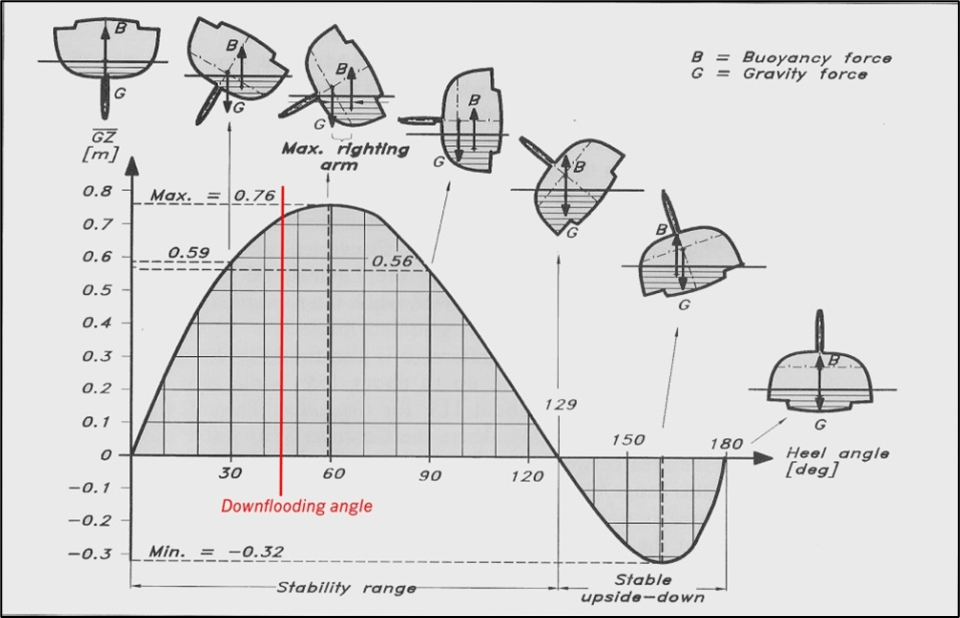
It can be seen in the chart above, the lower and heavier the fixed ballast keel the greater the righting force. The combined righting lever of these two features can be measured for any angle of heel. (It’s called GZ)
On most yachts the GZ increases up to about 45 degrees and then reduces to a vanishing point at about 110/120 degrees of heel at which point the boat will capsize. The other critical factor in the process is what is called the down-flooding angle.
This is the point at which the heel angle is such that the deck edge becomes immersed after which the deck structure comes into play. The importance of this is that the deck and higher hull topsides usually have openings like exhausts, hatches, ventilation openings, etc., all of which can potentially allow a flood of water to enter the hull. If this happens to any degree, the ship’s stability factors quickly change and the righting lever is compromised.
In normal operating conditions Bayesian had a down-flooding angle of about 44 degrees.
The MCA operating data for the Bayesian’s captain advises that, under sail, the vessel should not exceed 17.5 degrees of heel and various graphs show that this heel angle for gusts of 1.4 times any wind value allowing the vessel to keep clear of the critical down-flooding angle. (Imagine saying that to your average boat show client.)
As backup there were automatic systems to release the sails if 25 degrees of heel was exceeded. From the data it is obvious that Bayesian, although having an oceanic unlimited category, was more of a fair weather, light wind sailboat. The captain was advised in the SIB to use the data and his own experience to keep the sail areas safely within limits and, of course, never to sail with the keel raised. The data tops out at 60knot (70mph) squalls.
Sailing Offshore with the Iron Jib
Many superyachts never go oceanic with the owner on board because passage making is boring, so the vessels are mainly used for socialising and cruising between attractive places with the sailing restricted to fair weather. On passage, without the owner, the crew prepares the yacht for sea and mostly motors because of the hassle of handling sails with a limited crew, and the crewing requirement for a three-watch system.
A sailing yacht is a dynamic entity operating in a shifting environment in which some subtle combination of changes to the vessel or its surroundings can quickly alter the balance from safety to danger. A good captain is always thinking ahead, which can give him or her, a somewhat distant feel to anyone else on board. It can be difficult when everyone is having fun to spoil the moment because one has seen a dark cloud on the horizon which spells trouble.
“Free Surface Effect” of Tankage
In the case of Bayesian there are several, less obvious, things that may have contributed negatively to her ability to recover from her knockdown. At 525 or so tons displacement her water, fuel and waste tanks of 73 tons capacity constituted about 14% of her total weight. When these are pressed up full or completely empty they can be regarded as fixed weights in any stability calculation.
Full, they normally have a positive effect. If they are half-full their 35 tons can slosh around and constitute moving ballast. They are subject to what we call free surface effect. The SIB states. “Provided a tank is completely filled with liquid no movement of the liquid is possible and the effect on the ship’s stability is precisely the same as if the tank contained solid material. Immediately a quantity of liquid is withdrawn from the tank the situation changes completely and the stability of the ship is adversely affected by what is known as the “Free Surface Effect”. This adverse effect on the stability is referred to as a ‘loss in GM’ or as ‘virtual rise in VCG’.”
It is possible that halfway through her cruise, Bayesian’s tanks were half full. When the wind force heeled the vessel to 45 degrees these 35 tons of fluids would drop instantly to the downside of the tank with an attendant sudden negative effect on stability.
Other factors may have come in to play when she heeled. The 55-ton lifting keel was raised reducing her centre of gravity. In a fast knockdown similar to the Westhaven incident (sinking of a 62’ commercial fishing trawler in Scotland in 1997), the area of the keel may have damped the rolling motion a little. The sheer volume of rain under a cunim would have filled the rolled headsails with water affecting stability as would any water trapped in the boom.

As she heeled these added weights would come into play. At this time, we do not know the configuration of the hull openings and deck openings that may have affected at the down-flooding angle. The crew would not be expecting to roll 45 degrees while at anchor.
When Bayesian reached 45 degrees reports say that she hesitated. This moment is covered by the word loll which describes a moment of uncertainty where the righting forces are changing. On the positive side are the essential mathematical factors providing the yacht’s righting moment. On the negative side of the equation are the continuing force of the wind and the move of the fluids in the tanks combined with other apparently incidental factors like the weight of water in the foresails and boom.
At that particular point the vessel also reaches its down-flooding angle potentially bringing uncontrolled amounts of water into the hull spaces through any openings such as engine exhausts, aircon and ventilation openings etc. This extra water intake changes the flotation and the righting moment causing the vessel to enter a stage called foundering.
Foundering is an expression used when a vessel reaches a critical point at which she is trying to recover but the combination of negative factors mentioned above hold her down while the flooding situation gets worse. As buoyancy further decreases the yacht sinks sideways as more water comes on board.
Other Considerations
Comment has been made about the mast construction and the possible beneficial effect of a carbon spar over heavier aluminium. As a bald statement this appears knowledgeable and insightful, but misses two important factors. In the case of Bayesian, the critical rig windage area would have been the same. The effect on the centre of gravity would only show an improvement if the main ballasting remained the same. The possibility is that the ballast could have been reduced to the minimums for the MCA giving the same righting arms as for an aluminium spar.
A feature of Bayesian that can be discounted in this scenario is the claim of ‘unsinkability’ from the builder. Quoting the SIB – “AT SEA - Internal sliding WT doors may be left open, but consideration should be given to closing then when risk of hull damage and flooding increase (e.g. in fog, in shallow rocky waters, in congested shipping lanes, when entering and leaving port and at any other time the master considers appropriate.”
The transverse bulkheads and watertight doors are designed to control flooding in the event of collision damage within the spaces they enclose when the yacht is holed by accident when she is upright. If the boat is on its side their effect is limited because water floods simultaneously into the compartments from the top.
This scenario described is speculative, based on the information emerging. So where does that leave us? The inquiry will have to take a step-by-step approach to a complex accident
Issues for Investigation
First, they have to credibly investigate the ‘conspiracy theory’. The plot line to get a result to fit the events would have to include a well-timed plan to coincide exactly with a gale and a rare and unpredictable blast of wind. This stretches credibility into the realm of fiction. Any evidence of foul play should be eliminated when the vessel is salvaged. (Which it has been.)
Investigators must thoroughly research the storyline of the storm from weather data and those witnesses afloat and ashore. The crew have a story to tell which is of primary importance. There appears to be some evidence that the nearby Italian Air Force base detected the severe cyclonic situation on their weather radars.
A yacht at anchor some distance from Bayesian posted video on YouTube which illustrated the conditions of wind and lashing rain. The skipper of this yacht may shed some light on the down burst theory relative to what he experienced. What were the sea conditions? Sadly, an ITV documentary follows the normal practice of showing irrelevant archive oceanic pictures large waves for dramatic effect. Waves take time and a fetch to build up; a sheltered anchorage normally has relatively flat water.
Secondly, Bayesian was 16 years old and on her third owner. What modifications had she been subject to in that time? Her SIB advises recalculation for any modifications. So, her exact condition at the time of the accident must be established in terms of deck openings and her load condition to establish correct down-flooding angles.
The next calculation has to cover the wind effect on the mast and rig for a range of wind speeds and angles in order to establish the force required to push the yacht over to 45 degrees and hold her there and beyond. This stability calculation will include the free surface effect for the various tanks and the weights in the rig.
After these relatively straightforward mathematical and physical investigations have been completed the inquiry will have the correct starting point data from which to piece together the series of events which led up to the capsize and subsequent sinking. Like all accidents the story is more complex than many people believe with subtle side issues which nudge the balance of probabilities towards the result. This research should go right back to the philosophy of the design, usage and management of sailing superyachts.
My opinion is that Bayesian was unfortunate to be in the wrong place at the wrong time. An act of God. Like many ships before her, she met unpredictable conditions for which she was not equipped and within the short timescale of the event on a dark night with lashing rain the crew could not have acted fast enough to save the situation or the passengers.
For the builder to instantly blame the crew was a travesty and did nothing to elevate the reputation of Perini Navi. They stand alongside the MCA and the ABS as well as the naval architects in terms of establishing probable cause through facts – not speculation.
There are plenty of superyachts sailing the oceans without problems, but the Bayesian disaster might have been prevented with a little more understanding and oversight.
A Previous Microburst
A forerunner of this accident occurred in the aircraft industry in August 1985 when a Delta Airlines Tri-Star landing in Dallas encountered a microburst while landing in a thunderstorm crashing a mile from the runway killing 137 people. The crew could do nothing to prevent the crash. Flight 191 was a seminal moment of change in the industry as controllers and flight crew thereafter received training for this phenomenon and manufacturers researched radars which could detect similar weather events.
Taking a Page from the FAA
Although the MCA and similar marine authorities check designs, inspect and certify new builds of sailing superyachts it appears that tighter mandatory regulation could improve safety by making owners and crew more aware of the accident risk in all areas of marine operation. This is what the FAA did after Flight 191 and no further fatal accidents from microbursts have occurred. Safe practice for marine operations should be mandatory rather than advisory. This would relieve the skipper of some of the responsibility, restoring the balance of power a little between owners demands and safe practice.
Bear in mind that airline design and operation is all about safety and professionalism– not showing off. (Pressure for meeting schedules historically might have pressured pilots into taking off and landing in marginal conditions, but the FAA procedures took pilots’ discretion out of the equation when encountering marginal conditions.)
Following the Rules
Often in leisure yachting the owner and guests are not given safety drills and there is a feeling that taking timely precautions can be ‘spoiling the party’. Rich people are used to being ‘right’ and in control which can sometimes make them a little unapproachable when it comes to safety discipline standing in the way of relaxed objectives.

When it comes to safety there needs to be adult communication between the captain and owner - and owners should learn to respect the superior knowledge of their on-board team. (In fact, most megayacht insurance policies prohibit the owner from operating the boat.)
An aspect of leisure superyacht captaincy seldom appreciated is that it differs a great deal from a similar situation for a captain of a commercial vessel. The latter is truly master of his ship and any decisions; the ‘yacht’ captain often has to play a political game with the owner trying to provide a program to impress guests. It can be a mentally exhausting day pushing the vessel and crew to provide the, apparently relaxed but sometimes edgy, memorable sailing experience and then sinking into bed happy to have performed without accident among a lot of dangerous machinery.
There is no lonelier position than captain of any vessel with ultimate responsibility for her safety and that of the crew. Owners vary considerably and some can lack consideration for their highly paid staff.
In terms of construction the designer and builders need to feel free to advise owners when their dream of biggest and fastest is getting out of hand. But in doing so they always risk losing the contract because the rich and famous don’t like to be told they cannot have a bigger toy; and there is always a less scrupulous competitor who will take the money and agree to anything in the hope that all will be well.
One has to say that most designers and builders of these monsters are very competent and major accidents due to design and build are rare. But many owners are on a rather deaf and dangerous ego trip.
Tweaking the Culture of Yacht Design and Building
This is not to say that Mike Lynch was anything other than an intelligent and safe owner of his yacht. But like many others he was caught in a way of life which he assumed offered excitement without undue risk. Certainly, death would be low on the list. It’s a flag to all operators of these vessels to introduce some subtle safety changes at all levels.
To close the holes in the cheese, the culture of toys, ego and risk needs to be recalibrated, in my opinion. There should be – and there often is -- a more considerate team game within the design, construction, operation and the technical oversight. Authorities like the MCA have to look to their procedures and stability checks and be more – well – authoritative: definitive rules of minimum safety angles, higher ballast ratios standards, check lists of procedures covering certain conditions, and a tightening of modification logs and inspections.
All of this is not to spoil the fun but to eliminate this type of accident. Maybe the thrust will come in reverse from the insurers who will insist on a new regime reducing risk. Accidents like the Titanic, HMS Eurydice, Vasa and Flight 191 changed the safety culture of their times while accepting that culpability was irrelevant because lax prior practice created the environment for mishap.
Suggestions for the Future
Perhaps one of the best outcomes from the Bayesian tragedy would be for the large yacht industry to introduce some technology from aircraft operations by installing some of the sophisticated weather systems designed specifically to detect cunim systems including down drafts. Going on to the bridge of a modern superyacht is like walking on to the Starship Enterprise. Every possible nav aid, radar, comm system and safety warning device is there in multiples; but there is as yet no system like those fitted to airliners to detect microbursts.
An aircraft system like the Honeywell RDR-7000 radar costs between $200 and 250k and would probably work very well at anchor when the vessel is upright. This type of system would give the nocturnal officer of the watch better ability to take early measures in a storm situation. Bayesian cost about Euros 40m which is on the low end of the scale for billionaires’ toys making the relative price of safety an easy decision.
Chris Freer – copyright
Over a long career, Chris has worked as a yacht designer, author, journalist. He was born in wartime Leicestershire in 1943 and then grew up among the bombsites of Exeter. At the age of 16, having lost his mother to cancer three years earlier, he went to sea on tankers training as a navigator before living in Australia in the early sixties. He was a crewman on the Australian challenger for the 1970s America’s Cup held in Newport, RI.
He became a production engineer and yacht designer travelling widely. When he became a father for the first time at 55, he wanted his son to Alex to have a multicultural background, he moved the family to Lagos, Portugal, and now teaches flying.