Low-Cost Luxury
At Last the Dawn of a New Era
It is September 1950 and your issue of Motor Boating has just arrived. As you leaf through the magazine, you see an advertisement that stops you cold. “Too good to be true” you mutter and flip the page. How could you know that this simple ad would change pleasure boating forever?
Spring Fever
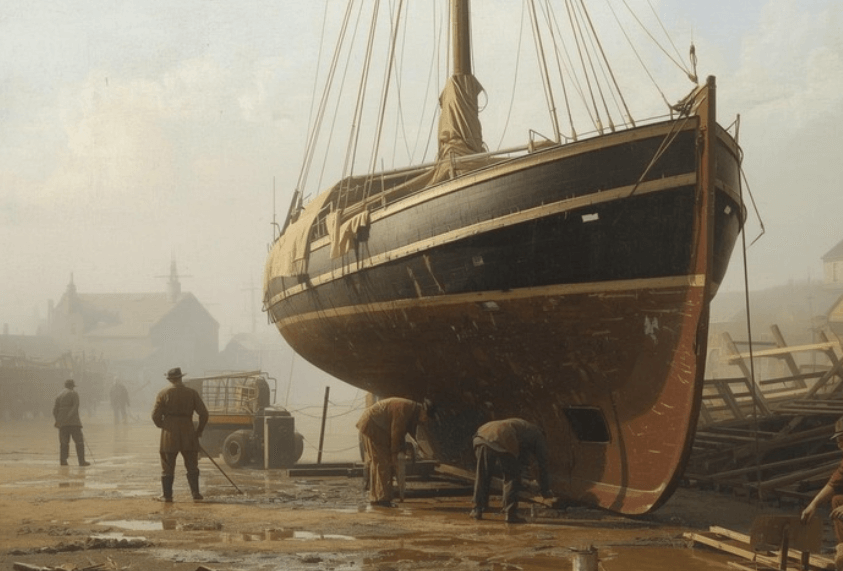
Back then, unless you were wealthy, most boat owners were relegated to backbreaking seasonal outfitting. In the Northeast where I was brought up, it all started in April when you would make your way to a muddy boatyard and take the canvas cover off your boat. In the fall, graceful boats were subjected to Rube Goldberg framing systems atop which a heavy (usually dark, oily) canvas was placed putting the boat in a canvas cocoon. In the spring this ominous, amorphous lump was transformed into a beautiful cruiser when the cover and framing system came off It was like witnessing birth – a real rite of spring. The whole exterior of the boat had to be painted and varnished every year including the bottom, topsides, decks and superstructure.
Painting was the easy part. First, the boat had to be scraped, sanded, puttied, sanded, puttied again and sanded some more. From the beginning of April through June, the average boat owner was a dropout from society. Every spare moment was devoted to getting the boat ready for the season (which oftentimes, didn’t start until the July 4th weekend). Weddings, anniversaries, kid’s school functions, funerals and birthdays were put on hold. It was common to finish painting your boat at night under the glare of your car’s headlights. When the long-awaited launching day came, wooden boats built of hundreds of little sticks and thousands of little fastenings would invariably leak until they “tightened up.” Many never really “tightened up” and continued leaking throughout the season.
A Beetle Emerges
And so, imagine a boat owner in 1950, familiar with this springtime ritual, leafing through the pages of Motor Boating and seeing this ad by the Beetle Boat Company of New Bedford, Mass. The headline was: “Low-cost luxury – at last.” A photo of a nicely styled little 24-footer skimming the waves with happy people in the cockpit waving to the photographer was displayed. She had a pleasant “S” sheer and a well-rounded cabin top. Under the picture were the words “precision molding of impregnated Fiberglas in one seamless leak proof piece.” Reading on, there were more revelations: “No longer can it be said . . . it is not the first cost that hurts – it’s the upkeep. Here at last is the extraordinary “BB – 24-foot cabin cruiser” that banishes forever the costly expensive continual maintenance.”
The ad continued: “Yes, the lifetime sustained economy of a “BB - 24 cruiser” now brings the unsurpassed pleasure of yachting within the means of the average income group. There is no old paint to scrape – no seams to caulk – no fastenings to replace – no rot to repair – no holes to putty! Permanently colored, it will never require painting! Non-deteriorating, impervious to all climatic conditions, it will never require inside storage. Weight remains constant, as there is no water absorption. Leak proof throughout, from cabintop to bilge. All the inevitable discomfort, inconveniences and repair expenses can be forgotten…” Then came the big hook: “You can afford this economy cruiser. Compare it’s cost with all others of comparable size – then ask the owner of an ordinary cruiser about his seasonal upkeep cost. Add this expense to his purchase price and it will prove that the first cost of a “BB – 24” is practically the last!” The boat price was $5490 with a 4 cylinder 95 hp inboard gasoline engine. Dinghy money today. This was one of the first ads for a fiberglass cruiser.
Post World War II America was a time when all seemed possible – even maintenance free boats. Of course, the ad overstated things a bit. You still had to scrape and paint the bottom if the boat was to be left afloat for the season. What was called “permanent color” topside would eventually fade and require paint. And we know now that there is some water absorption with fiberglass construction – especially with many of the older fiberglass boats, which were fabricated predominantly of fiberglass mat and resin. Some of these early fiberglass wonders died an untimely death due to water being sucked into the porous laminates, like a sponge, eventually destroying the structure itself.
Varnish Farms
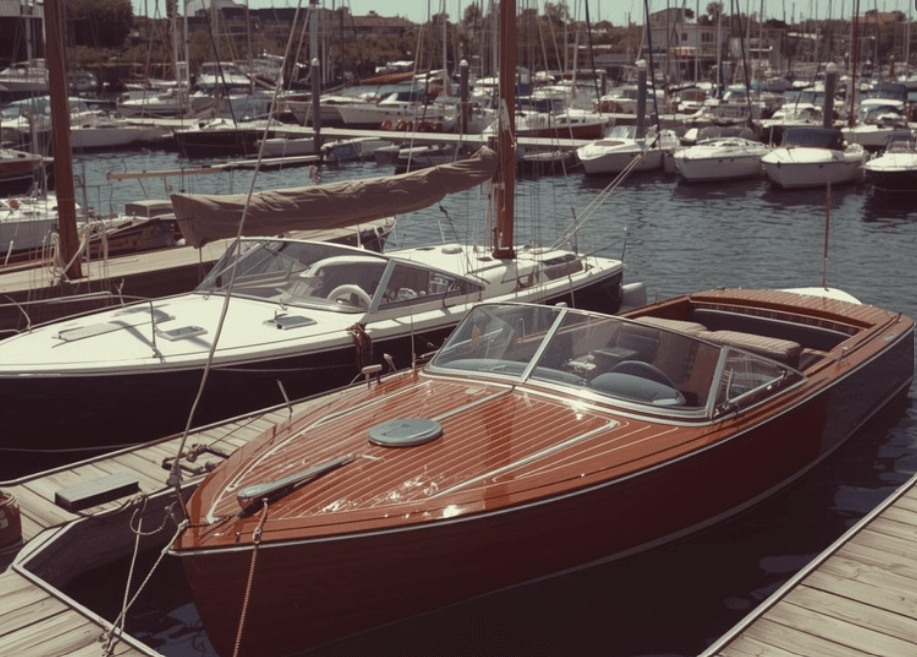
In 1950, a plethora of elegant, beautifully constructed wooden vessels dominated the market. In the 40 to 45-foot range for what is, today, the price of a compact car, you could buy yourself a stunningly beautiful new wooden boat – and virtually all vessels over 30-feet were built in wood at that time. Leafing through the magazine, the following ads would jump out at you: there were the stark, paramilitary Fairform Flyers from Huckins which always appeared on page one. A few pages back, Wheeler Shipyard had an ad for some absolutely magnificent vessels: a 41-foot sportsfisherman and a 44-foot flyingbridge motoryacht. These were vessels designed and built the “old school” way and were eye popping, showpiece varnish farms. Moving on, there was an ad for Owens – a volume builder at the time.
Matthews advertised every month showing their sleek, husky, level riding cruisers. Richardson was a big name with a line of conservatively designed vessels. Other builders like Trumpy, Colonial, CruisAlong, Baltzer and Harco advertised. Then there was, of course, Chris-Craft always occupying the back cover. In the 50’s, marinas like Bahia Mar were packed with big, slick Chris-Crafts (at the time, “big” was anything over 42-feet). Chris-Craft had a huge line ranging from 8-foot Prams to magnificent 62-foot motor yachts.
David and Goliath
And so, in the midst of these ads for all of these glorious, hand crafted, varnished masterpieces was the Beetle Boat Company ad for their innocuous, simple little 24-foot, cabin cruiser. We could not know it then, but this small, nondescript vessel was the leading edge of a wave that would sweep the boating industry eliminating most of the seemingly, invincible boat companies that existed at the time. Today, only Huckins survives intact. Chris-Craft survives with smaller boats only and all the rest are gone. Who would have thought back then that this add offering “precision molded impregnated fiberglass” would displace the likes of Wheeler Shipyards and rendered it, and others who failed to jump on the fiberglass bandwagon totally obsolete in a few years?
Everyone knows that when one sees or hears something that is “too good to be true”, it invariably is. The claims of the Beetle Boat Company seemed “too good to be true” but, for the most part, their claims were valid. Beetle was at the vanguard of a boat building revolution that would completely change the future of pleasure boating around the world. Although some of the materials have changed, all fiberglass vessels are, essentially, built the very same way Beetle Boat Company built their “BB – 24” in 1950.
(Reprinted with permission of Regina Fexas.)
If you would like to read more of Tom's pearls of wisdom, tune in next Friday -- "Fexas Friday."
Better yet, why not get a full dose of infectious Fexas whenever you need it -- and buy one of the volumes below. Better yet, why not buy all of them -- we call them the "Fexas Five." They will provide many evenings of fun reading (better than Netflix), and you'll make the widow Regina very happy knowing that Tom will live on with you the way most of us remember him.
Order 1, 2 or "The Fexas Five" --

To find the "Fexas Five" on Amazon, click here...
Tom Fexas (1941-2006) was one of the most influential yacht designers of the last quarter of the 20th century. With the narrow Wall Street commuters that were built in the 1920s and '30s always on the back of his mind, he wanted to design boats that were at once fast, comfortable, seaworthy and economical to operate. Over the years, he and his firm designed over 1,000 yachts for some of the most prestigious boat builders in the world, including Choey Lee, Palmer Johnson, Grand Banks, Mikelson Yachts, Burger, Abeking & Rasmussen and many others.
Even though toward the end of his career he only designed megayachts and superyachts, including the remarkably influential PJ "Time" in 1987, he is best remembered for his first major vessel in 1978 -- Midnight Lace -- which became a series of 44-52-footers. They were light, narrow, and fast with relatively small engines. He was also influential in the boating community because of the monthly column he wrote for Power and Motoryacht, which began in its very first issue in January 1985.