My Ancient Mariner

It is an ancient mariner,
And he stoppeth one of three
By thy long grey beard and glittering eye,
Now wherefore stopp ‘st me?
Samuel Taylor Coleridge, 1798
A nor’easter had blown in during the late afternoon. Although the marina was completely protected, the swinging trees and whistling rigging indicated a stiff 30-knot wind. It was nighttime as my wife, my dad and I walked down the long float to the boat. Suddenly, a hand reached out from the shadows and grabbed my arm. It was a knurly, cold, clammy hand attached to a short, thin body donned in oilskins. I looked at the man’s bearded face and said something really intelligent like “what the hell is going on here?”
Since he would not let go of my arm, I sent my wife and dad ahead while I dealt with this rude guy. “You are Fexas aren’t you?” he asked “The one who writes those silly Spectator pieces in Power and Motor Yacht magazine?” Now when people come up to me asking if I am the guy who writes Spectator, I know that one of two things will happen: either I will be patted on the back and lauded for my sagacity, wittiness and insight… or threatened to be punched out. There is no in between. Being that this man was at least 90 years old and weighed all of 100 pounds, I figured I could take him and did not spring into my defensive judo position that I usually do when people ask if I write Spectator. I admitted I was the guy.
Minimalism Afloat
The old mariner then reminded me of a series of articles I wrote back in 1994/95 entitled “K.I.S.S. Me You Fool” extolling the virtues of simple, minimalist powerboats (at the time I had under construction for my personal use a slick 42’ Midnight Lace successor called “Phantasus” designed and built with the latest materials and technology but equipped as a power boat in the 1930’s might have been). “You sold out,” the old man said as his eyes narrowed and his grip tightened on my arm. “I have seen your new boat and she is equipped just the like the rest of these barges. She is fitted with a generator, windlass, electric head, refrigerator and microwave. Hell, I have even seen your wife making bread in a bread maker. You installed two dammed TVs and, from the bristling antenna on the radar arch, I can see that you have full complement electronics including radar and GPS. I had faith in you but you sold out.”
Pulling my arm from his grasp, I stood back and thought a minute. Yes, the boat I was building in ‘95 was to be minimalist. She would have no generator, a holdover refrigeration system, a gas stove, manual head and a light anchor on nylon line. The idea was to simplify maintenance and save weight for increased speed and efficiently. Unfortunately, the boat builder ran out of funds and retreated to the woods in Maine. I came out Ok in the end and the design is presently in production in Ohio at the old Lyman Boat Company facilities. As luck would have it, as this project went belly up, we were just starting a new design for a 43-foot sedan cruiser/sportsfisherman for Mikelson Yachts and I promptly ordered hull #2 for myself.
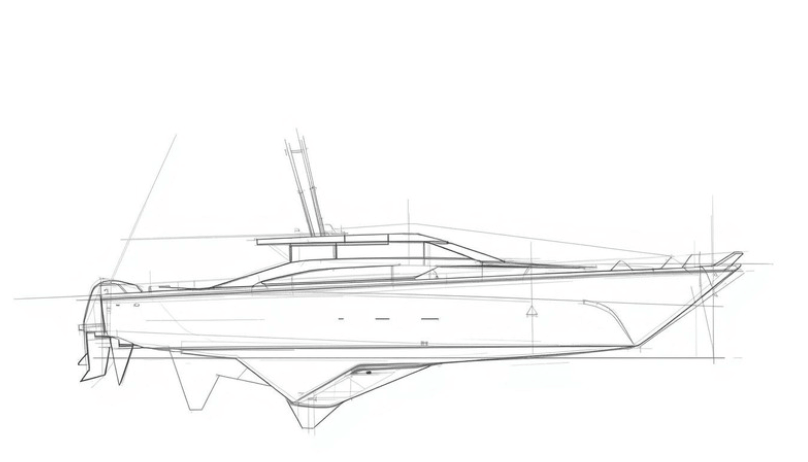
The Way We Were
I explained to the old man that on a custom, one-off boat I could do what I damned well pleased and, when it came time to sell the boat, I could sell her to another minimalist nut like myself (probably a glassy eyed ex blow boater) who would be overjoyed with the fast, simple vessel. The Mikelson, however, was another story entirely. Here was a production design and, when it came time to sell her, people looking for a Mikelson 43 would not be looking for a minimalist boat but one that was fully tricked out. Resale value would have been in the W.C. had I applied minimalism in her outfitting. The old man looked at me with scorn and began rambling about what boating was like in the 1920’s.
“Boating was very popular among blue-collar workers. They could take their families away from congested cities on weekends at affordable cost since they did all the work on the boat themselves. The boats were old since the owners could not afford to buy new ones and most leaked badly. The engines were huge one or two cylinder slow turning rigs with big, heavy flywheels and bucket sized pistons. Didn’t exist self-starters so engines had to be hand cranked after pouring gasoline in a petcock at the top of the cylinder. There was no reverse gear. Six dry cell batteries of one volt each powered the ignition. The engines had no generators. Lighting was provided by kerosene lamps, which were also used for tile running lights. Cooking was done on a small stove fueled by gasoline. There were no electric pumps, running water, radios, television or anything else”, his voice raised as he continued on.
“Boatsmen today are not the men they were in the 1920’s. Most boats never leave marinas and the owners wear white pants and fancy jackets and damned captain’s hats and press buttons to run their boats”. He stood silently, glared at me and repeated: “You sold out”. Then he turned away dissolving into the windy night. I snapped awake in cold sweat and sat up in my king-sized berth, I got up and walked around the boat taking inventory. Yes, there was the faithful Northern Lights 5KW in the engineroom and there in the machinery compartment under the saloon was the inverter and bank of gel cell batteries. I used the head and pressed the button to flush it. I turned the air conditioning down a little cooler, got an ice-cold drink from the fridge, sat on the sofa and zapped on the TV with the remote. I looked around at the beautiful cherry interior. Did I sell out? Of course, I did and I love every minute of it.
Nevertheless, in my free time at home I am developing plans for a dynamite 48-foot “Phantasus.” She will be long and skinny and very light. She will have a tiny 3KW generator to charge the batteries and be fitted with hold over refrigeration and a gas stove. One of her two heads will be a manual type. In my mind, I can see her softly parting the waves of Long Island Sound cruising at an efficient 25-knots. Her black hull and blood red boot stripe glistening in the sun as her twin rat block VS gasoline engines produce a throaty roar through the transom mounted exhaust pipes. The point here is: One can never enjoy being a marine monk until he has sampled the life of a voluptuary.
(Reprinted with permission of Regina Fexas.)
If you would like to read more of Tom's pearls of wisdom, tune in next Friday -- "Fexas Friday."
Better yet, why not get a full dose of infectious Fexas whenever you need it -- and buy one of the volumes below. Better yet, why not buy all of them -- we call them the "Fexas Five." They will provide many evenings of fun reading (better than Netflix), and you'll make the widow Regina very happy knowing that Tom will live on with you the way most of us remember him.
Order 1, 2 or "The Fexas Five" --

To find the "Fexas Five" on Amazon, click here...
Tom Fexas (1941-2006) was one of the most influential yacht designers of the last quarter of the 20th century. With the narrow Wall Street commuters that were built in the 1920s and '30s always on the back of his mind, he wanted to design boats that were at once fast, comfortable, seaworthy and economical to operate. Over the years, he and his firm designed over 1,000 yachts for some of the most prestigious boat builders in the world, including Choey Lee, Palmer Johnson, Grand Banks, Mikelson Yachts, Burger, Abeking & Rasmussen and many others.
Even though toward the end of his career he only designed megayachts and superyachts, including the remarkably influential PJ "Time" in 1987, he is best remembered for his first major vessel in 1978 -- Midnight Lace -- which became a series of 44-52-footers. They were light, narrow, and fast with relatively small engines. He was also influential in the boating community because of the monthly column he wrote for Power and Motoryacht, which began in its very first issue in January 1985.