New Electric Jet Tender Delivers More Space and Amazing Versatility
By Jeff Butler
Two global leaders in their fields – McConaghy Yachts and ZeroJet – have come together to launch a new company and new electric jet tender with some game-changing features.
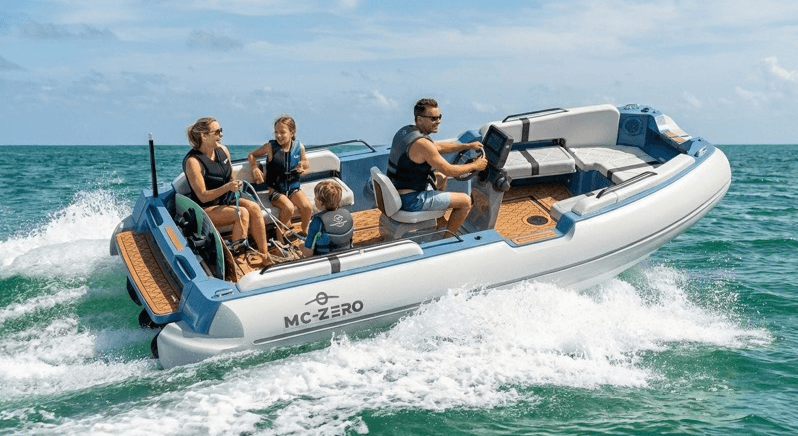
McConaghy, founded in 1969, has built many legendary, breakthrough boats over the years that include foiling monohulls, international regatta-winners and show-stopping superyachts. ZeroJet started life in 2014 developing an e-motor for powered surfboards. In 2019 they became one of the first companies in the world to develop electric jet propulsion for boats.
A new corporate entity – MC-ZERO – fuses the names, expertise and DNA of the two companies and will launch its first model – the MC-ZERO 450 electric jet tender – at the Palm Beach International Boat Show on March 25.
Electric jet tender maximizes space
Chris Baird, CEO of MC-ZERO, says the engineers and designers started with a totally clean sheet and free rein to throw out the compromises that have had to be built-in to many fossil fuel tenders. That allowed them to create, in Baird’s words, “a boat that adapts to the user, rather than the other way around,” and one that maximizes space with smart functionality.
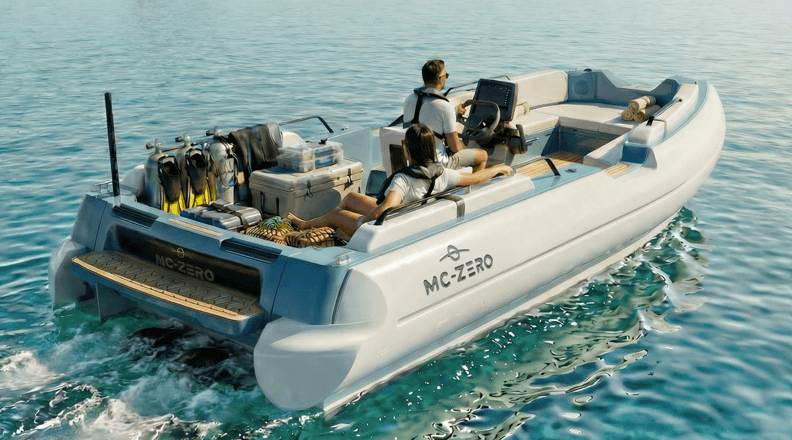
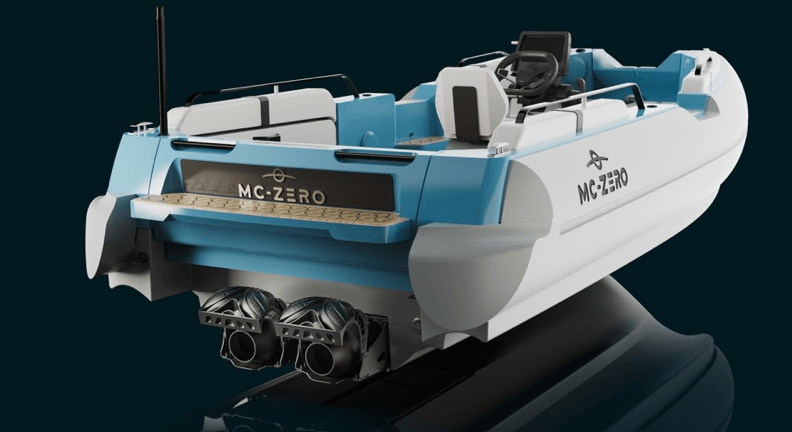
A quick glance at the MC-ZERO 450 leads to the impression that it is a RIB – Rigid Inflatable Boat, but closer inspection reveals that it is actually a carbon hull. The rigid carbon construction has straight inside walls and an integrated outer fender system so that the contour of inflatable pontoons doesn’t take away valuable interior space.
The company says the result is “a structurally superior vessel that is lighter, stronger, and maintains its premium finish throughout its lifetime —no inflation or maintenance required”. Those straight walls also allow for flip seats along the sides of the interior.
The next obvious thing that sets the new electric jet tender apart is a world-first (and patent pending) ‘moveable helm’ that can be fixed in one of three positions: aft, mid or foredeck. That makes for a modular-type design with huge flexibility.
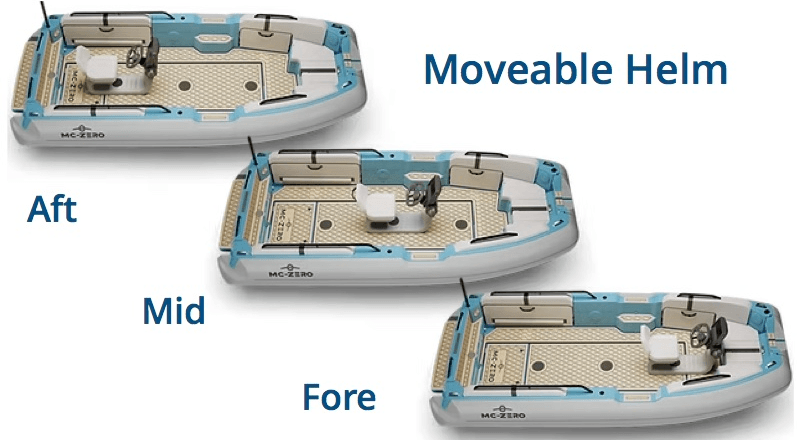
You can slide the helm forward and flip up the seats to clear the deck for a kayak, boards, skis or dive gear, or move it back and flip down the seats to create a social, open-plan for up to eight passengers.
When you combine those features with the fact that the electric jet propulsion system is entirely below deck and there are no outboard motors or engine boxes, the overall space savings are big. MC-ZERO says internal volume for the 4.55 meter / ≈ 15 ft boat is 40% greater than on similar-sized traditional RIBs.
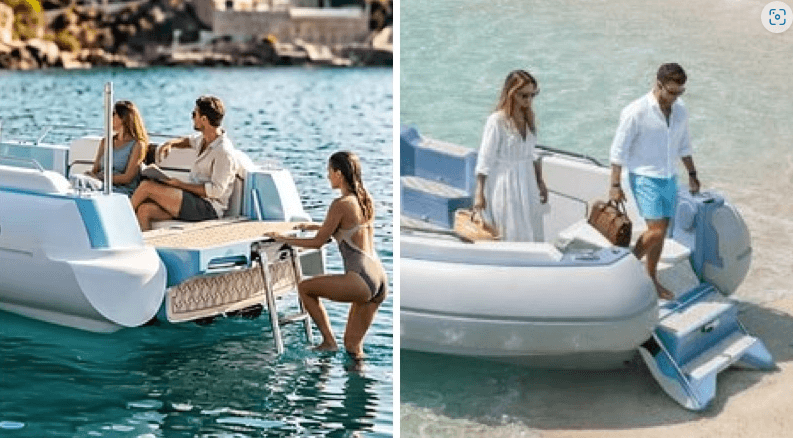
It also allows for a complete flow-through layout, and MC-ZERO have added a couple of nice touches. At the bow, unfolding electric drop-down steps make getting in and out easier when landing on a beach or in shallow waters. At the stern, there is a transom platform that extends the deck for a wider, more stable surface at water level. Both are deployed with the touch of a button.
Twin electric jets add versatility
The MC-450 has two of the 30 kW motors and total battery capacity of just over 32 kilowatt hours, enabling a top speed of 25 knots (46 kph / 29 mph) and a range of 27 nautical miles (50 km / 30 mi) when cruising at 5 knots (9 kph / 6 mph).
Those specs make the boat suitable for just about anything a tender is asked to do: quickly transfer guests to and from shore, slowly explore shallow waters, get out to deep waters and anchor as a dive boat, or anything in between.
The near silent operation and zero emissions of electric propulsion is another bonus, appreciated not just by those in the boat, but also fish and other aquatic creatures nearby. The twin jets allow for navigation in the shallowest of waters and precise low-speed maneuvering in tight spaces.
The 48V semi solid-state batteries from SAFIERY are a significant feature of the MC-ZERO system and offer significant benefits. Compared to standard li-ion chemistries, semi solid state is less prone to safety problems and can store more energy by weight. The battery pack has a 5-year warranty and expected life of 10,000+ charge and discharge cycles.
In addition, the 48-volt architecture is ‘safe-to-touch’, meaning anyone working on the boat does not require any special high voltage training or specialized equipment. It also reduces any electrical risks for those on the boat.
While it is always possible to design a more spacious tender, the realities of inflatable pontoons and fossil fuel motors sometimes place a ceiling on what can be accomplished. The MC-450 is a great example of how – for some applications – electric propulsion can not only make for a cleaner, quieter ride, but also allow for greater design flexibility.
Well done, McConaghy and ZeroJet, for a tender that responds to customer desire and use cases –demonstrating how electric propulsion can add to overall boating enjoyment in more ways than one.
The company is also working on a smaller MC-ZERO 325 model that should be released soon.