New Integrated and Scalable Marine Battery System
Developed for the Volvo Penta Professional IPS Hybrid, a new energy system from ZEM provides a fully compatible and ‘stackable’ modular battery system.
As large scale all-electric and hybrid propulsion systems continue to arrive in the commercial sector, so the industry is adopting high-performance batteries from land-based transport, along with the fast-charging systems needed to ensure a long and efficient life.
One of the specialists in this field is the Norwegian company ZEM, now 85% owned by Volvo Penta and officially part of the Volvo Group. The company was established in 2009 to ‘green’ the commercial workboat sector and has since supplied over 114 integrated electrical propulsion installations.
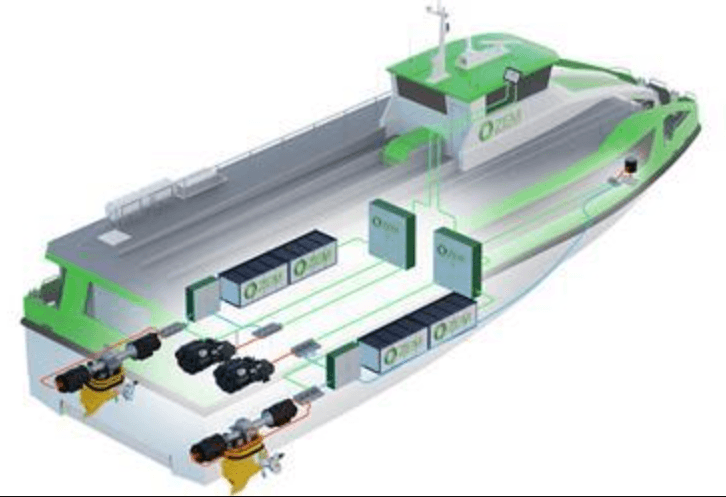
A graphic of a serial hybrid concept due for release to market later this year. A pair of IPS Professional Hybrid drives are fitted with two electric motors on each leg. Power is generated by twin D13 diesels, stored in the LFP battery racks, and the energy flow monitored on the bridge by Volvo’s EVC system.
A graphic of a serial hybrid concept due for release to market later this year. A pair of IPS Professional Hybrid drives are fitted with two electric motors on each leg. Power is generated by twin D13 diesels, stored in the LFP battery racks, and the energy flow monitored on the bridge by Volvo’s EVC system.
Launching at Seawork 2026 was their latest 510V - 745V battery system, which uses Lithium-iron-phosphate (LiFePO4) batteries sourced from the leading Chinese manufacturer CATL.
CEO Jonathan Sørbye with the latest modular and scalable 657V (nominal) LFP marine battery pack. The company is 85% owned by Volvo Penta and specializes in custom systems for marine workboats and fast ferries.
CEO Jonathan Sørbye with the latest modular and scalable 657V (nominal) LFP marine battery pack. The company is 85% owned by Volvo Penta and specializes in custom systems for marine workboats and fast ferries.
“The batteries are the same ones used by Volvo electric trucks and buses,” said CEO Jonathan Sørbye. “We know they are robust and well proven in a high-cycle environment. We take the batteries and then build them into this modular and fully integrated marine system, for which we have obtained full DNV certification.”
The modular ‘racks’ are all interconnected and can be expanded as demand increases. The new LFP stack at Seawork was showing a typical arrangement with a nominal voltage of 657V, with a relatively modest charge/discharge rate of 1C. The pack provides 176kWh of energy with a usable energy density (assuming a state of charge range from 10%-100%) of 150Wh/kg. Intended for fast ferries, and adaptable to performance electric yachts, the network can be connected into Volvo’s ‘propeller to helm’ Electronic Vessel Control (EVC) system. The integrated network also offers DC distribution, AC Microgrid and charging, and MCS (Megawatt Charging System) and CCS2 (Combined Charging System Type 2) connectivity. The automotive-style CCS2 plug, and socket is rapidly becoming an industry standard for electric leisure vessels and is used by quayside suppliers such as Aqua Superpower.
The key takeaway from ZEM is how their systems are fully customizable and scalable (33kWh – 10MWh) but based on a proven platform. The technology is also said to be futureproof, so as battery technology evolves, it can be seamlessly integrated into the existing system.
ZEM currently has 41 employees and is now expanding into other sectors of electric transport. The close association with Volvo will lead to innovations from the truck, bus and heavy off-road machinery sectors moving swiftly to commercial and leisure marine.