NTSB: Tiny Defect Caused Dali Power Failure That Led to Key Bridge Collapse
By Meg Walburn Viviano
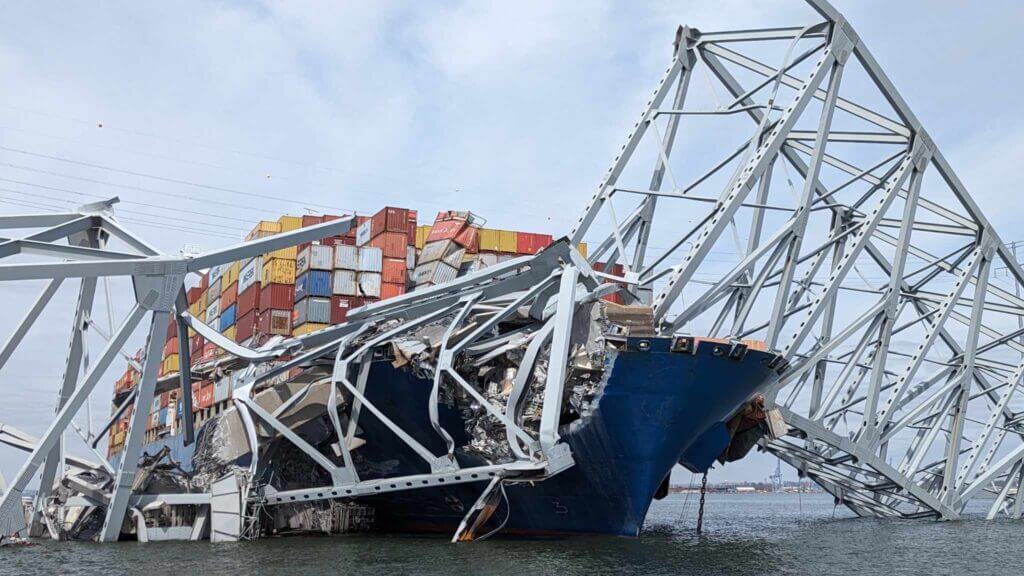
The National Transportation Safety Board (NTSB) met Tuesday, Nov. 18, to publicly lay out the cause of the M/V Dali strike that destroyed the Key Bridge. The board also made in-depth recommendations that could prevent another catastrophic bridge strike by a ship.
Miswired Signal Failure
In its statement of Probable Cause, the NTSB found that the chain of events that led to the Key Bridge collapse started with a misplaced label on a tiny wire that had likely been that way since construction of the ship a decade ago. Just one signal wire among thousands was loose in its terminal block (a piece that is smaller than a deck of cards). The signal wire did not fit tightly because wire-label banding had been placed improperly, making the wire too thick to fit properly into the spring-clamp gate. Its precarious connection resulted in an electrical power loss (blackout) as the Dali approached the Key Bridge. The blackout led to a loss of lighting and machinery (like engine cooling and steering gear pumps), which caused the ship to lose propulsion and steering.
A second loss of power occurred after the first, due to insufficient fuel pressure to two of the ship’s online diesel generators. Investigators found that the ship was using a flushing pump as a makeshift service pump, which did not automatically restart after the power loss, as a proper service pump would have done. According to the NTSB, the improper pump had been that way for at least seven months, though ship operator Synergy said they didn’t know about it. Investigators also learned the same kind of flushing pump had been used improperly in other Synergy ships.
Even though investigators found the pilots and the bridge team acted in a timely manner in response to the emergency, their actions were ultimately ineffective because the vessel lost power so close to the Key Bridge.
Preventable Safety Gaps
The NTSB revealed its findings just one day after discouraging news on the Key Bridge rebuilding effort: it’s now estimated the new bridge will cost twice or three times as much as initial estimates, and won’t be completed until late 2030. In the meantime, drivers contend with longer commutes and businesses on both sides of the Patapsco continue to be affected by the lack of access.
The NTSB calls the loss of the Key Bridge a preventable disaster.
While a power loss led the Dali to hit the bridge, the agency also found that the bridge did not have countermeasures to make the bridge less vulnerable to collapse from a ship strike. Crucial countermeasures could have been implemented if the Maryland Transportation Authority (MDTA) had done a vulnerability assessment as the American Association of State Highway and Transportation Officials recommended in 1991 and again in 2009. The Key Bridge was above the threshold of risk for catastrophic collapse from a vessel collision. Along with the Key Bridge, federal officials recommend vulnerability assessments on 30 U.S. bridges, including both spans of the Chesapeake Bay Bridge.
The loss of life when the Key Bridge collapsed could have been lessened if there had been more immediate communications to notify the highway workers to evacuate the bridge, the NTSB said. While the pilots, dispatchers, and police prevented driver deaths by quickly stopping vehicle traffic on both sides of the bridge, the construction workers weren’t notified as quickly. In one of its findings, the NTSB said, “Had the inspector and highway workers been notified of the Dali‘s emergency situation about the same time the MDTA workers at each end of the bridge were told to block vehicular traffic, the highway workers may have had sufficient time to drive to a portion of the bridge that did not collapse.” It’s a heartbreaking reality for the families of the six workers killed in the disaster.
In its recommendations, the NTSB tells bridge owners to evaluate, and possibly implement, “motorist warning systems capable of activating when a threat is identified and immediately warn and stop motorists from entering onto the bridge.”
Other NTSB recommendations to help prevent tragedies like this one include more redundancy in large commercial ships’ steering and propulsion systems and more data recorders on board, including in the engine room.
The board recommends ship inspection manuals be written more clearly to ensure that inspectors check thoroughly for problems like the loose wire connection. The NTSB also believes that thermography, using infrared light to measure surface temperature of the switches compared to engine temperature, could have caught the loose wire.
”Our investigators routinely accomplish the impossible, and this investigation is no different,” said NTSB Chairwoman Jennifer Homendy. “The Dali, at almost 1,000 feet, is as long as the Eiffel Tower is high, with miles of wiring and thousands of electrical connections. Finding this single wire was like hunting for a loose rivet on the Eiffel Tower… But like all of the accidents we investigate, this was preventable,” Homendy said. “Implementing NTSB recommendations in this investigation will prevent similar tragedies in the future.”
You can see the NTSB’s synopsis of actions from Tuesday’s meeting, including the probable cause, findings and recommendations, on ntsb.gov. The complete investigation report will be released in the coming weeks.