RAD 40-kW Electric Outboard Motors Power Pangolin Photo Safari Boats
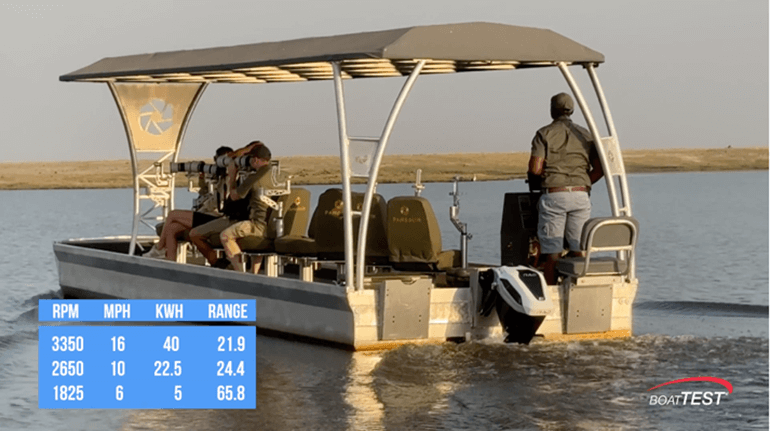
During the summer of 2025, Pangolin Photo Safaris began powering their 104’ resort houseboat on the Chobe River, in Africa, as well as their 8-passenger photo boat, with RAD 40-kW electric outboard motors. This marks a most unusual application for RAD motors, but one that makes sense for them, and other applications all over the world. By capturing the sun’s energy with solar panels, storing it in massive battery banks, then using it as needed to power both the RAD motors and virtually all needs on the luxury mothership “Pangolin Voyager,” this luxury photo safari company has been able to create a truly sustainable operational environment.
104’ Luxury Houseboat Mothership
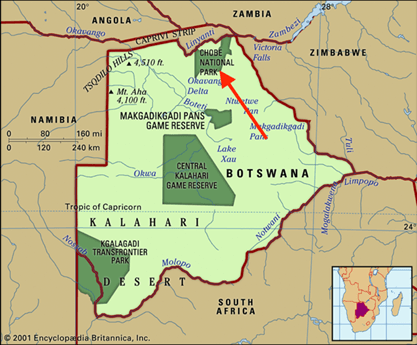
The Pangolin Voyager is owned by Pangolin Photo Safaris, which is the premier African outfitter for truly world-class wildlife photography. This remarkable vessel is located in Africa, between Botswana and Namibia, which is one of the richest areas in Africa when it comes to up-close viewing of wild game.
She’s 104’ long, 38’ wide, weighs over 60 tons, and she’s the largest solar-powered houseboat in the world…and she is the only houseboat in the world propelled by four electric outboard motors – RAD 40-kW electric outboards. The RAD units are axial flux motors driving 13” x 8” 3-bade props. The energy for the motors comes from 80 solar panels -- adding up to 2,152 square feet -- that produce from 20 to 30 kilowatts per hour depending on the time of year, time of day, and other conditions.
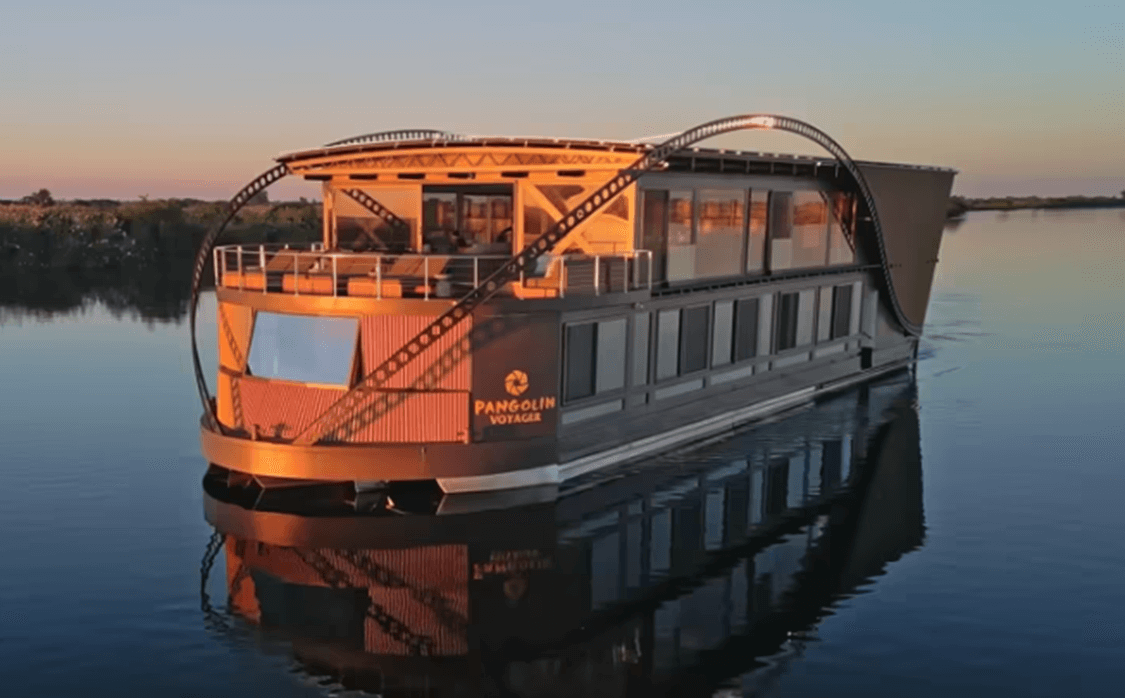
There are five en-suite staterooms on the Pangolin Voyager, each with a huge picture window looking out on the river and passing game. (Four of the staterooms are used for guests, and the fifth one is for the photographer instructor that accompanies every tourist outing.) The top decks are the public areas for the guests aboard, with lounges both outside and inside, a well-stocked bar, dining room and even an air condition photograph room where guests can edit their wildlife images after a long day on the water. The galley is behind the bar in the stern.
All of this was created by the company’s co-owner, Guts Swonepoel, an internationally known photographer who started his company in 2015, long with his business partner, Toby Jermyn, a London businessman. The two have built what is arguably the best photographic safari business in Africa.
Why Choose Electric Outboard Motors?
When operating a luxury houseboat and photoboat in the African bush, the last thing an owner needs is downtime due to maintenance problems. If guests can’t go out on a boat because the outboard engine isn’t working, that tour company won’t be in business for long.
A 4-stroke 50-hp gasoline outboard engine can have over 1,000 named parts, over 200 in the powerhead alone, more than 100 in the ignition system, 150 in the fuel and air intake system, 100 in the cooling system, and so on. Any one of these parts can put the outboard engine out of service, and a tour company out of business.
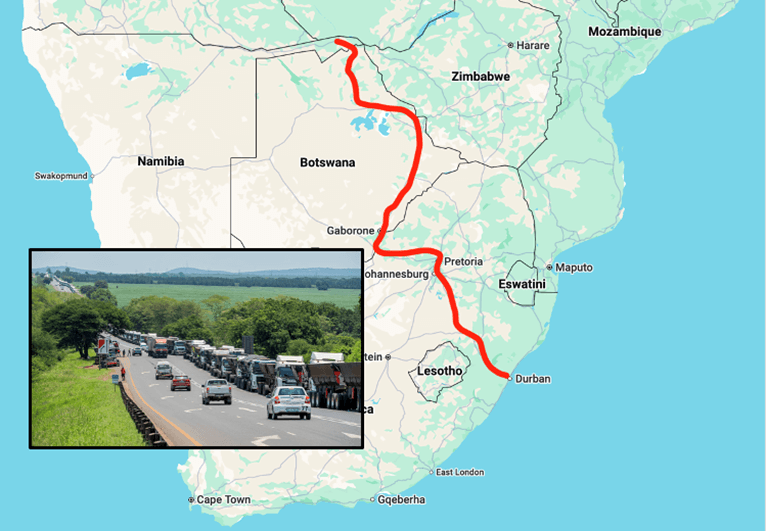
Making matters worse for tour operators in the bush, ordering outboard engine parts and having Amazon Prime deliver them the next day can’t happen. For example, the Pangolin Voyager’s home base on the Namibian side of the Chobe River is over 1,100 miles from Durban, South Africa, and 736 miles from the nearest International Airport, in Johannesburg.
That’s the good news. The bad news is those parts have to clear customs in three countries – South Africa, Namibia and Botswana. The latter being the worst, where trucks are lined up from 5 to 20 miles every day of the week waiting to clear customs. Typically, according to Guts, it takes two weeks for parts to clear Botswana customs.
Electric Motors Are More Practical
Another reason that Guts decided to use electric outboard motors was because they are more practical/ They are quiet. One need only hear the racket created by a single outboard -powered boat shattering the calm on the Chobe River to understand how disturbing it is to the game. Thirsty animals must brave a 100-decibel outboard shrieking down the river to get a drink. More likely they’ll stay away till nightfall when boating on the river is forbidden.
When close to the animals and the ICE-powered photo boats are quietly at idle, there is still the constant clunk, clunk, clunk of the dog clutch going in and out of gear, which frightens the animals s, even the elephants. Gas powered tourist photography boats often can’t get as close as they’d like. The solution is electric outboards which are quiet, and changing gears only means the motor turns in the other direction quietly.
Gasoline is not cheap in the middle of Africa. All of that makes selecting an electric outboard motor a no-brainer.
The RAD Power System
Power from the solar cells on the roof of the Voyager is directed to the two 61 kW stacks of Lithium-ion batteries just abaft the helm on the houseboat. These are the house batteries. They power everything on the boat including the air conditioning. Not only that, but because on a typical day, the 80 solar panels produce more electricity than the houseboats equipment consumes, the system is “charge-positive” during the day. It only needs to start drawing down the batteries after sunset.
Once the house batteries are fully charged, electricity is then fed to a 61 kW battery pack in the bow just under the deck, and to another one in the stern to power the four RAD electric motors. These batteries power both port and starboard RAD outboard in the bow, and in the stern.
All told, there are 183 kWh of battery capacity on the Pangolin Voyager.
At night, a cable is run from the mother ship to recharge the 61 kW battery under the deck of the 8-passenger photo boat. By keeping all of the battery banks the same, one set of spare parts serves all batteries, and they can be inter-changed in a pinch.
About the RAD Electric Motors
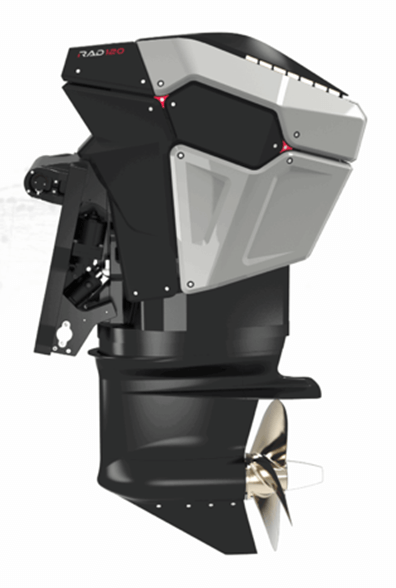
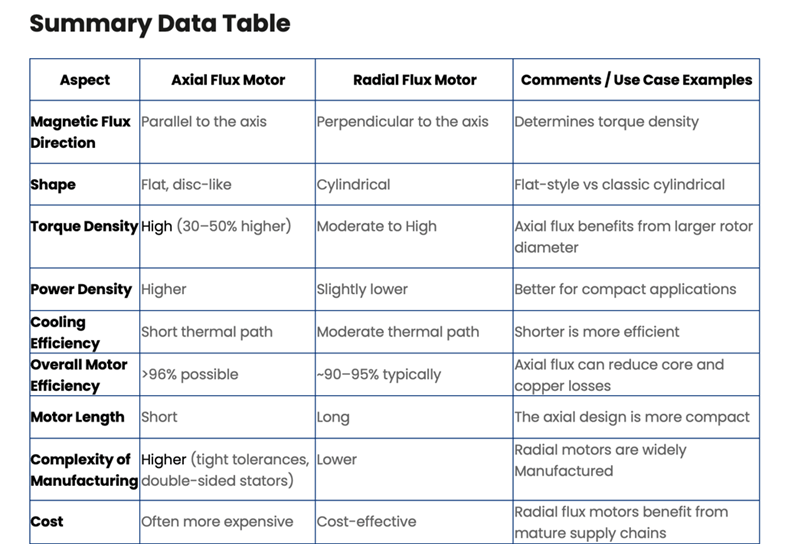
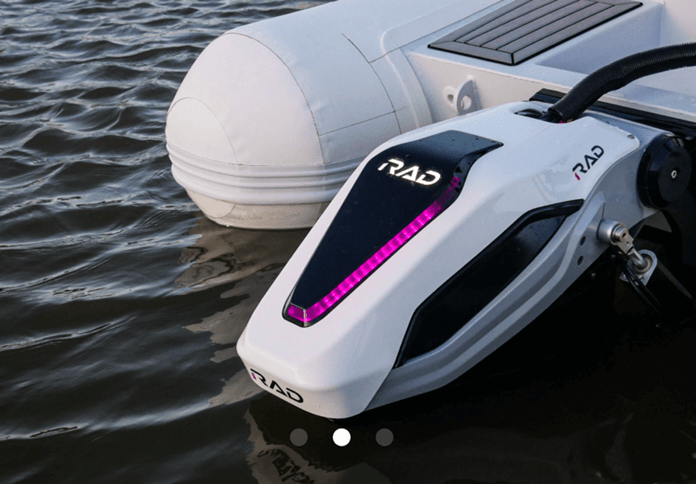
We asked Guts why he chose RAD electric outboards, and he said there were a number of reasons. One of the most important is the fact that RAD motors use the relatively recent re-emergence of the axial flux architecture, as opposed to the traditional radial flux one. The axial flux design gives RAD motors a demonstrable performance advantage over the traditional radial flux design, which was patented in 1888 by Nikola Tesla. Rare earth, soft composite, permanent magnets now allow magnetic flux to flow in three dimensions, rather than just two, as is the case in radial flux motors.
This important difference means that axial motors can have 30 to 50% more torque than radial flux motors – an all-important detail when it comes to outboard motors pushing a 60 ton luxury houseboat. Greater torque means higher thrust, which is the Achilles heel of a conventional 4-stroke gas outboard – or shall we say, one of them.
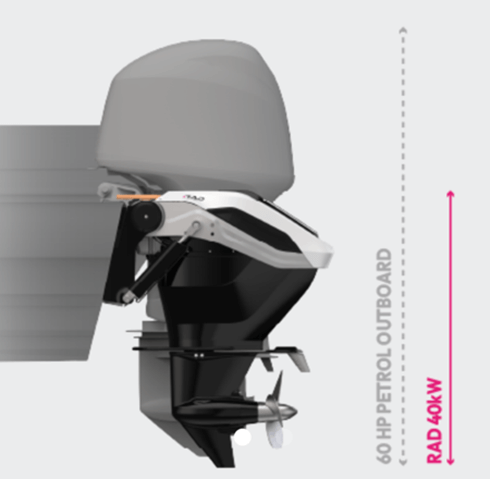
That gives the RAD electric outboard a low profile, which allowed Guts to place the four motors under the houseboat’s floorboards, rather than having to create a well for them. On his 30’ photo boat, the low-profile design meant he didn’t need to waste precious inboard space on an outboard well, and the motor tilts up 80-degrees.
180-Degree Turning
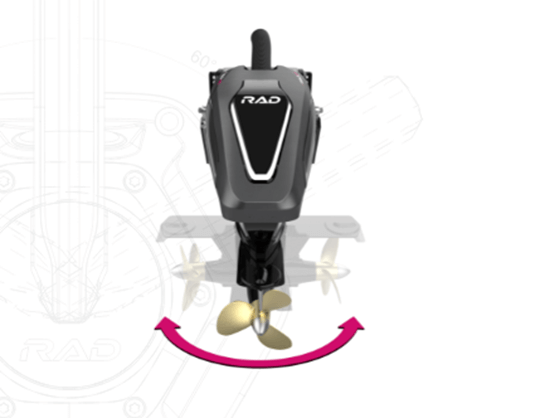
Another thing Guts liked about the RAD design was that he didn’t have to turn the whole outboard unit when maneuvering, because the lower unit swivels. Not only that, but it rotates 180-degrees – the only outboard made in the world -- either electric or gas powered -- that can do that.
On the Chobe River that means the Pangolin photo boat can point into the beach where the animals are, then turn the boat on its own axis 90 degrees to give all 8 of the photographers an equal and clear vantage point to the game.
When it comes to docking alongside the mother ship, all the driver has to do is point the bow in, then turns the prop perpendicular to the waiting crew and the photo boat slides right up to the boarding steps.
The 4 RAD electric motors on the 60 ton Houseboat allow here to do 360-degree turns on a single point, something that is unheard of with stern-only propulsion.
Closed-Loop Cooling
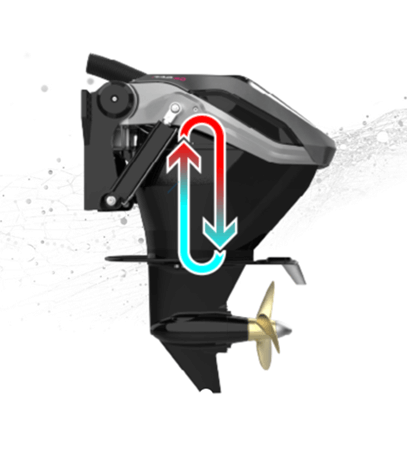
The RAD outboard also has its own closed loop cooling system with 12 volt pump to cool the motor. The unit’s heat exchanger is internal to the lower unit’s cavitation plate, thereby obviating the need for a raw water pump that can become damaged by debris. An internal 12 volt pump keeps the coolant flowing. This is an ideal design for saltwater applications, as no freshwater flush out is needed after each use.
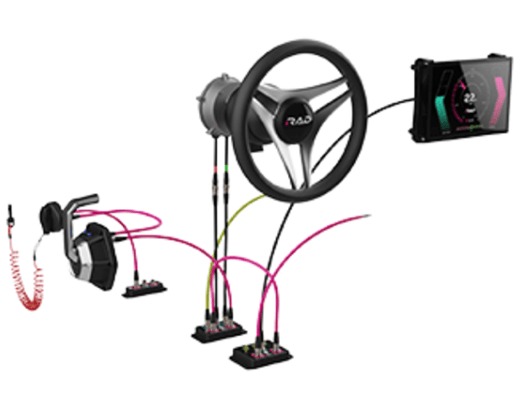
All Digital Control. Maintenance headaches are further reduced by eliminating cable steering and throttle controls. The RAD system is strictly drive-by-wire digital. Not surprisingly, Guts opted to have RAD’s telemetry system connected to all of the RAD equipment so it can be monitored at the RAD factory in England 24/7. If the company’s techs detect a possible future problem, Guts can be notified immediately to take action.
The RAD Fully Turn-Key Solution
RAD Propulsion provides the full turnkey solution for boatbuilders with long-lasting, dependable, and high-capacity electric batteries for your outboard. Our Lithium-ion batteries are available in 21 kWh and 61 kWh sizes, to fit a variety of boat configurations and requirements – whether it be for commercial use or simply for boat enthusiasts to enjoy the waterways.
- 40 kW of continuous power
- 400 V architecture, fast charging compatible
- Compact footprint maximizes usable space
- Maneuvering made easy with 180° steering (±90°)
- Precise control with drive-by-wire throttle and steering
- Ultra-low maintenance
To find out more about RAD motors and their electric solutions and Pangolin Photo Safari visit: