Reducing Susceptibility to ESD
By Craig Ritchie
Electric shock drowning incidents related to faulty shore power connections are coming under greater scrutiny.
One consistent trend in boating over the past decade has been a relentless increase in levels of onboard electrification, which has in turn driven demand for increasingly more powerful shore power installations. Unfortunately, this increase in electrification has also driven concern over increasing incidents of Electric Shock Drowning (ESD), with marine shore power systems coming under increased scrutiny among boaters, boat builders and marina operators alike.
Understanding Electric Shock Drowning
Electric shock drowning refers to a condition where individuals in the water come into contact with electricity, typically leaking from a faulty shore power connection. According to the US-based Electric Shock Drowning Prevention Association (ESDPA), an electric leak of just 10 to 15 milliamps – or around 1/50 the wattage required to power a standard 60-watt light bulb – can incapacitate a person in the water and result in a fatal drowning. The organisation further notes that this phenomenon is far more widespread than previously believed, with a random sampling of shore power cords in US freshwater marinas revealing 13% of boats tested to be leaking some volume of electrical current (AC) into the water. ESD, it says, is a serious problem that results in multiple deaths around the world every year.
The cause of this escaped electrical current can frequently be traced to unreliable shore power connections resulting from long-term corrosion, improper installation, or faulty ground circuits. In most cases, these leaks – and resulting accidents – can be prevented.
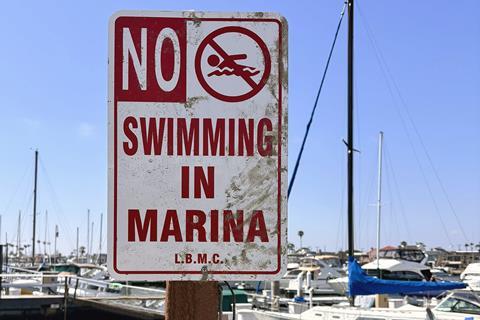
The easiest way to protect against stray electrical currents is for marina operators to simply keep people out of the water. While a number of marinas post no swimming signs on their property, these may not explain why entry into the water is prohibited. In the US, a proposal introduced to the US Senate in July would require marinas to update signage to read “ELECTRIC SHOCK HAZARD RISK: NO SWIMMING WITHIN 100 YARDS OF THE BOAT DOCK” in order to underscore the potential safety risk.
Improving Marina Electrical Safety
Unfortunately, no amount of signage can protect persons who enter the water by accident. This is why there are growing calls to have marinas require all berthed vessels to be equipped with an isolation transformer or shore power converter. These simple devices convert potentially unreliable AC shore power into clean current for onboard distribution, effectively creating an onboard power source. This is critically important because stray electrical current always tries to return to its source – leaking current from a vessel with a shore power converter installed will return to the boat, rather than attempting to return to shore through the water, where it represents a significant shock hazard.
Beyond that, both isolation transformers and shore power converters further correct against the potential for polarity faults arising from incorrect connections. Reversed polarity can be extremely dangerous onboard a boat because it allows current to continue flowing through AC-powered appliances even when they’re powered off. When polarity is reversed on common household appliances like refrigerators, their metal casing can become energized with stray electrical current, creating a potential electrocution hazard. This threat is eliminated with the use of an onboard shore power converter.
While adding protective devices like isolation transformers or shore power converters to protect against shore power woes does represent an additional cost for boat buyers, the ESPDA says the device can pay for itself by protecting against the galvanic corrosion that can occur between boats in a marina that share a common AC shore power ground. By preventing this corrosive damage to underwater fittings, the shore power converter can reduce the boat owner’s overall maintenance expenses.
Most importantly, the use of isolation transformers or shore power converters can save lives by protecting against electric shock drowning. That alone should be reason enough for marina operators today to support their use onboard every vessel.