The Remote Boat (Revisited)
Virtual Boating Is Here!
Let’s face it. Boating can be a pain in the ass. While most owners dream of lounging on the fantail sipping a cocktail, the reality is that much of the time, they are scurrying around tending lines, tying knots, lowering antenna, navigating channels, doing routine maintenance, and hundreds of others things that cut on to cocktail in the fantail time.
Unburdening Boatsman
Over the years, many pieces of equipment have been designed to ease the boat person’s burden – many of which are foolish and/or redundant. There are automatic dockline reels. There are electric antenna retractors (to save you all that trouble of pulling down that little lever and lowering the antenna manually). There are cleats that you simply drop a line into (to avoid having to learn all those pesky knots).
There are remote controls for every dammed thing including davits, doors and passarelle deployment – all designed to save the owner or crew a few seconds here or a few steps there. Hell, there’s even a remote-controlled shore water valve system. When you tie in to shore water pressure, it will save you the burden of opening and closing the valve. This little gem (with the unfortunate name of “Muff Master” TM) opens and closes the valve with a simple push of a button in a convenient hand-held key chain remote control transmitter.
Our poor, downtrodden sailing brethren have it even worse. These poor guys are always feverishly chasing around the deck pulling on strings and wires, cranking windlasses, getting wacked in the head by flying booms and, generally, getting soaked and being miserable. The sailing industry (which has been in the toilet for a number of years now) has made a great effort to simplify and bring more luxury to sailing in an attempt to snag people new to boating and to bring back people who have converted from sail to power. All kinds of innovative things are being tried to simplify sailing (which, as you may know, your Spectator views as a complete anachronism).
Tired of cranking those pesky winches by hand? Buy an electric winch handle! It looks like an oversized polisher that fits in the key atop the winch and rotates one way or the other. Tired of choking yourself on the strings and wires proliferating from the mast every time you walk forward? An unstayed mast is the answer. Tired of sailing in competition with rough water, nasty powerboats always getting in the way, heat, cold, rainstorms and fluky wind?
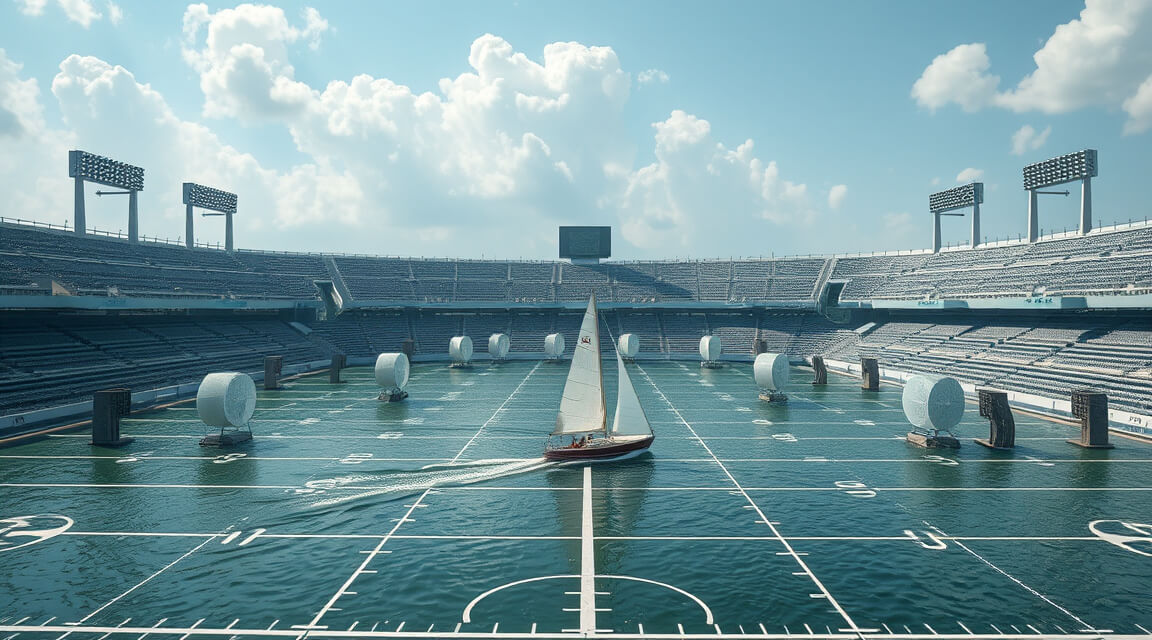
Well, you can now sail in competition in what is called “Arena Sailing.” Think of a football field filled with water and huge electric fans mounted all around the perimeter. The Arena is closed to the elements and climate controlled. The electric fans provide dependable breezes. Spectators can sit around the artificial lake in grandstands cheering on their favorites. (Equally exciting for the spectators would be a grass growing competition in the middle of the Arena).
There have been a number of completely automated, remote controlled puffboats built where sails are raised and lowered by the push of buttons. Sheets (and probably blankets too) are adjusted at the touch of other buttons. The whole thing is orchestrated from a central, enclosed climate-controlled console by one man thus minimizing crew and allowing the operator to stay out of the elements. Now one might think this would be the absolute ultimate in isolating one’s self from the process of zepherboating but no, something new and unbelievable has come along.
Robosailer!
Next month, the first circumnavigation of the world by an unmanned sailboat will be inaugurated (no joke friends). This is the brainchild of a little college in Germany – HOCHSCHULE FURTWANGEN (bless you!) – and is a student/teacher project lead by a couple of sailing eggheads: Dr. Reiner Schmid and Professor Rolf Katzsch. Their breezeboat is a 36-feet trimaran built of high-tech materials and designed by ace multihull ragboat designer Dick Newick. The thing has a carbon fiber wing mast capable of rotating 360 degrees.
The complete operation will be controlled from a command center at the college by a staff of 10 experts and 160 students. The boat will be sailed by a “digital crew” consisting of computers and a myriad of sensors, actuators and instruments. Multiple onboard cameras will put them “on the scene”. The vessel has a rather bad name – “Relationship” (which probably sounds better to Germans than it does to us). The whole show will cost about 2 million bucks. Of course, the complete trip would not be by remote control. A real living, breathing crew will take the boat from her dock into open water at which time they will jump ship. They will again join the vessel prior to arriving in port.
Sinister Intent?
Most people reading this story will probably assume that this is merely another “off the bulkhead” academic endeavor. Your Spectator, however, sees something a bit more sinister. This technology can be refined and marketed to smugglers (if caught, who will be arrested – Microsoft?) and to dejected rag baggers who are too old to sail or just basically tired of the whole sailing rigmarole. Visualize this scenario: a beautiful 60-foot remote controlled ragboat is gently tugging on her lines at a marina in Shelter Island, San Diego.
A crew boards with much bravado talking of crossing the ocean, beating a storm and setting new records. A band plays as they are seen off by friends and the press while they gloriously sail out into open water. As soon as they are out of sight, however, they set the vessel on “automatic” and are spirited back to shore in a fast powerboat. The Zepherboat continues unmanned until she nears French Indonesia where the crew is spirited back on board to gloriously sail into port with much fan fair and adulation. What a great, hassle-free way to go sailing!
Or, picture this: a salty type is hanging around the Yacht Club bar. You can tell he is “salty” from his salt encrusted top siders and his captain’s hat with corroded gold emblems. We join him in conversation with members of the club who are totally in awe of him “Yeah mates, we sailed across the Atlantic in five days. Was a hell of a trip. We met the mother of all storms off Bermuda, where chased by pirates near the Azores and ran aground coming into Gibraltar. Dammed near lost the rudder.” People’s mouths are agape as they listen to his tale. The truth is his boat really went through these things, however, he was not aboard. He was merely monitoring progress of his unmanned puffboat, which transmitted real time pictures via satellite direct to his big screen TV in his comfortable home.
This project joins the ranks of the wonderful remote controlled, computer activated toilet/bidet that the Japanese invented, computerized notebooks (which take far longer to retrieve information than a conventional note pad) and all the other worthless gizmos made possible by the microchip. Chalk this up to another useless task performed by computers simply because they can do it.
(Reprinted with permission of Regina Fexas.)
If you would like to read more of Tom's pearls of wisdom, tune in next Friday -- "Fexas Friday."
Better yet, why not get a full dose of infectious Fexas whenever you need it -- and buy one of the volumes below. Better yet, why not buy all of them -- we call them the "Fexas Five." They will provide many evenings of fun reading (better than Netflix), and you'll make the widow Regina very happy knowing that Tom will live on with you the way most of us remember him.
Order 1, 2 or "The Fexas Five" --

To find the "Fexas Five" on Amazon, click here...
Tom Fexas (1941-2006) was one of the most influential yacht designers of the last quarter of the 20th century. With the narrow Wall Street commuters that were built in the 1920s and '30s always on the back of his mind, he wanted to design boats that were at once fast, comfortable, seaworthy and economical to operate. Over the years, he and his firm designed over 1,000 yachts for some of the most prestigious boat builders in the world, including Choey Lee, Palmer Johnson, Grand Banks, Mikelson Yachts, Burger, Abeking & Rasmussen and many others.
Even though toward the end of his career he only designed megayachts and superyachts, including the remarkably influential PJ "Time" in 1987, he is best remembered for his first major vessel in 1978 -- Midnight Lace -- which became a series of 44-52-footers. They were light, narrow, and fast with relatively small engines. He was also influential in the boating community because of the monthly column he wrote for Power and Motoryacht, which began in its very first issue in January 1985.