Rise of the Solar Garage
By Jake Kavanagh
Pioneering what could become a major trend for electric runabouts, the Portuguese-built Faro Powerdock also lifts the hull clear of the water.
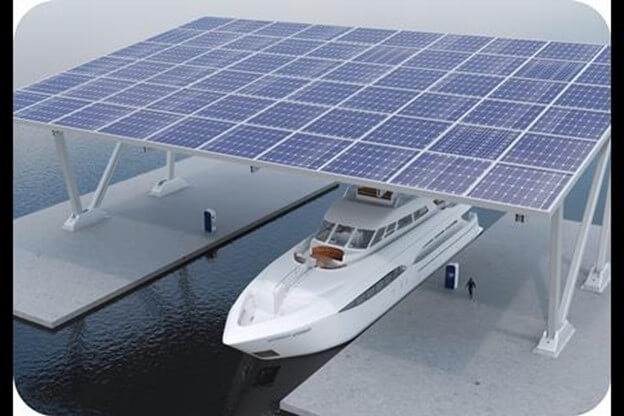
One of the first proponents of a solar-covered boat dock was the Italian company Sealence, the makers of the DeepSpeed electric pod, but that was on a much grander scale than the towable Faro Powerdock. This latest solar-topped pontoon garage has been designed around the needs of the Faro5 electric launch but has been sized to fit just about any standard marina berth throughout the world. Not only does the dock recharge the boat’s 6kWh battery bank in around 4 hours (7-8 hours for the larger batteries) it is also able to lift the hull out of the water, removing the need for antifouling. If the owner wishes to cruise in another area, the dock can either be towed by water or moved by road to the new location.
The product impressed judges in November’s Boat Builder Awards, held in association with Raymarine, earning Faro a win in the Innovative Design Solution award, sponsored by Fusion.
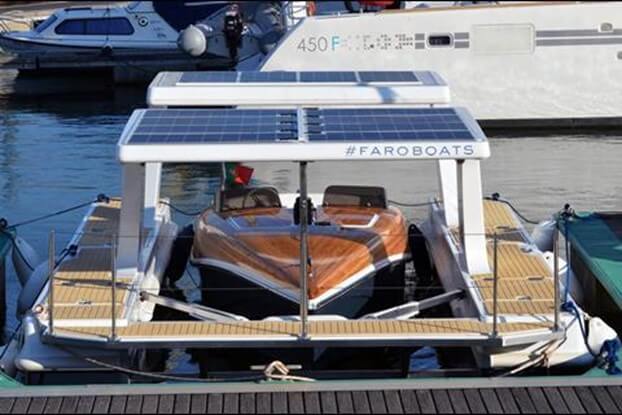
The solar array on the roof can be supplemented by wind turbines and advances in bi-directional charging means that soon the dock will be able to feed excess power back into the grid via marinas equipped with suitable infrastructure. This energy transfer will help defray the mooring costs, which in some areas may be higher as the pontoon could be classed as a small catamaran due to its width.
Based in Portugal, Faro is a forward-looking company dedicated to producing sustainable boats for use with electric propulsion. The 5m x 2m Faro5 is available in three distinct finishes (wood, composite and branded) and with a choice of electric motors. These range from a 6kW Torqeedo (top speed 6 knots) to a 30kW Huracan (top speed 22 knots). The batteries specified are lithium iron phosphate and matched in size to give each motor option a range-extending run time of 8 hours at 5 knots. Voltages can vary from 48V to 250V, depending on the installation, with the Powerdock carrying the necessary conversion electronics on board.
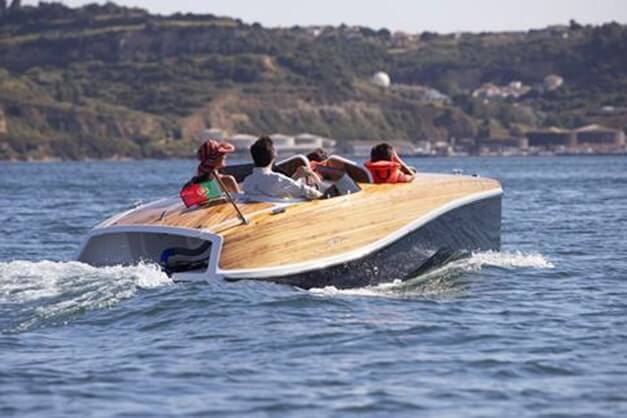
Larger versions of the Faro Powerdock can be configured for boats of up to 12m and are now available for pre-order. The layout of the renewables, and the mix of solar and wind, can also be modified depending on the location.
This clever blend of practical solutions could well be the forerunner of large numbers of solar garages for increasingly larger electric motorboats, removing the need to carry solar panels on deck. The only drawback we can see is that the panels will need regular cleaning in areas popular with seabirds, and perhaps higher mooring costs than for a standard 5m runabout, but the power generated when the boat is unused should make that a minor inconvenience.