Running Hazardous Inlets: Capt. Steve’s Near Disaster And The Lessons He Learned
“The NTSB final report on the capsizing of the small charter fishing vessel determined that the probable cause was the decision of the master to attempt to cross the bar at Garibaldi, Oregon in hazardous sea states that existed at the time.” “Boca Raton Inlet is dangerous and particularly hazardous to all boats not designed for open seas. Persons using this inlet should be experienced boatmen and should be extremely knowledgeable of the area.” “The Columbia River Bar is opened and closed to navigation at the discretion of the Columbia River Bar Pilots, based on existing or anticipated weather conditions.” So what are we mortal boaters to do? What do you do if the weather has turned nasty and there are breakers on the only inlet to home for 50 miles? If you chose to run that inlet, doing it right might be the difference between a few heart flutters and disaster. Let’s look, with Capt. Steve, at some lessons he learned and see what we can do right, and wrong.
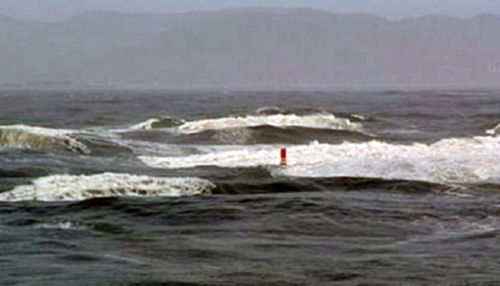
Capt. Steve’s Story…
Anyone who has been a boater long enough can tell you horror stories of crossing a rough inlet, and I’m one of them. My lesson happened in the late ’80s as I was taking one of my party fishing boats for a seasonal haul out in the Cape Cod Canal. The trip called for me to transit Woods Hole and enter Buzzards Bay to set up an approach to the Canal. It was late October, roughly ½ mile vis. in dense fog, I was in command with a crew of one. The Champion II was 42' (12.8 m) long and top-heavy as hell thanks to the combination of the enclosed wheelhouse and the boat's narrow beam (the measure of which escapes me).
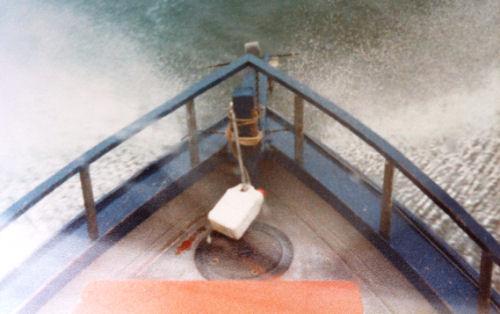
I had finally entered Buzzards Bay and the going went well enough for the first several miles. Then things started to change. The winds, ever-present from the Southwest, started to increase without warning, just as the tide was reaching its max ebb. This was a setup for the classic wind against the tide scenario that causes building seas. And with nothing but unobstructed room for hundreds of miles, the waves did build indeed. But this was nothing I hadn’t been through before, and when you operate the same boat every day for years on end, you become intimate with its handling quirks in different seas.
C2's Handling Characteristics
And the ole “C2” had her quirks to be sure. She had high bows that flared out nicely, and that made her great in head seas. But beam seas were another matter, as she was so top-heavy. This caused a serious roll that you really had to watch out for. More than once I’d trail a 5-gallon bucket off the stern when anchored with the wind against the tide in order to get myself out of a beam to anchor position. Then there were the following seas.
If the beam seas didn’t catch you on this boat, the following seas would. With her narrow beam, C2 would get pushed around when a wave came up against the square stern. Every day was a fight heading back in from the fishing grounds since every day it’s blowing in Nantucket Sound...every day. Such was the case this day in Buzzard’s Bay, and the following seas were steadily building.
So it was just a matter of gritting my teeth and fighting with the helm to keep the boat headed square to the seas coming from behind. We’d surf down one wave and hit the next, throw water everywhere, ride up and over the top and do it all over again. And over and over and…
Recipe for Disaster
Then, we hit upon the perfect combination of wave height, speed, and angle of attack that set the stage for disaster. While coming down the front side of a particularly large wave, we hit enough speed to cause us to penetrate the forward wave, rather than ride up and over it. Now a number of things could happen and they were all going through my mind in quick succession.
This had happened before, and when it did, the bow’s buoyancy took effect and pulled itself out of the wave. This time I waited briefly for that to happen...but it didn’t. We just kept going deeper into that forward wave. Suddenly white water was going over the rails, and then it started turning to blue water.
We had a serious problem: My beloved boat was becoming a submarine. If allowed to continue, the bow would act as a scoop, and stop the travel, while the following wave would lift the stern up and over. That’s called a pitchpole. Or… more likely in this boat, the stern would get pushed to the side and we’d roll over. Or… we’d just keep going straight down, which looked like exactly what was happening before my eyes. All of this was going on while I was fighting to keep the boat headed straight.
With the rails going under, it was time to take action. I backed off on the throttle, hoping the following wave would come under, and lift the boat clear of the surface. What ended up happening was the following wave did indeed come under us, while at the same time the forward momentum had stopped enough to end the downward trip. Then, we simply backed out of the wave in the opposite direction that we went into it.
…and...we started to surface.
Taking Stock of Damage
Once out and wallowing at idle speed, it was then a matter of heaving to, and initiating damage control. I sent the crewman down to report, and he found several feet of water in the forward cabin, which meant the bilges were flooded. A quick look over the side showed that the three 1750 gph pumps were working, but not quickly enough. The scuppers were almost awash and we were in serious danger of going back down. The 6-71 Detroit Diesel was still turning, so I left the helm with the crewman and went below to direct the engine-driven fire pump to divert the water from the bilge overboard. Twenty minutes later, we were back to normal and continuing on our way. At least normal for the boat. I was purging adrenaline.
What Did I Do Wrong?
Twenty years of Monday morning quarterbacking this event has done little to help me figure out what I could have done differently. To be sure, I was acting on the past history of the boat and I, therefore, expected history to repeat itself, as it had thousands of times before -- but just didn’t this time. What I needed to do was go slower down that one wave. Only a little slower would have done it. Following the waves and riding on their backs was not an option. I had miles to go.
We ultimately continued the trip but it definitely put a fear into me and the memory lingers to this day. Since then, however, I’ve operated differently to ensure that I’m keeping the boat out of trouble rather than depending on the boat to do it for me. And that’s a big difference.
So What Does This Look Like
To determine how to do it right, we first need to see it done wrong. The following pictures depict another captain in nearly the same predicament. The differences are the boat of course, and the breaking seas are closely located over an inlet reef, not stretching for miles like mine were.
Let’s dissect this trip with some incredible photos….
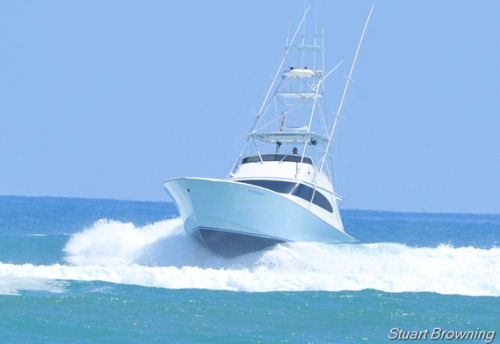
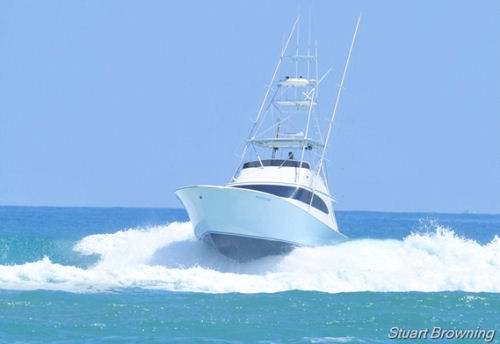
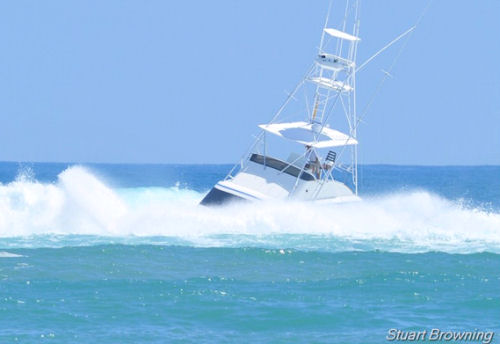
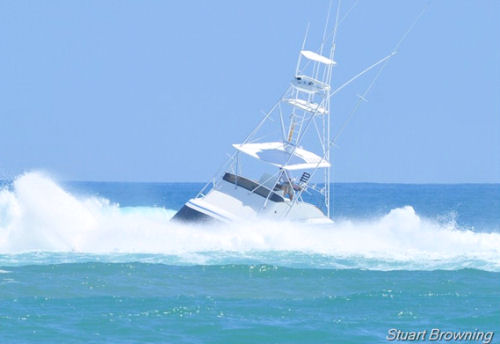
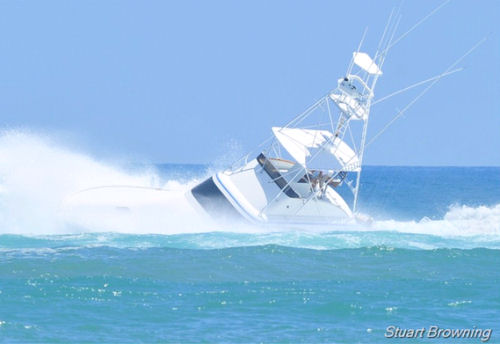
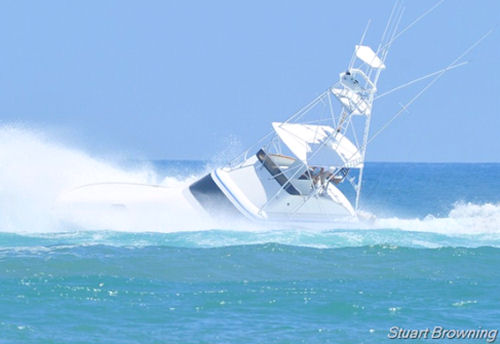
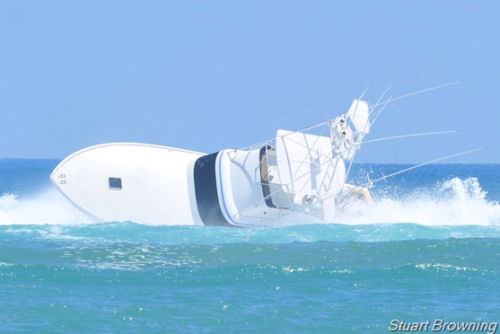
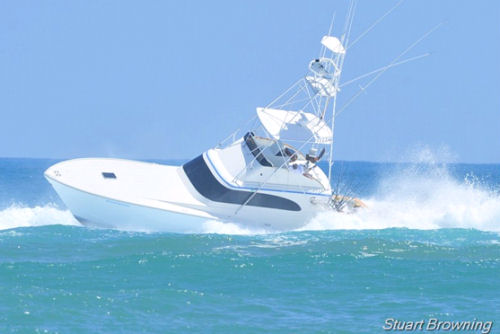
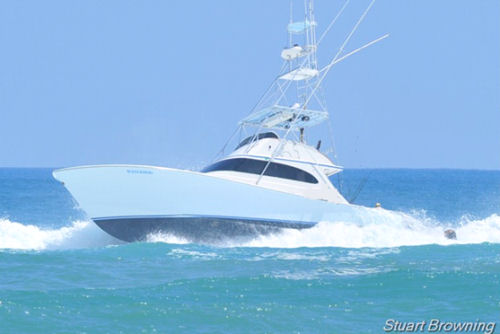
Why Do The Waves Get This Big in an Inlet?
Picture a wave as viewed from the side. Now picture that there is as much under the wave as there is on top. When this bottom section comes into shallow water, as in an inlet, the wave gets pushed up. Eventually, there will be so much of the wave on top that it can’t hold itself up anymore, so it must crest and break over itself, or the shoreline.
When you have a wave running in one direction and the tide running against it, the resistance of the current underneath also acts to push the wave up. That’s why wind against the tide is such a bad combination.
So What Are We To Do?
Well, there are a number of things that we as mariners can do. First, stay inshore, inside the inlet. Of course in our private boats, there is rarely a need to make the trip. There is always an option of sitting at the dock wishing we were out there. And that can be classified as good seamanship.
But saying inshore is not always practical, so if we must head out into a breaking inlet, proceed out with our bow into the seas, or even just off. Ride up and over at a slight angle and we should be fine. Do not get caught sideways to a wave, and you still need limits. You can’t just go out in everything. Why not have everyone put on life jackets?
Heading Into an Inlet
If heading in, timing is everything. Ideally, you’ll want to avoid an ebb tide. Check your tide tables, waiting a couple of hours for the tide to change could be the smartest thing you ever did. If you must run into the inlet, then do not go over the forward wave. Ride in along its backside. It will not be fast going, but it will be safer. For a rule of thumb, generally, waves run in threes with the third being the largest and the tenth will be larger than the threes. That’s a “rule of thumb,” not a hard and fast rule.
If the seas are too big to handle, choose another inlet, preferably one with deeper water, or heave to and wait out this one. It’s easier to get a cab ride back to your car from another port than to lose your boat getting into this one. If fuel is an issue, drop the hook.
Lesson Learned
When I said that my experience has changed my method of operating, I meant that I don’t let myself get caught screaming down a wave anymore. I do it, but not if it gets the boat to extremes. Not on any size boat.
I test boats regularly, but every time build-up to the ends of the performance envelope slowly. It’s not like in the movies when you launch off and put the plane in the worst situation to see if it stays together. That never happens. But most importantly, when I’m in following seas, I progress slowly over the waves to see how the boat handles.
If I get close to stuffing the bow, I’ll slow down first, then raise the trim, then back off the speed more until I’m able to stay in control of the boat, rather than depend on the boat to control itself. Then I can report on what I did, and how you can do it in that boat.
I’ve crossed the street without getting hit by a car, but that by no means guarantees that I won’t ever get hit. Seeing someone else get hit, or almost getting hit myself, makes me cross that street differently. My incident makes me operate differently, but I still am an operator. Hopefully, reading this and seeing these photographs will have the same effect on you.
Capt. Steve
Editor's Note: As regular readers know, BoatTEST.com is dedicated to boater safety and helping boaters learn safe boating practices. We have published the photographs above, as well as Capt. Steve's commentary, to help make boaters all over the world more acutely aware of the danger of running inlets — even for life-long professionals — in adverse conditions. — Ed.