Sea Ray 320 'Dancer 4.4 MPH Faster w/Sharrow Props
Real World Testing of Sharrow’s Patented Continuous Blade Propellers
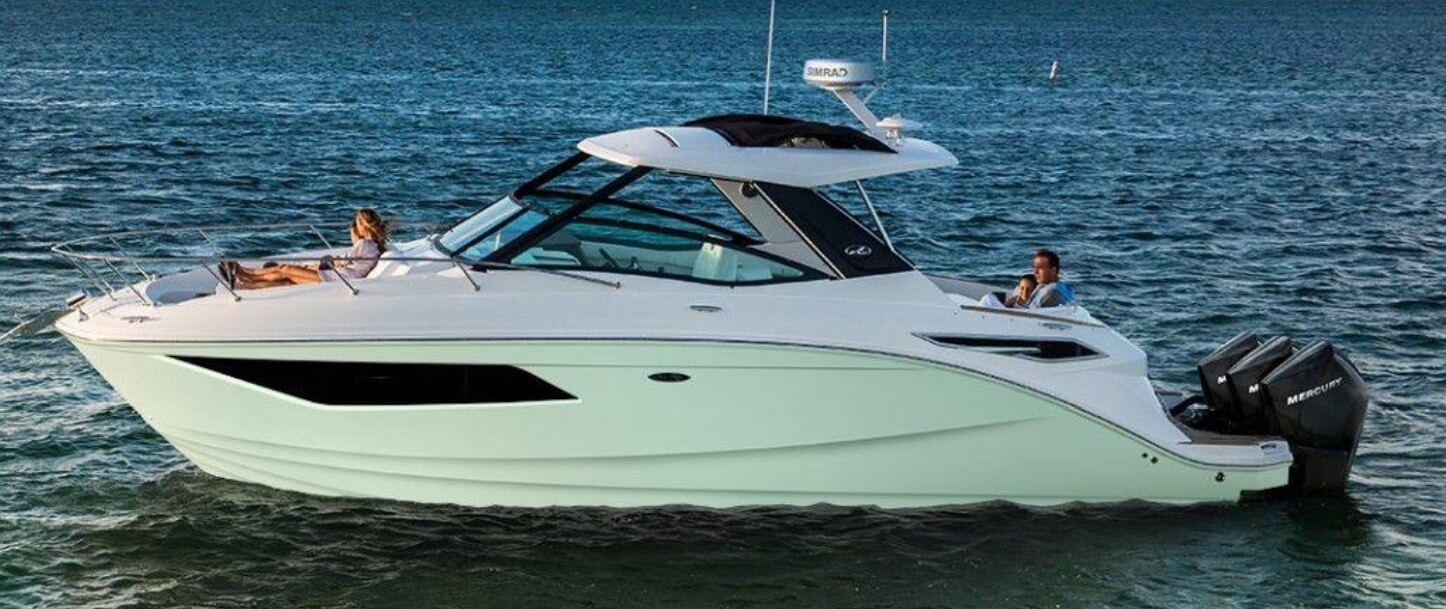
The Sea Ray 320 OB model has a 10’7” (3.23 M) beam and weighs 14,566 (6,607 KG). Sharrow’s engineering team tested the boat equipped with triple Mercury 250’s, first turning Mercury’s Rev 4, 14.625 x 19 stainless steel 4-blade propellers, then with Sharrow’s True Advance continuous blade propellers in 15.5 x 19 models.
Sharrow has been running these tests for several years, and in nearly every case, the innovative design of their patented propeller has delivered dramatic improvements in terms of MPG and range.
The propellers also sometimes exceed conventional propellers in speed, though that’s not the primary aim of the design.

The Sharrow propeller was first introduced to the market in 2019, and since then has proven to be the most innovative approach to boat propulsion since the initial boat propeller introduction in the mid 1830’s. While the Sharrow design is not primarily aimed at improved speeds, in some applications, including this one, they deliver a higher top end. At WOT with the conventional 4-blade stainless steel Rev 4’s, the Sea Ray maxed out at 38.5 mph, while with the Sharrow’s WOT speed was 42.9 mph. That's 4.4 mph or 11% faster at the top ended, something that's unusual, even for Sharrow props.
Express cruisers, even ones that are 32' (9.75 m), are by nature heavier than day boats the same size, and as a result they need more torque to get out of the hole, and up on plane. Note in the fuel burn chart (MPG vs MPH) that the Mercury 4-blade prop performed extremely well and was about the same in both fuel burn and speed compared to the Sharrow prop -- in the low RPM range. This is because the surface area of the Rev 4 props is about the same as on the Sharrow props, and the engines' torque was being transferred relatively efficiently to the water with boat props.
Sharrows Break Away at 2500 RPM
But look what happens at 2500 RPM. That is where the Rev 4s begin to slip badly relative to the Sharrows, and as the boat goes faster that slip dichotomy becomes even greater. The Rev 4s are turning as much as the Sharrows, but as they go faster the slip-gap widens. which is way the Sharrows are faster at the high end.
This is a 4-blade phenomenon. Four-blades have more grip on the water than does a 3 blade. They also have more surface area. That's why builders put them on engines powering heavier boats. And since 4-stroke engines have relatively low torque at the low end, they need all the blade area they can getto ride the boat on plane.
But at 2500 RPM the two prop designs begin to diverge in performance. Four blade props almost never go faster than three-blade models, but in this case, at high RPMS, the Sharrow props begins to perform like a 3-blade standard prop in terms of high-end speed.
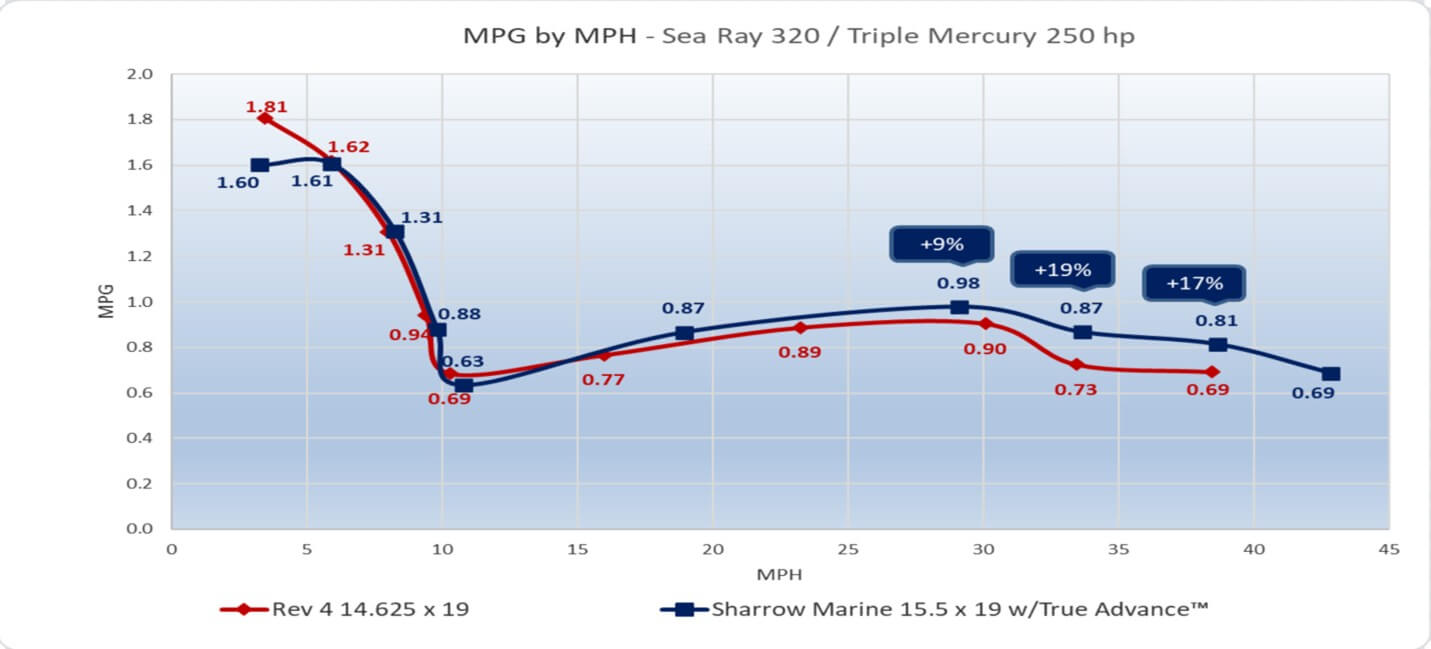
MPG Advantage Sharrow at All Planing Speeds
In this test, mpg tracks very closely for both props in the lower ranges, and at 10 mph the Sharrow’s were actually slightly less efficient than the Rev 4’s.
However, the Sharrow propellers showed an advantage at all planing speeds, maxing out at a 19% advantage at just under 35 mph.
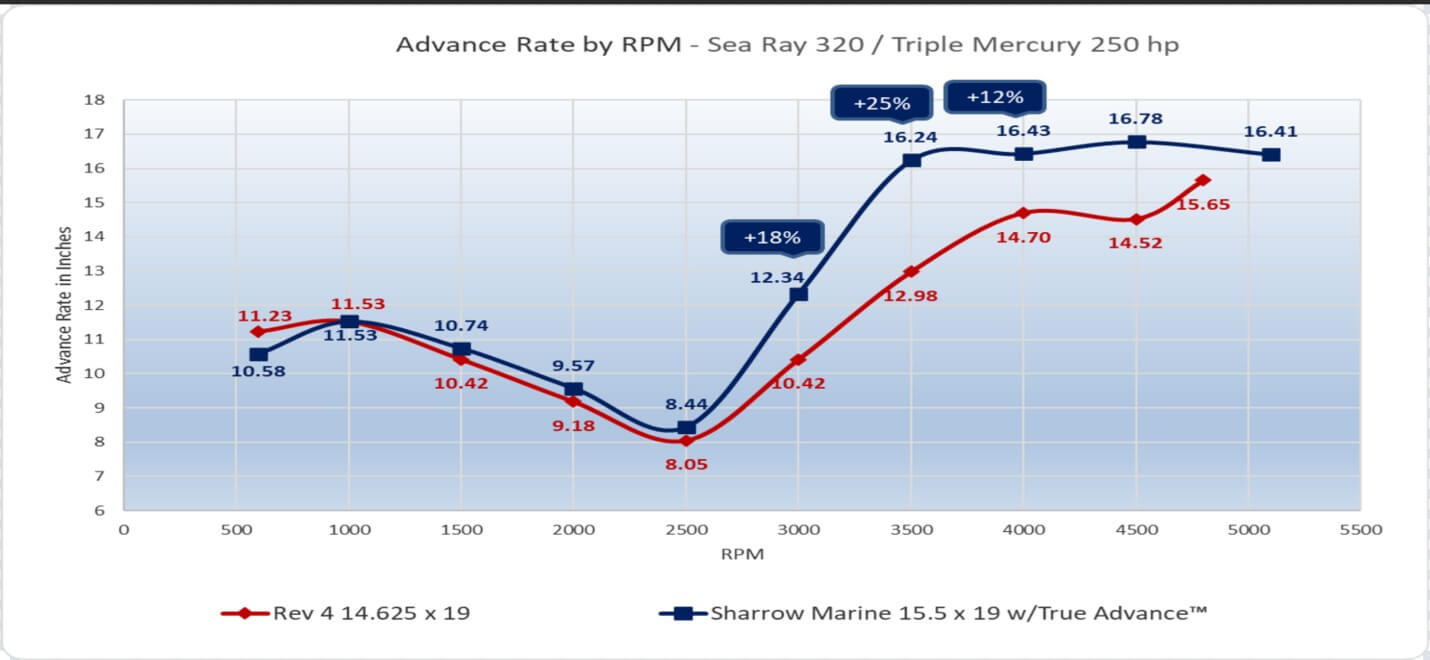
The “advance rate” as used here is a measurement of how far the boat moves forward with each rotation of the propeller—a number nearer the pitch of the propeller shows a higher efficiency.
As this test shows, the Sharrow’s had a higher advance rate at every rpm above idle, with a particular advantage between 3500 and 4500 rpm, the range where most boats are run most often.

Greater Efficiency Equals More Range
Sharrow propellers were a dramatic 25 percent more efficient at 3500 rpm than the Rev 4 Mercury propellers, 12 percent better at 4000 and 16 percent better at 4500. Greater efficiency equals better MPG, which not only means reduced fuel costs at the pump, but also greater range, allowing more time on the water between refills, more confidence in making long runs between gas docks.

Slip limits the efficiency of any propeller, since water is a liquid medium not allowing a 100% grip with each revolution. In this test, the Sharrow propellers had a dramatic advantage in reduced slip from 3000 rpm all the way to WOT, particularly in the usual on-plane operating range.
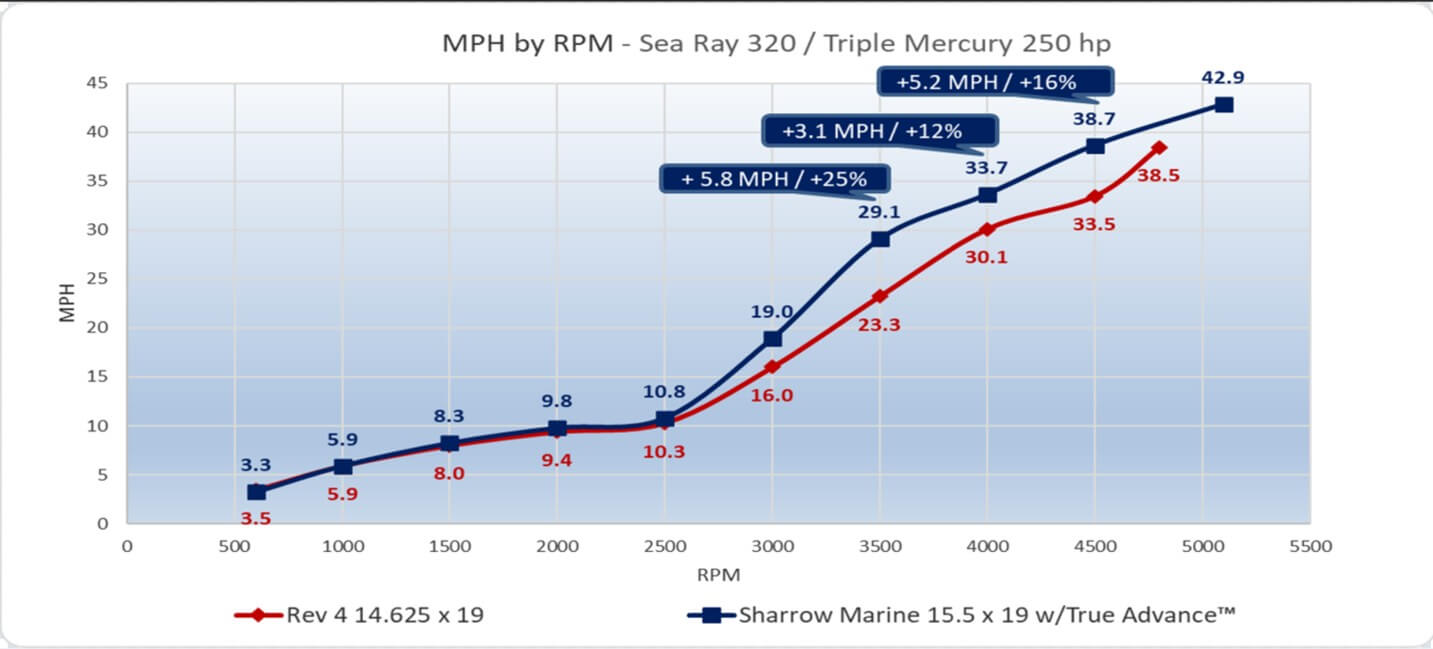
While Sharrow propellers are not engineered for maximum speed, in some applications they turn out to be faster than stock propellers. That was the case in this test, with the Sharrow’s faster at all rpm above 1000, and dramatically faster at on-plane speeds. The Sharrow's blades were 16% faster at 4500 rpm, where most boaters run their outboards most often when on plane.
Virtually all users of Sharrow props report lower vibration than with conventional props. They also report much less noise and that is because the rooster tail is not as pronounced and because there is very little cavitation with Sharrow props, and massive cavitation with most conventional props.
3X 250s w/Sharrows or 3X 350s?
Sea Ray now offers the 320 OB with triple V10 350-hp Mercury Verado outboards, as standard. The reason this change was made was because Mercury recently introduced the V10, and by all accounts it is a superb performer. The 32 'Dancer simply needed more torque with standard props to get the boat into the mid 40s. Triple V10s will certainly do that, and possibly even with 3-blade props.
So the question begs, would a consumer be better off with triple 350s (MSRP $60,695 x3) or triple 250s (MSRP $28,390 x3 +$15,000)? We don't know, but we'd sure like to find out.
Bottom line is that an investment in Sharrow propellers can pay for themselves in fuel savings on a boat regularly used over a number of seasons—and pay dividends immediately in terms of the overall boating experience. And, maybe -- just maybe -- a set of Sharrows can obviate the need for larger, more costly engines.
(Sharrow also makes props specifically for the Mercury V10.)