See How They Run, Part 1
The Elusive “Nice Running Boat”
True story: I am in a boatyard surrounded by many vessels “on the hard.” Strangely, the bottoms of all the boats look exactly like mattresses complete with the swirled stitching and faded pastel flower patterns. The bottoms are soft to the touch. Then I awake. It was a dream! While I am sure shrinks out there will have their own twisted analysis of this, I tend to be a practical sort and, to me, it is very simple. I always been obsessed by the way boats go through the water – especially through rough water and these mattress bottom boats were simply a manifestation of my desire to produce smooth running hulls. Take that Sigmund!

Greyhounds and Dachshunds
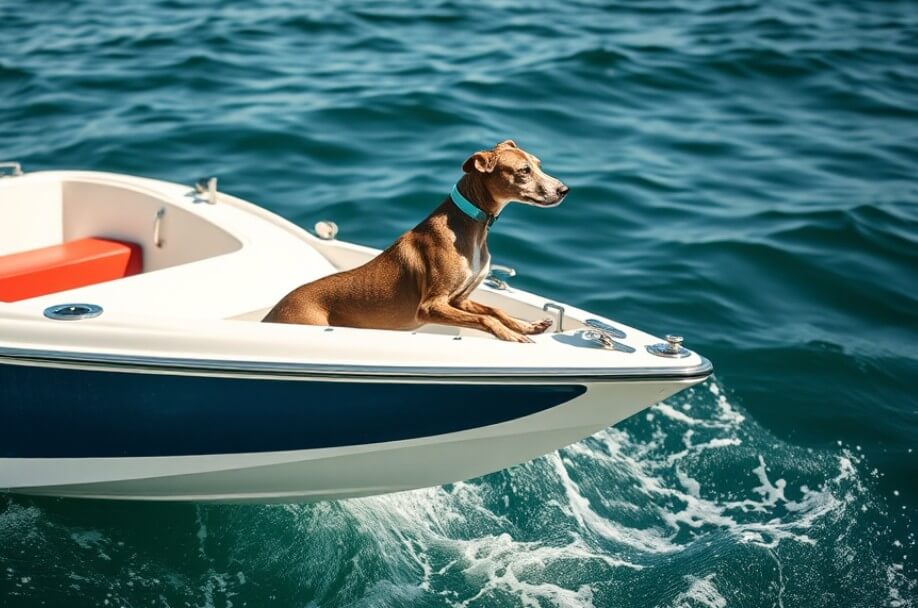
A marina buddy passes your slip and greets you with “Nice Running Boat.” Well, just what entails a “nice running boat?” Some hulls are Greyhounds, others are Dachshunds. The Greyhound is one of the most graceful animals at speed and the Dachshund is one of the clumsiest. The Greyhound makes long, fluid strides effortlessly moving forward. The Dachshund takes many choppy steps and struggles for headway. The Greyhound/Dachshund analogy applies to boats of all sizes at all speeds. Offshore speedboats can be Greyhounds or Dachshunds, as can trawlers and everything in between.
Cleavage
In the context of this article, “cleavage” is not what you see when your wife or girlfriend bends down. Cleavage is simply how a hull cuts the water. Clean running boats slide through the water while sloppy running boats plow through it. One can determine this by the wave pattern forward. Clean running boats (Greyhounds) will throw the bow wave aft and out while the Dachshunds push water ahead in various amounts depending upon hull shape. Entry angle (the half angle of the bottom from the bow in plan view) is key here. The finer the entry of the vessel, the cleaner she will cleave through the water and the smoother she will ride. This applies to both slow and fast boats. Entry angles are best made as tight as possible while still allowing reasonable accommodations forward.
Long, skinny hulls can have entry angles of only 8 or 9 degrees. Wider boats might have entry angles of 15 to 25 degrees. Generally the finer the entry, the better. Some may be surprised to hear that shape and fineness of the entry forward not only affects head sea performance but also following sea performance. If the forward end is too fine, following seas will raise the stem and depress the bow at which time the deep forefoot acts as a rudder, which can induce broaching (broaching can ruin your whole day. It occurs when the bow catches a wave and the stem is pushed around it putting the hull broadside to the seas).
This can be overcome by incorporating volume above the waterline thereby combing a fine entry and enough buoyancy to prevent the bow from depressing. Pigboats pushing walls of water ahead of them are usually the result of pure and simple greed. As I have said many times before, greedy interior designers demand maximum floor space forward dictating wide, blunt entries. This maybe be great for fitting damned emperor sized berths forward but it will severely compromise performance. I will say it again: a boat should be designed from the outside in not the inside out.
Trimmings
Proper trim angles for high-speed vessels can run anywhere from 2 to 4 degrees depending on many factors. A hull running bow high looking like she is preparing for a moon shot is not a good thing. First, visibility over the bow is impaired. Secondly, initial impact with the waves occurs further aft where the bottom is flatter thereby producing a rougher ride. As a general rule of thumb, at speed if one can see daylight under the forefoot, the boat is not properly trimming. There are really two trim angles to be concerned with: one is the cruising trim and the other is trim at, pardon the expression, “hump speed.” We have all seen boats that, when power is applied, tip their noses high in the air and suck their tails down struggling to get over the hump. Hump angles for properly design hulls range from 3 to 6 degrees.
Generally, “hump speed” is the speed at which a semiplaning or planing hull breaks its transom clean. The cleanest running hulls make the transition from displacement to “over the hump” speeds effortlessly and unnoticed – they simply assume a trim angle of 2 to 4 degrees when power is applied and maintain that angle through hump speed into cruising speed. Poorly designed or overloaded hulls may require some help getting through the hump (which is similar to breaking the sound barrier). This is often done with trim tabs and, indeed, the subject of trim angles cannot be fully analyzed without discussing trim tabs. Are they needed in a well-designed hull? The answer is a very clear “yes and no.” Tests have shown that, on a given hull, tab application may help at one speed but hurt at another. Trim tabs are also handy for trimming the boat athwartships in a beam wind and also allow one to adjust trim angles for different sea states (for example: in following seas, a hull sometimes runs better with the bow up producing less steering by the forefoot).
Sometimes, poor performance can be cured with some simple changes. A good part of my email correspondence is from frustrated boat owners seeking to transform their Dachshunds into Greyhounds. Changes to hulls cannot be recommended simply based on a description of what the boat is doing. Before changes are prescribed, one must first ride the boat, measure speed, trim angle, etc. and take still and video pictures of the under way. So please friends, restrain from sending correspondence informing me that your beloved “ASEA DSEA” will not get on top, will not turn to port and is pounding your molars loose unless you are prepared to arrange sea trials and pay the freight. To be continued.
(Reprinted with permission of Regina Fexas.)
If you would like to read more of Tom's pearls of wisdom, tune in next Friday -- "Fexas Friday."
Better yet, why not get a full dose of infectious Fexas whenever you need it -- and buy one of the volumes below. Better yet, why not buy all of them -- we call them the "Fexas Five." They will provide many evenings of fun reading (better than Netflix), and you'll make the widow Regina very happy knowing that Tom will live on with you the way most of us remember him.
Order 1, 2 or "The Fexas Five" --

To find the "Fexas Five" on Amazon, click here...
Tom Fexas (1941-2006) was one of the most influential yacht designers of the last quarter of the 20th century. With the narrow Wall Street commuters that were built in the 1920s and '30s always on the back of his mind, he wanted to design boats that were at once fast, comfortable, seaworthy and economical to operate. Over the years, he and his firm designed over 1,000 yachts for some of the most prestigious boat builders in the world, including Choey Lee, Palmer Johnson, Grand Banks, Mikelson Yachts, Burger, Abeking & Rasmussen and many others.
Even though toward the end of his career he only designed megayachts and superyachts, including the remarkably influential PJ "Time" in 1987, he is best remembered for his first major vessel in 1978 -- Midnight Lace -- which became a series of 44-52-footers. They were light, narrow, and fast with relatively small engines. He was also influential in the boating community because of the monthly column he wrote for Power and Motoryacht, which began in its very first issue in January 1985.