See How They Run, Part 2
Further Studies of the Elusive “Nice Running Boat”
Last month, we analyzed two running characteristics of hulls that could be determined by entry angle and trim. This month, we will check some more. Some may find this stuff boring. If so, I suggest you to make healthy, delicious canapes from bilge slime. If you want to learn something, read on.

Ride Softness
Generally, the cleaner a hull parts the water, the softer the ride will be. Blunt sections forward present flatter areas to impact the sea. Of course, everybody will tell you that their hull rides better then everybody else’s and, while a measurement of how soft the hull rides can be attained by fitting decelerometers to a hull, the verdict on the ride is usually SOTP (seat of the pants). Deadrise angle is not the only measure of softness, which also depends a great deal on the shape of the bottom forward. Concave sections produce a dry ride with good spray suppression but “focus” the impact of waves producing a jarring ride. Convex sections, on the other hand, are soft riding but monsoon wet. What’s a poor Yacht Designer to do? The answer is: compromise like hell. Add a little here, take a little off there, put a bulge here and a hollow there. After many long years of shapeshifting, a designer will arrive at a hull form that works best (usually about the time he is ready to retire).
Spray Suppression
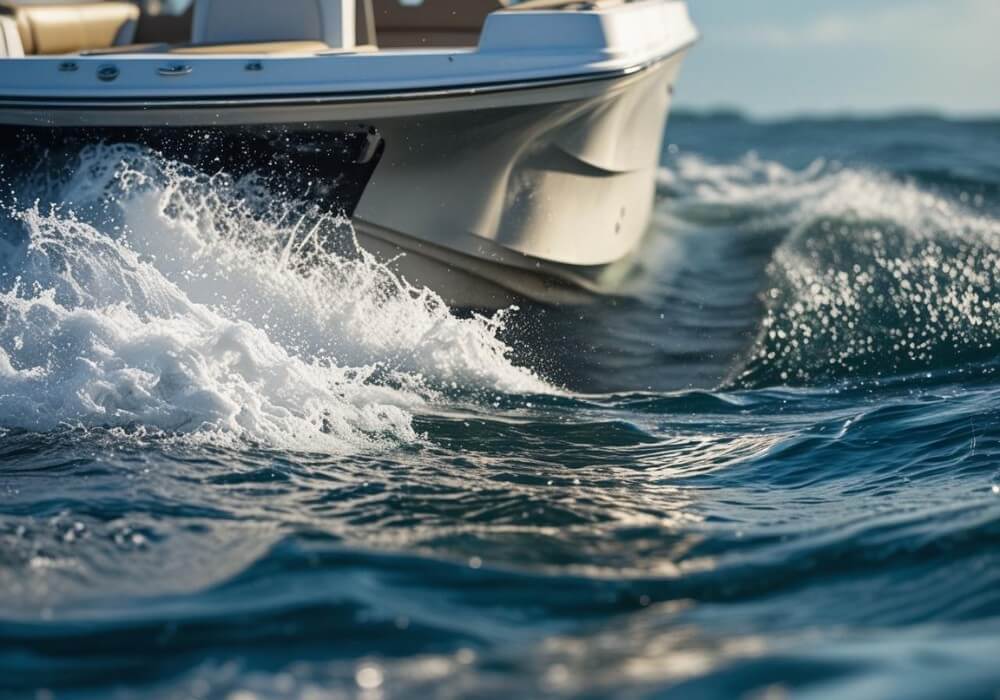
When running at high speed into seas off the bow, if you are receiving mouthfuls of water, you have a wet boat. The trick here is bottom shape manipulation and spray rail placement (usually located by divine inspiration). At best, the bow wave is caught close to its source and deflected as a sheet downward. Deflecting the bow wave in droplets or a disturbed pattern will result in more water.
Wake and Efficiency
Generally, vessels that create the least fuss aft run more efficiently than ones that keep you looking over your shoulder wondering who the hell is following you. Wake generation has to do with bottom shape and, most importantly, overall weight. A porky hull (even with an optimum hull shape) will produce much more wake than that same hull lightly loaded. Also, beam plays an important part here. A fat boat is less efficient than a skinny one at semiplaning speeds. At planning speeds, a wider hull is more efficient. The original Midnight Lace 52, for example, was very light and had a beam of only 13-feet. With two tiny 220 hp engines, she ran about 23-knots.
The new Midnight Lace 52, currently under construction, is somewhat heavier (due to creeping comfortism), with a beam over 16-feet and will require twin 320hp engines to run at 23-knots. While the wider, heavier boat will never be as efficient as the skinny, light boat, it is possible to refine the hull shape such that efficiency is not severely compromised by increased beam. Deadrise aft has an effect on efficiency also. No matter what you may hear, the simple fact is that flatter sections aft develop more lift (and efficiency) than high deadrise sections. This is common sense and has been proven in tank tests and on full-scale hulls. That’s why you will never see high deadrise surfboards or water skis. What high deadrise aft does well is soften the landing impact when a hull becomes airborne (such as the famous Wellcraft in the opening credits of Miami Vice). A boat that becomes airborne will land on its tail. If the aft sections are flat, impact will be harsh but if it is highly veed, reentry will be softer.
As far as cruising boats are concerned, the question then has to be: “how often do I take “Mamma’s Mink” airborne?” Most cruising boats over 35- feet will never go airborne and that’s why high transom deadrise is not usually found on cruising hulls. In general, a hull should be shaped for the cruising speed she is locked into by the power installed. If a hull is powered such that she will never reach planing speeds, she should not have a planing (hard chine) bottom shape (ever see a duck with chines?). Water does not like hard corners unless true planing occurs (when the water cleanly separates from the transom and chines at speed). Otherwise, a semi-planing (or penetrating) hull form will be more efficient. There are far too many boats designed with planing bottoms that never have a prayer of planing (except, maybe on the face of a 50-foot wave).
In the end, it all comes down to guile and cunning on the part of the Yacht Designer. How do you make the transition from a very deep, fine entry (for softness) to a flatter after bottom (for efficiency) without twisting the bottom such that the stern will suck itself down? How do you shape the forefoot to be soft yet dry? How do you form the hull for a steady ride in following seas? Well, at these prices, none of these secrets will be revealed here (you’ll have to wait for the book).
All I can say is that after 35 years of pushing volumes around like Jell-O in a balloon, I have come up with I deem to be a killer hull form: our “MCR roundV” configuration (since everybody else has foolish names for their bottom configurations, I thought I’d join the party. “MCR” stands for “Magic Carpet Ride.” Sorry about that). But, like I said, everyone will tell you their hull is the softest, driest, most efficient ride in town. Boat salesman may lie to you outright. Yacht Designers can be evasive and change the subject. The only way to tell for sure is to plant your butt in the helm chair and mash the throttles forward in a 20 or 30-knot breeze. Then carefully analyze posterior input. The butt knows.
(Reprinted with permission of Regina Fexas.)
If you would like to read more of Tom's pearls of wisdom, tune in next Friday -- "Fexas Friday."
Better yet, why not get a full dose of infectious Fexas whenever you need it -- and buy one of the volumes below. Better yet, why not buy all of them -- we call them the "Fexas Five." They will provide many evenings of fun reading (better than Netflix), and you'll make the widow Regina very happy knowing that Tom will live on with you the way most of us remember him.
Order 1, 2 or "The Fexas Five" --

To find the "Fexas Five" on Amazon, click here...
Tom Fexas (1941-2006) was one of the most influential yacht designers of the last quarter of the 20th century. With the narrow Wall Street commuters that were built in the 1920s and '30s always on the back of his mind, he wanted to design boats that were at once fast, comfortable, seaworthy and economical to operate. Over the years, he and his firm designed over 1,000 yachts for some of the most prestigious boat builders in the world, including Choey Lee, Palmer Johnson, Grand Banks, Mikelson Yachts, Burger, Abeking & Rasmussen and many others.
Even though toward the end of his career he only designed megayachts and superyachts, including the remarkably influential PJ "Time" in 1987, he is best remembered for his first major vessel in 1978 -- Midnight Lace -- which became a series of 44-52-footers. They were light, narrow, and fast with relatively small engines. He was also influential in the boating community because of the monthly column he wrote for Power and Motoryacht, which began in its very first issue in January 1985.