Sharrow Prop Tested on Everglades 253
More efficiency and range in a single-engine CC
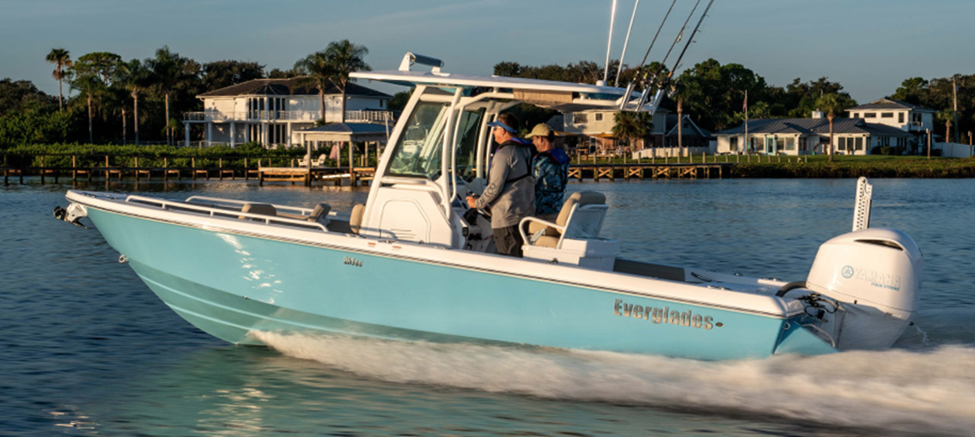
The Everglades 253 is an offshore-capable center console that can also function as a bay boat or perhaps a tender for a larger sportfish. LOA is 24’ (7.32 m), beam is 8’6” (2.44 m) dry weight 5,600 lb (2,540 kg). She carries 105 gallons (397.5 l) of fuel.
For the test conducted by Sharrow’s engineering team, she was rigged with a single 300-hp Yamaha outboard.
Sharrow Marine propellers were first brought to the industry in 2012 by inventor and company owner Greg Sharrow, and since have proven their remarkable efficiency on a wide range of recreational boats ranging from single outboards to large twin diesel yachts.

For the review, the 300 Yamaha was first tested with a Power Tech 3-blade stainless 15.25 x 17, then with a CNC-machined stainless Sharrow 15 x 17 True Advance propeller.
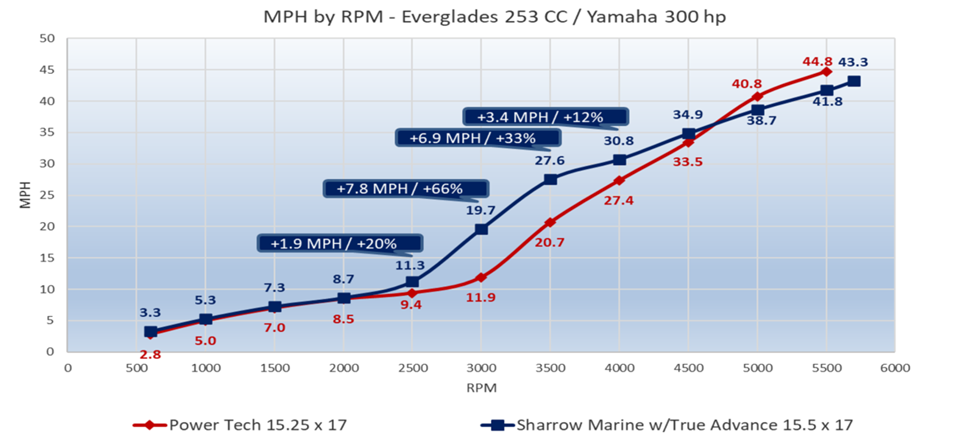
As has been the case in nearly every combo tested, the Sharrow was notably more efficient in the mid-range, roughly from 2500 to 4500 rpm. It delivered better fuel economy, as well as more speed at lower rpm. And it put the boat on plane more quickly.
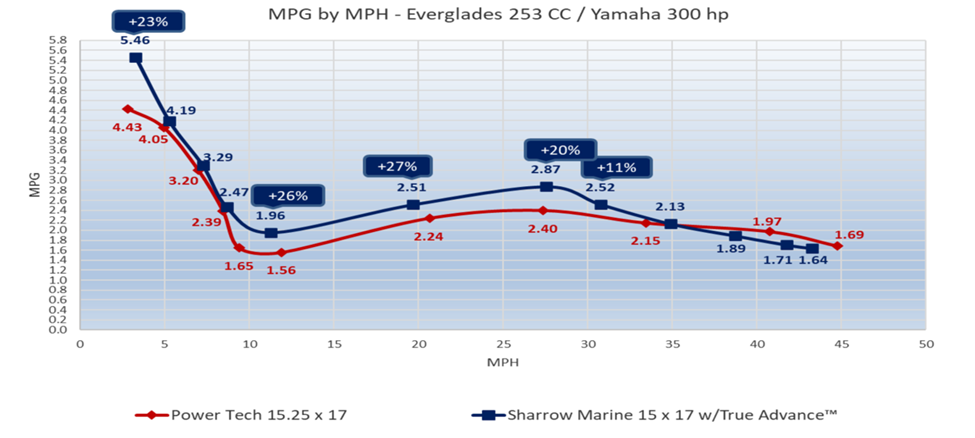
Up to 27% Better MPG
The Sharrow propeller delivered better fuel economy from 10 to just under 35 mph, peaking at 27% better at 20 mph. The advantage in fuel use and resulting range in the power band where this boat is likely to be operated most often not only means big fuel savings but also fewer trips to the gas docks.
We note the Power Tech—a good propeller in its own right-- showed some advantage at higher rpm, but most operators running center console fishboats keep their speeds in the mid-range to extend range and reduce engine wear.
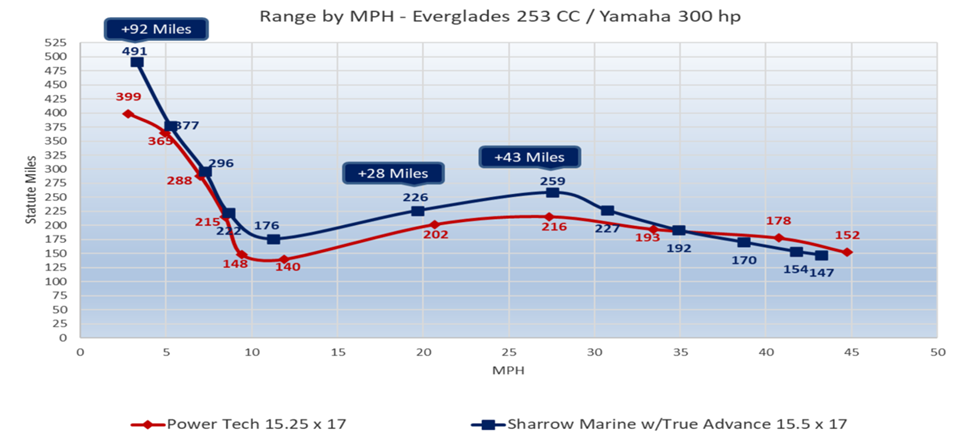
More range makes any boat more useful, but particularly a boat like this one that may be run well offshore in good weather, troll for many hours and then run back.
The Sharrow range advantage peaked between 25 and 30 mph, where the Sharrow could push the boat 259 miles on a full tank, versus 219 miles for the Power Tech—a 43-mile improvement.
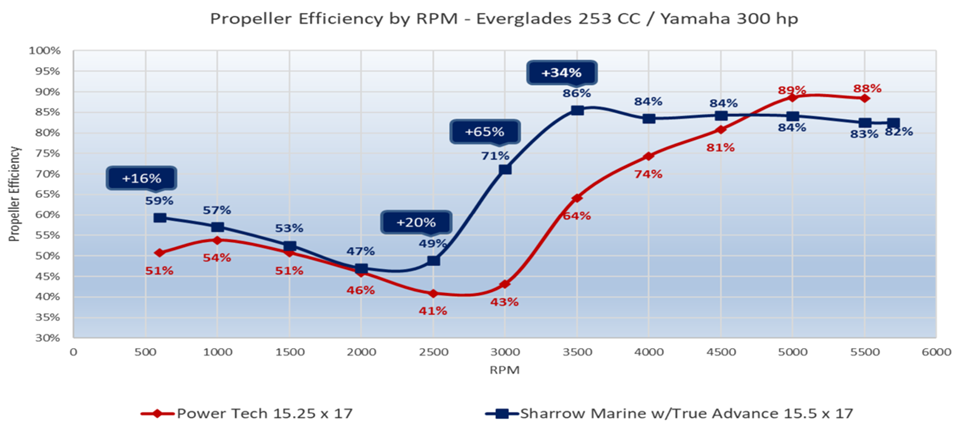
Propeller efficiency is essentially the ratio of useful work to the total power input from the engine. It’s a measurement where Sharrow’s usually do exceptionally well, and that was the case in this test.
The Sharrow was an impressive 65 percent more efficient at 3000 rpm than the conventional propeller. Note that at this point, the Sharrow already had the boat on full plane, while the stock prop was still trying to get it over the hump, explaining the dramatic difference.

Less Slip Equals Better Efficiency
Slip is a measure of how well a propeller grips the water and advances the boat with each revolution.
Sharrow’s nearly always show a dramatic advantage in this specification throughout the lower and mid rpm ranges. In this application, the Sharrow showed an amazing 157% reduction in slip compared to the conventional three-blade.

Sharrow’s do exceptionally well in the advance rate in the mid ranges from 2500 to 4500 rpm.
Note at 3000 rpm, the Sharrow pushed the boat 65% farther with each revolution than the conventional propeller.
More Mid-Range Speed, Less Engine Wear
The Sharrow propeller delivered more speed from 2500 up to 4500 rpm, the typical rpm range a fishing boat is operated in most. The propellers are engineered for maximum efficiency in this power band, where most boats are run most often.
It was not quite equal the Power Tech prop at WOT, where the conventional design topped out at 44.8, the Sharrow at 43.3 mph. Note that Sharrow propellers are not designed to deliver maximum speed at WOT.
The ability to deliver good mid-range speeds at lower rpm not only means less fuel consumption, it also means less engine wear, extending the time between repairs or replacement.
Overall, many users report that Sharrow propellers pay for themselves over a few seasons due to the savings in fuel use. They’re also said to deliver less noise and vibration at the helm, and to allow more positive maneuvering in reverse and at idle speed around the docks.