Sharrow Prop Tested on Galeon 325 GTO
Twin outboards double the Sharrow Marine propeller advantage.
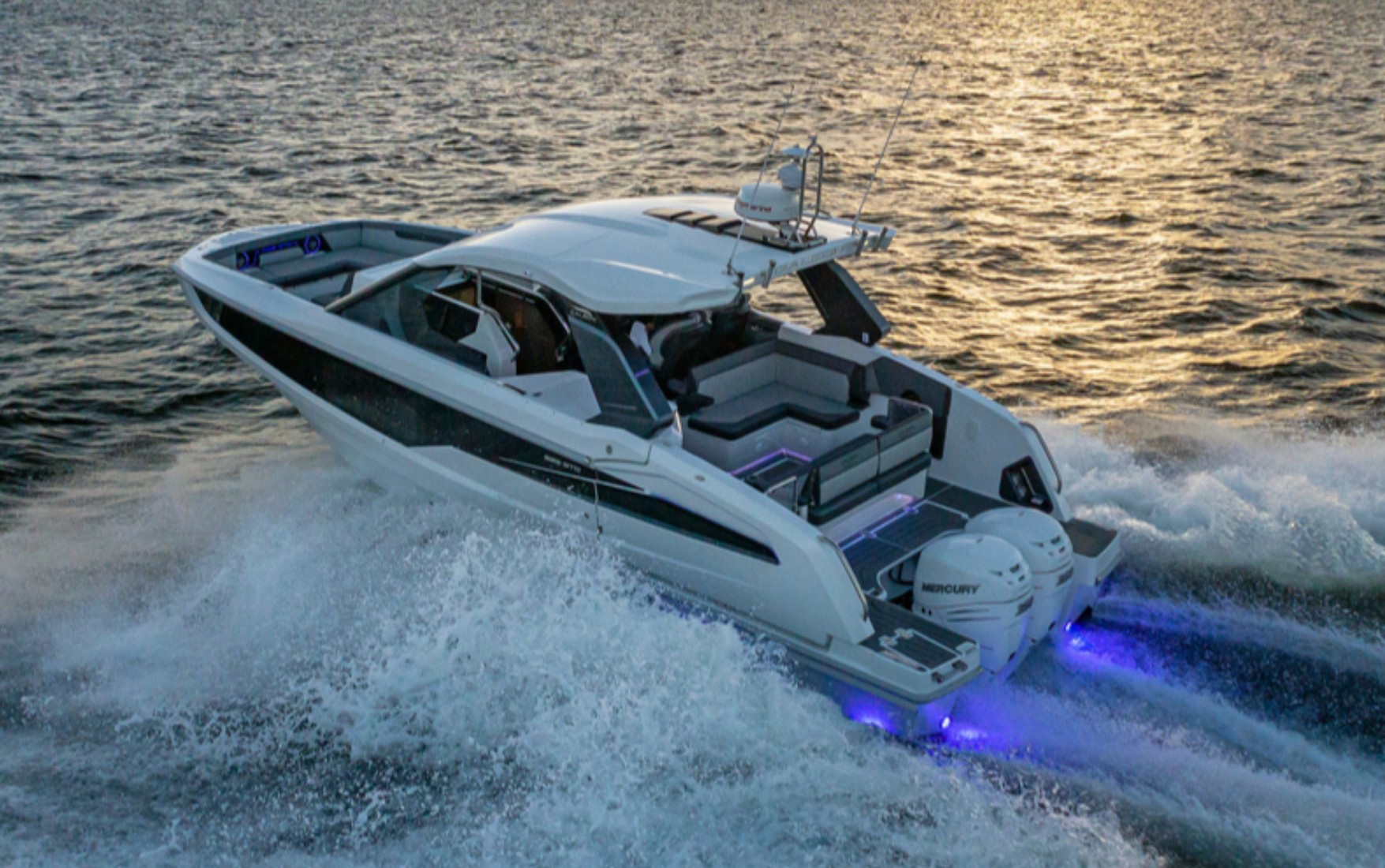
The Galeon 325 GTO has a length of 32’7” (9.97 m), a beam of 10’9” (3.32 m) and a dry weight of 14,800 lb (6,713 kg). Fuel tankage is 225 gallons (850 l). She’s designed for dayboating with lots of friends, and for an occasional overnight aboard.
For the test conducted by Sharrow engineers, she was equipped with twin Mercury Verado 400’s.
Stock propellers were 14.65 x 15 four-blade stainless, tested against Sharrow’s CNC machined stainless steel 15.5 x 13.9 True Advance propellers.
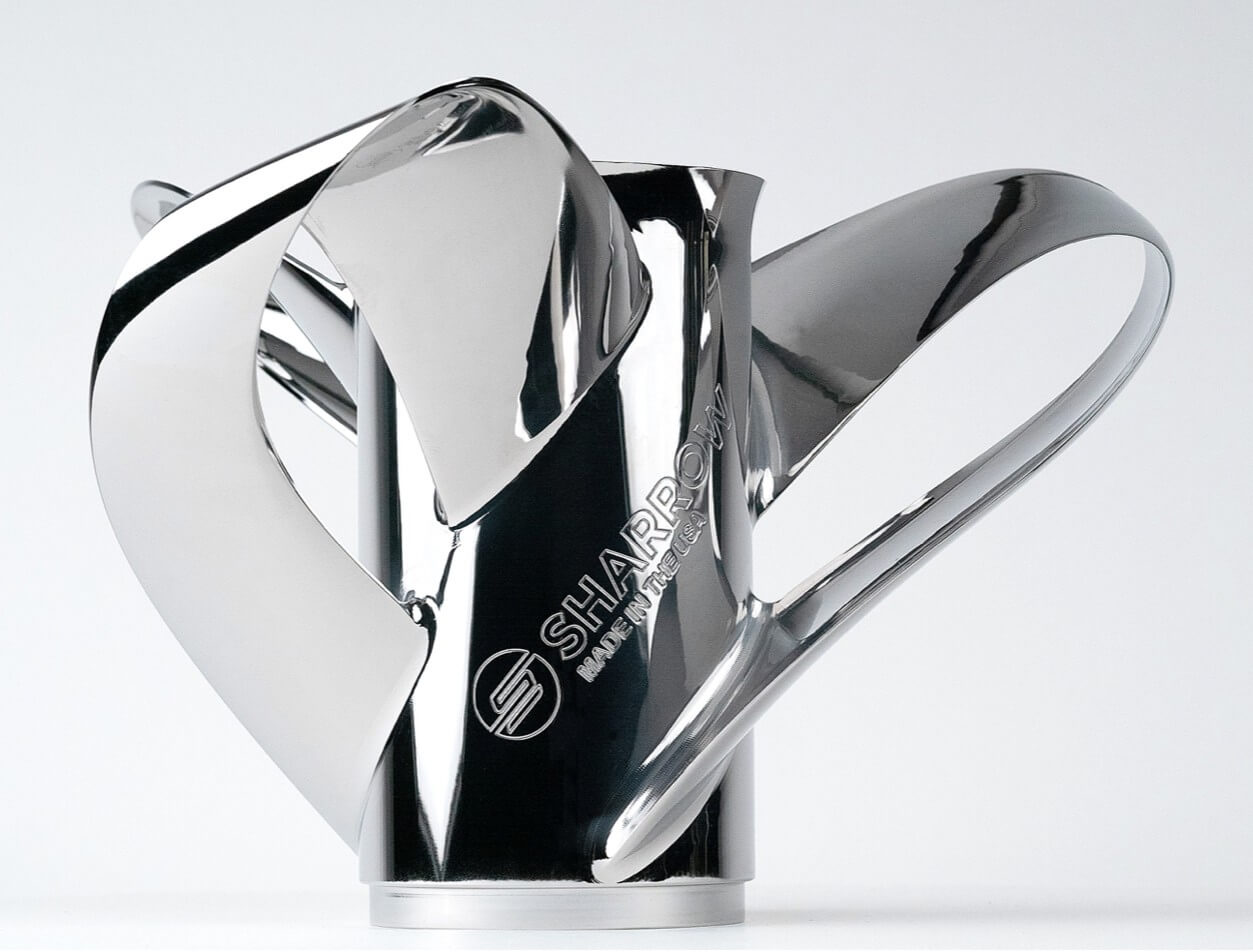
Sharrow’s continuous-blade stainless steel propellers are investment cast and then CNC machined to exact tolerances, which is among the reasons they run so smoothly and with minimal noise and vibration.
The company also makes continuous blade machined aluminum propellers for lower horsepower outboards as well as contra-rotating SS propellers for the largest motors.
Big Savings on Fuel Use
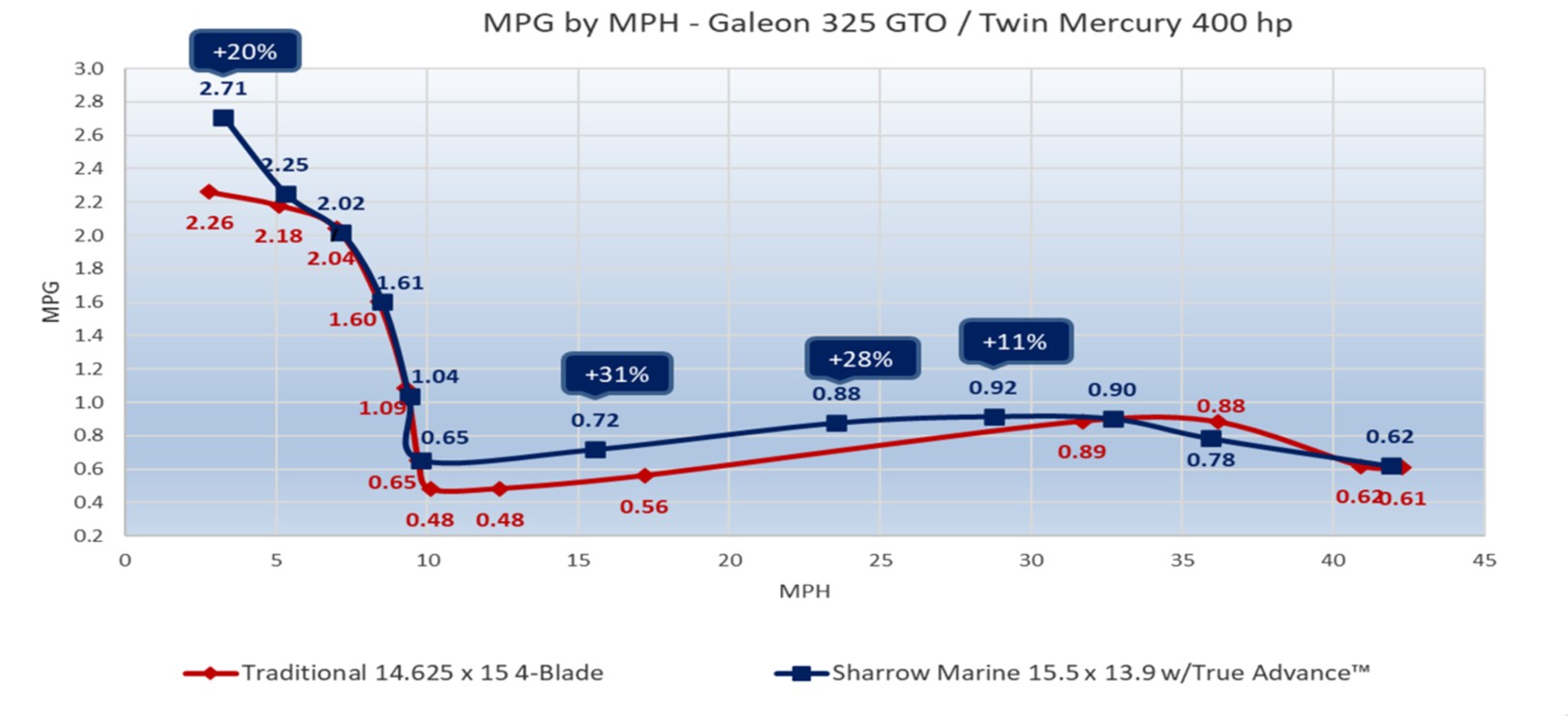
Sharrow’s have repeatedly shown an advantage in mpg tests on a wide variety of boats from single-engine outboards to large twin diesel yachts. They again proved their value in this test, particularly from 15 to 30 mph, where the advantage varied between 11 and 31 percent.
Since this represents the mid-range that most users of this boat are likely to operate within most of the time, the reduced fuel usage is a significant value.

This chart shows the relation of rpm to mpg, and we note the Sharrow advantage peaks from 3500 to 5000 rpm—right in the sweet spot where most four stroke outboards are run most often on a boat of this type.
Better fuel economy means greater range for a given fuel tankage, opening more destinations to boaters on large bays and rivers. It also means fewer trips to the fuel docks, and less range anxiety.
Less Wear and Tear on Engines
The 3500 to 4500 rpm range only gives the most economical fuel profile in most boats, but also promises the greatest longevity for most outboards due to reduced wear and stress on moving parts.
Sharrow propellers produce impressive hole shots in almost every boat/motor combination the test team has tried. In this test, the boat got on plane in under 11 seconds with the Sharrow’s, while it took over 16.5 seconds to get over the hump with the conventional four-blades.
Getting on plane more quickly not only cuts fuel use, but also makes a boat easier to handle at low speeds.
It also reduces or eliminates the temporary blind spot at the helm which can occur with some boats that have excessive bow rise on take-off.
Improved Efficiency, More Positive Handling
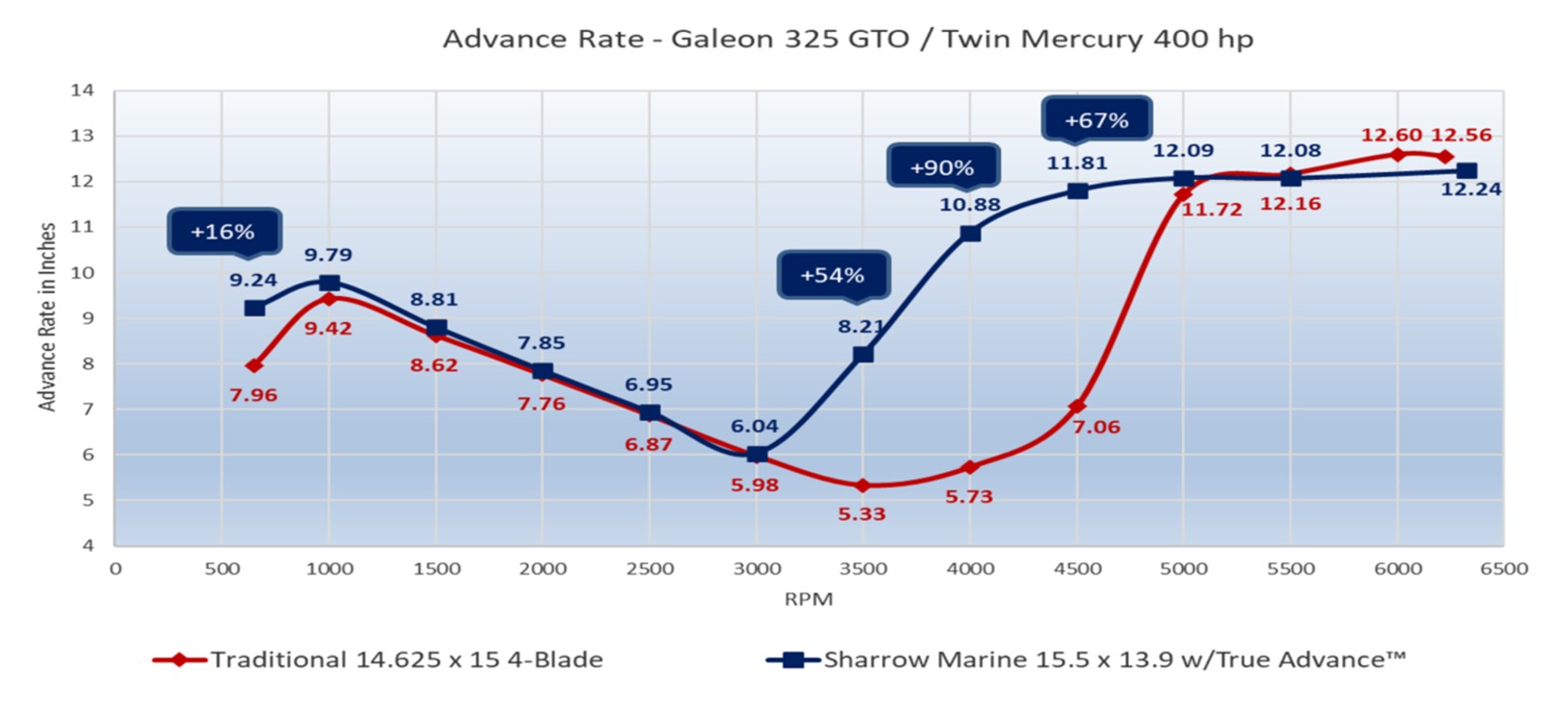
The advance rate of Sharrow Marine propellers operated in the mid-ranges is nearly always nearer the numeric pitch of the propeller than conventional propellers, indicating higher efficiency.
In this measurement, the Sharrow’s peaked at an amazing 90% better than the traditional props at 4000 rpm, 10.88 inches per revolution versus just 5.73 inches.
The better grip on the water at low speeds also means more positive handling around docks. Many users also report lower noise and vibration.

Sharrow propellers are not designed to maximize speed, but they frequently deliver higher speeds at a given rpm than conventional propellers. As this chart indicates, the advantage for the Galeon test was most significant from 3500 to 5000 rpm.
The ability to maintain more speed at lower rpm not only adds fuel efficiency but also significantly reduces wear on moving engine parts, extending the time between repair/rebuild cycles.
The traditional four blade propellers, which were a slightly higher pitch, produced a slightly higher WOT speed, 42.3 versus 41.9. However, most wise boaters don’t run their motors at WOT very often due to greatly increased fuel use as well as reduced engine longevity.
For those who use their boats frequently to make long runs or for all day operation, the added efficiency of Sharrow propellers can pay for the investment in a few seasons on the water.