Sharrow Prop Tested on a Great Looper

Sharrow propellers have proven their value on a wide variety of boats ranging from small single-outboard center-consoles to large twin diesel yachts—but how might they fare on a tugboat-style design -- a design intended for displacement speeds and running in the teens? The Sharrow’s techs chose the Ranger Tug R-25 with a single Yamaha 300 outboard for testing to find out.
The Ranger 25 is 31’7” (9.62 m) long, has an 8’6” (2.59 m) beam and a dry weight of 7,700 lb (3,493 kg). She’s designed as a fuel-friendly coastal cruiser for two, seaworthy enough to take on navigating large sounds as well as open sea in lumpy conditions.

With a draft of just 19” (0.8 m) motor up, she’s great for exploring shallow bays and creeks, and low top hamper means the Great Loop is no problem.
The Yamaha was equipped with the company’s SWS II 15.75 x 15 three-blade stainless steel propeller for the base runs, and with Sharrow’s continuous blade propeller in 15.68 x 15 TrueAdvance design for comparison.

Displacement Speeds are Key
When travelling on the Great Loop Route in an outboard-powered boat, particularly one on a budget, displacement speeds are the order of the day. Not only does it allow the couple driving the boat to enjoy the sights along the water way, but it also is the most economical way to travel with any propeller. Note that at idle she travels at 5 mph, but with the Sharrow she gets 4.7 mpg or 18% more miles per gallon than with the Yamaha prop.
In fact, at 8 mph which is a comfortable displacement speed that many long-ranger cruisers choose as a good compromise between speed and fuel consumption, the Sharrow delivers a remarkable 37% more mgp – 3.3 mpg vs 2.4 mpg.
At Low Planning Speeds
Look closely at the chart above and you can see that the Ranger Tug get on plane at about 15 mph with the Sharrow props and at about 16.5 mph with the SWS wheels. Both of these speeds are low and are a testament to the fuel-efficient nature of the Ranger Tug bottom design. Here the boat was from 8% to 28% more fuel efficient with the Sharrow loop props.
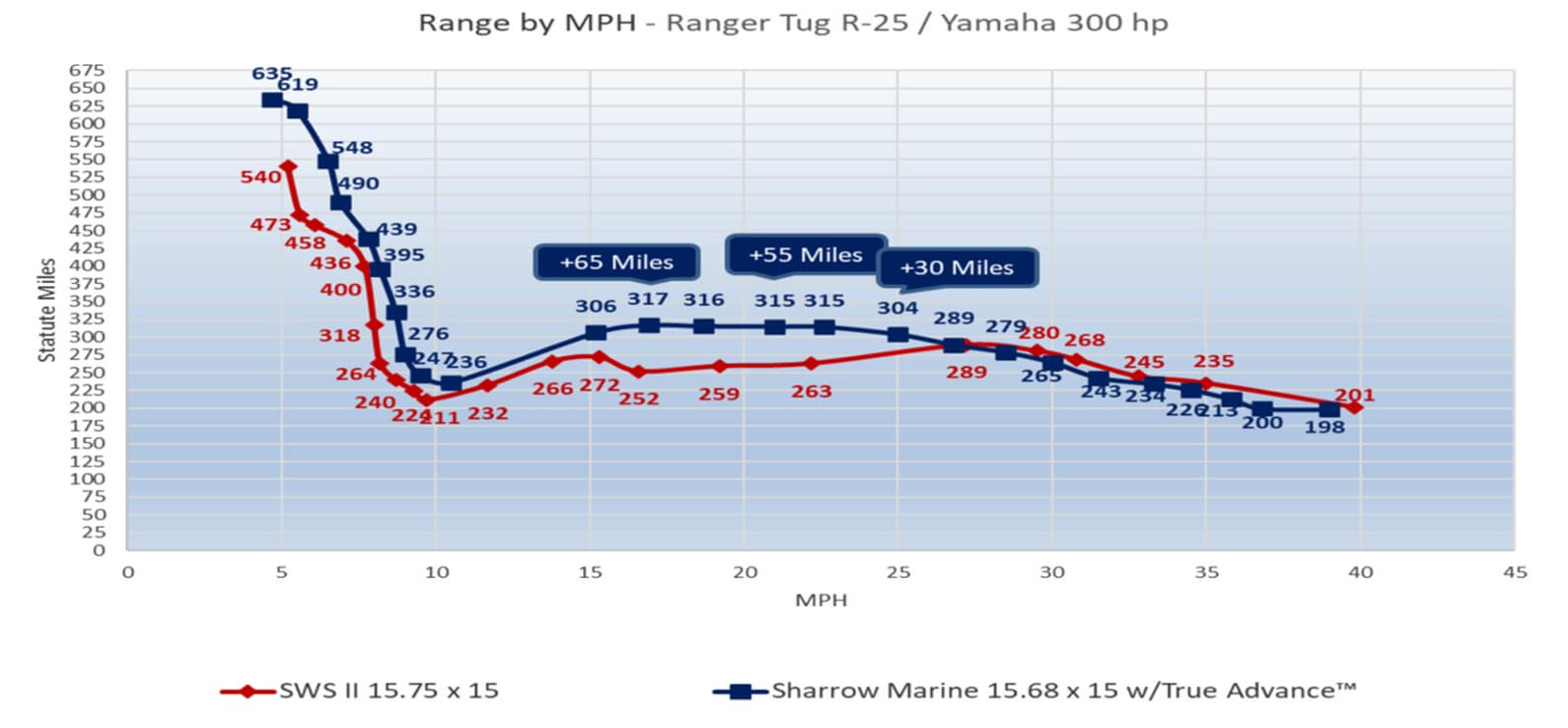
It is in this range that the Great Loop couple will operate the boat when want to cover lots of ground at an affordable speed. At about 27 mph and faster, both props deliver about the same fuel efficiency.
Reduced Range Anxiety
Improved range is one of the major selling points of Sharrow propellers, and as this chart shows, for those who run in the mid ranges from just on plane up to about 27 mph—likely a frequent speed with this boat design—the Sharrow delivers significant range improvement.
The chart shows the Sharrow was slightly less efficient at speeds above 30 in this application. However that requires the motor to be operated at settings above 4800 rpm on this boat, not good for outboard longevity. As with most recreational packages outside sport boats and bass boats, 3500 to 4500 rpm is likely to be the most frequent on-plane operating speed.
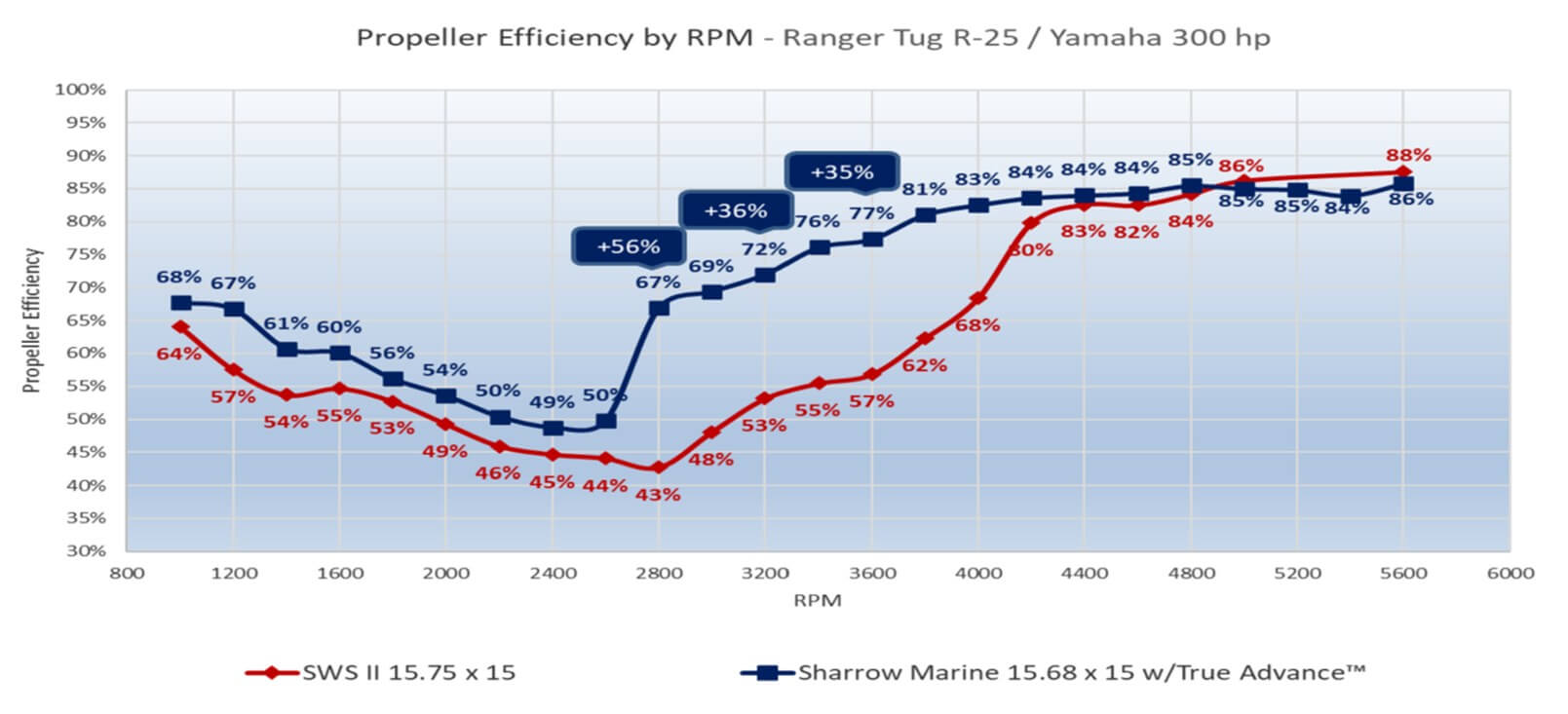
Propeller efficiency is among the strongest features of the Sharrow design. The Sharrow True Advance design showed the most dramatic difference starting at 2800 rpm, where it was 56% better than the SWS II.
Again, it maintained the advantage up to 4800 rpm, and then at full throttle was slightly less efficient. But running a boat of this design at full throttle is likely to be a rarity for wise skippers.
Less Slip Equals Greater Efficiency
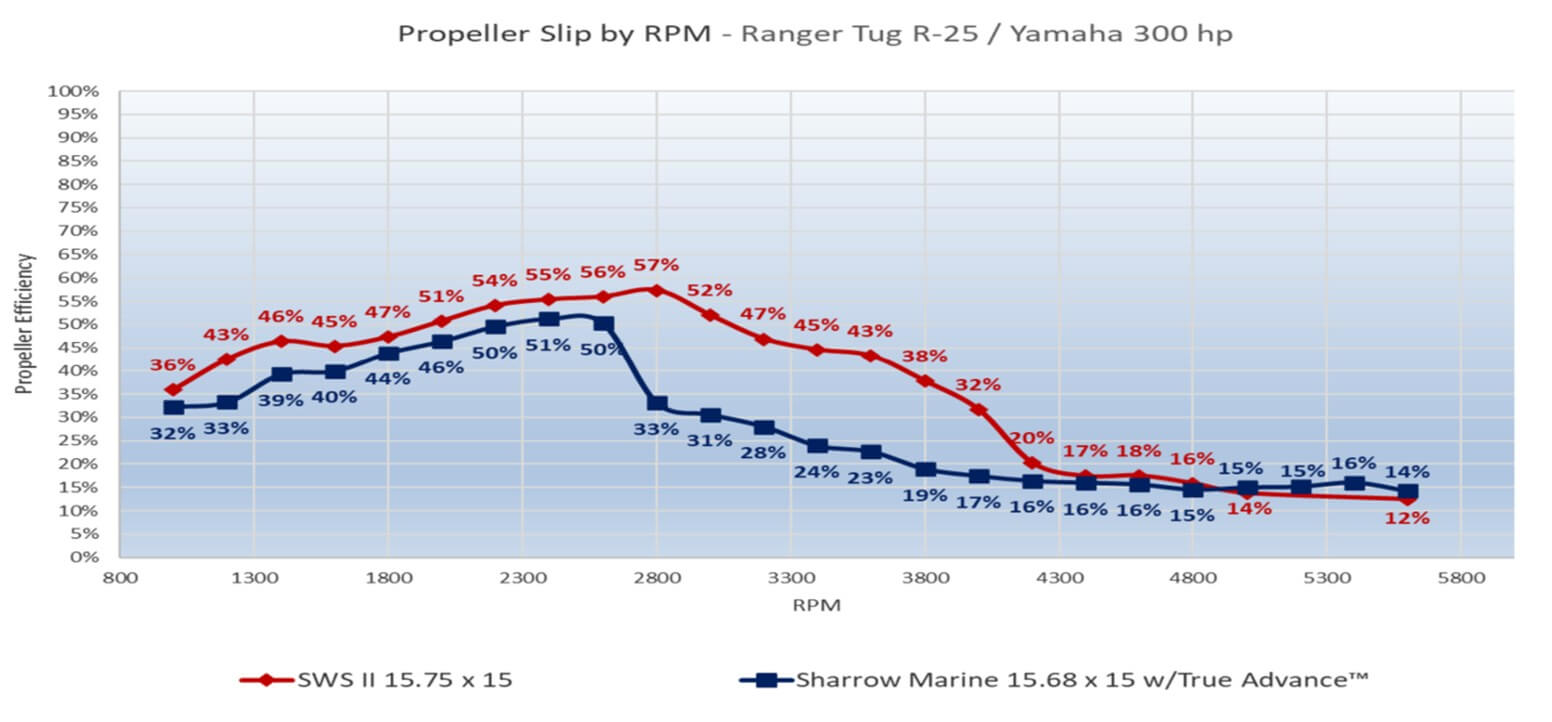
Though propellers behave much like a screw sinking into wood, water is not a solid medium like wood, so there’s always a certain amount of slip. Less slip means the propeller pushes the boat farther on every revolution—it’s another way to talk about efficiency.
The Sharrow propeller in this test showed significantly less slip starting at about 2500 rpm as the boat came on plane, and continuing to around 4800 rpm.
More slip is particularly evident in the conventional propeller as it continues to struggle to lift the boat on plane at about 2800 rpm before starting to get a better grip as it comes out of the hole.
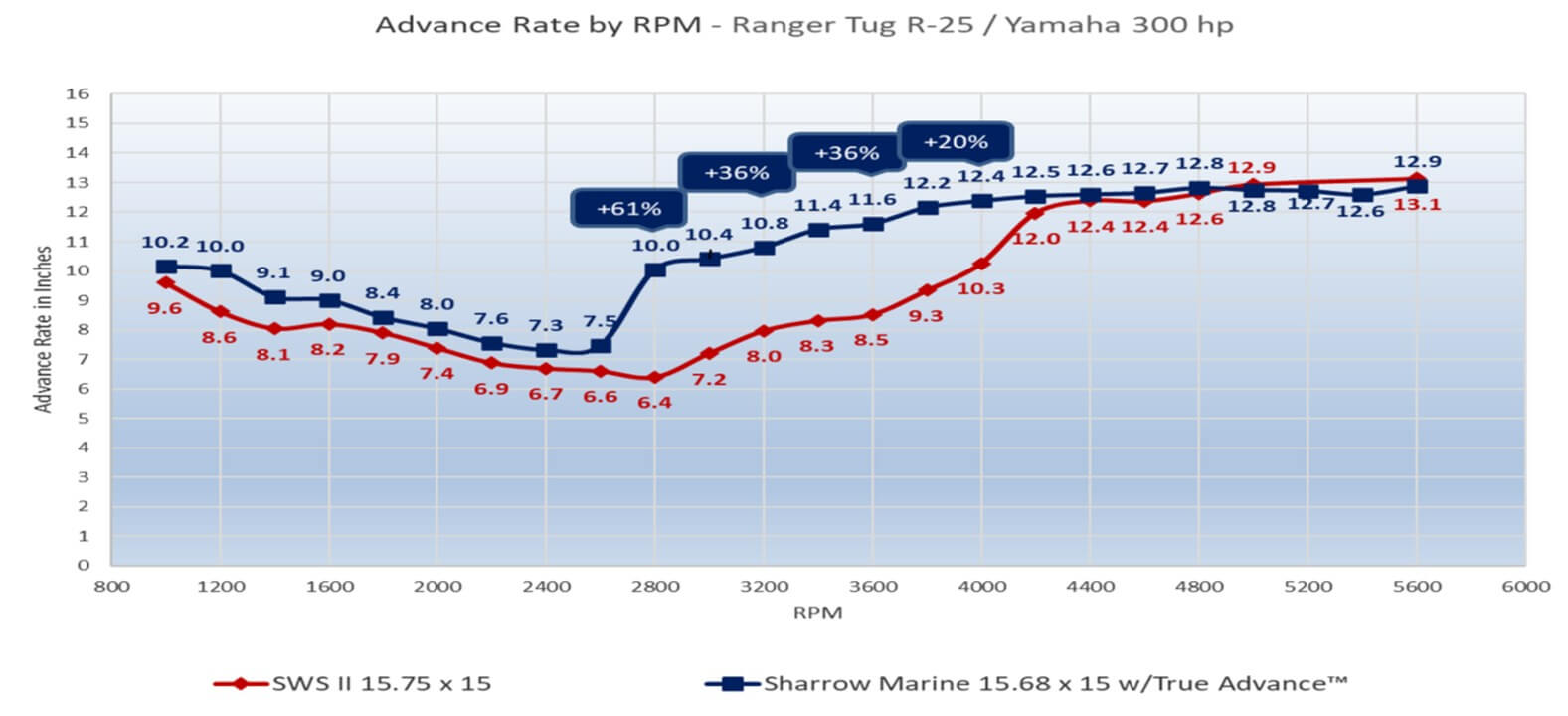
The advance rate in inches is another measure of the efficiency of a propeller. Numbers nearer to the pitch of the propeller indicate a higher advance rate and a more efficient propeller.
As this chart shows, the Sharrow propeller delivered a higher advance rate all the way from idle to 4800 rpm in this test, with its greatest advantage between 2800 and about 4000 rpm, when the conventional propeller was still struggling to bring the boat onto a full plane.

First to Plane. As can be seen in the chart above, the Ranger Tug jump on plane at 15 mph with the sharrow prop at 2800 rpm. The SWS II prop doesn’t hi 15 mph until about 3450 rpm – or 650 rpm more. This is the typical dichotomy between the Sharrow design and old technology, as the new tec get on plane from 500 to 1000 rpm less.
Higher Mid-Range Speed as Lower Cost
Sharrow propellers are engineered for efficiency, improved range and more positive low speed handling, but they also excel in producing mid-range speed. This chart shows the Sharrow had a significant advantage from around 2500 rpm up to 4200 rpm in this test.
Being able to produce higher speed at lower rpm means less wear and tear on the engine and a longer service life, as well as reduced noise and vibration aboard.
Sharrow propellers are significantly more expensive than conventional propellers, but for those who use their boats a lot, they may more than pay for themselves in reduced fuel and maintenance costs over several seasons, with noise reduction and better handling a bonus.