Sharrow Prop Tested on World Cat 32
Sharrow propellers have repeatedly proven their efficiency on mono-hull boats—but how do they fare on a catamaran like the World Cat 32?

The World Cat 32 has an LOA of 32’2” (M), a beam of 10’6” (M) and a weight with outboards of 9,600 lb (KG). Fuel capacity is 300 gal. (L). Power cats are noted for their stability and for delivering a smooth ride in choppy seas—but not necessarily for economical operation.
The Sharrow team put their 15.5 x 15.4 True Advance stainless steel three-blade propellers against traditional 15.75 x 15’s for the test on the twin 300-hp Yamaha outboards powering the World Cat. The results were another endorsement for the innovative propellers.

Sharrow propellers were first introduced to the market in 2012 when inventor and company owner Greg Sharrow brought the innovative continuous blade patented design to market. Since then, it has become popular across a wide swath of the marine industry for both recreational and commercial applications. The company has manufacturing agreements with Yamaha and with Veem among others.
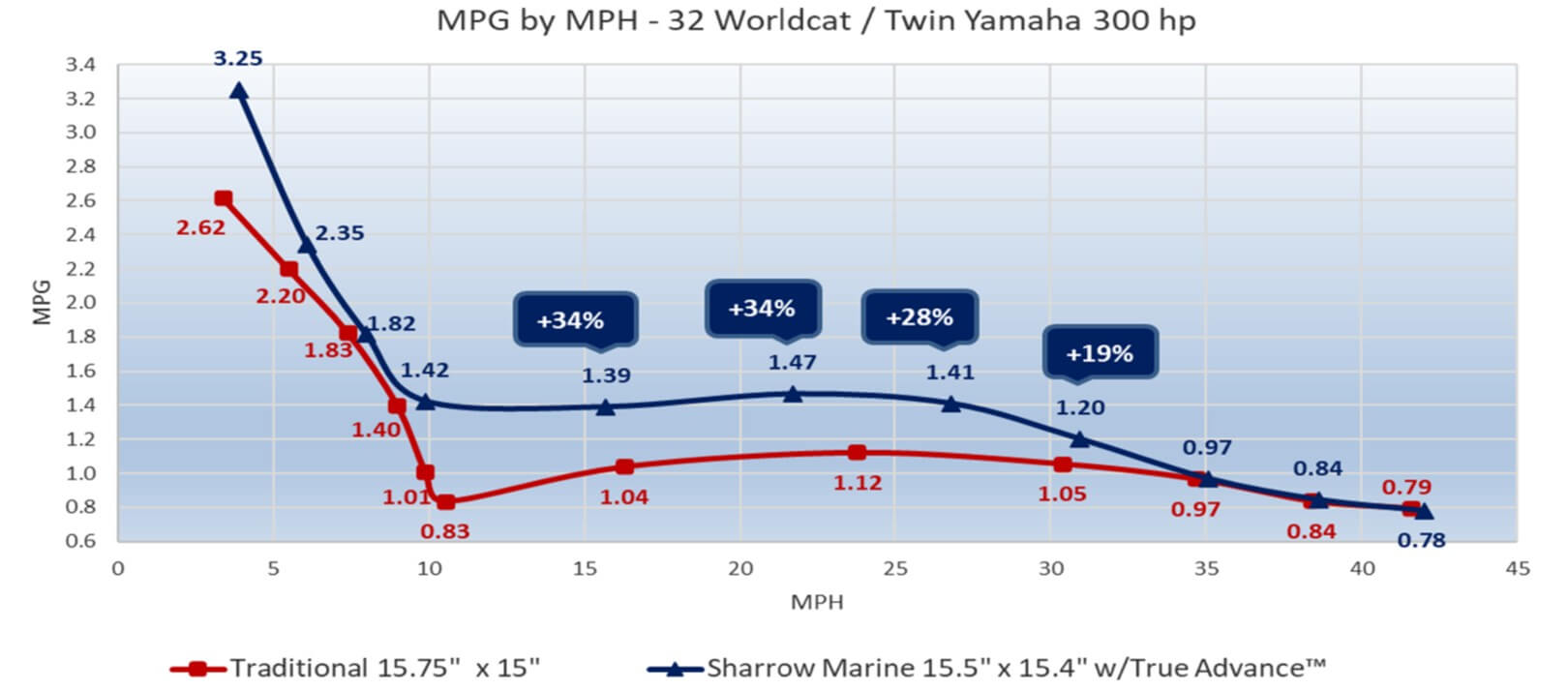
The first takeaway from this test is that the Sharrow’s appear to work as well on the catamaran design as on monohulls, with more fuel-efficient operation from idle all the way up to 35 mph.
The 3.25 mpg recorded at idle speed with the continuous blade Sharrow’s speed would be a big selling point for those who slow-troll live baits hour after hour for big offshore species. And, better on-plane mpg from 15 to 35 mph, typical running speeds for a cat of this design with this power option, also means extended range as well as big savings on fuel costs.

A more efficient propeller maximizes the boat's speed and fuel economy for a given engine power.
As this chart indicates, the Sharrow’s had a slight edge from idle up to about 2000 rpm, and then a significant advantage from that point up to full throttle. The advantage maximized at 3000 rpm, where the Sharrow’s were an impressive 107% better. The difference declined at higher rpm, but even at 5500 rpm, the Sharrow’s had a 6% advantage.
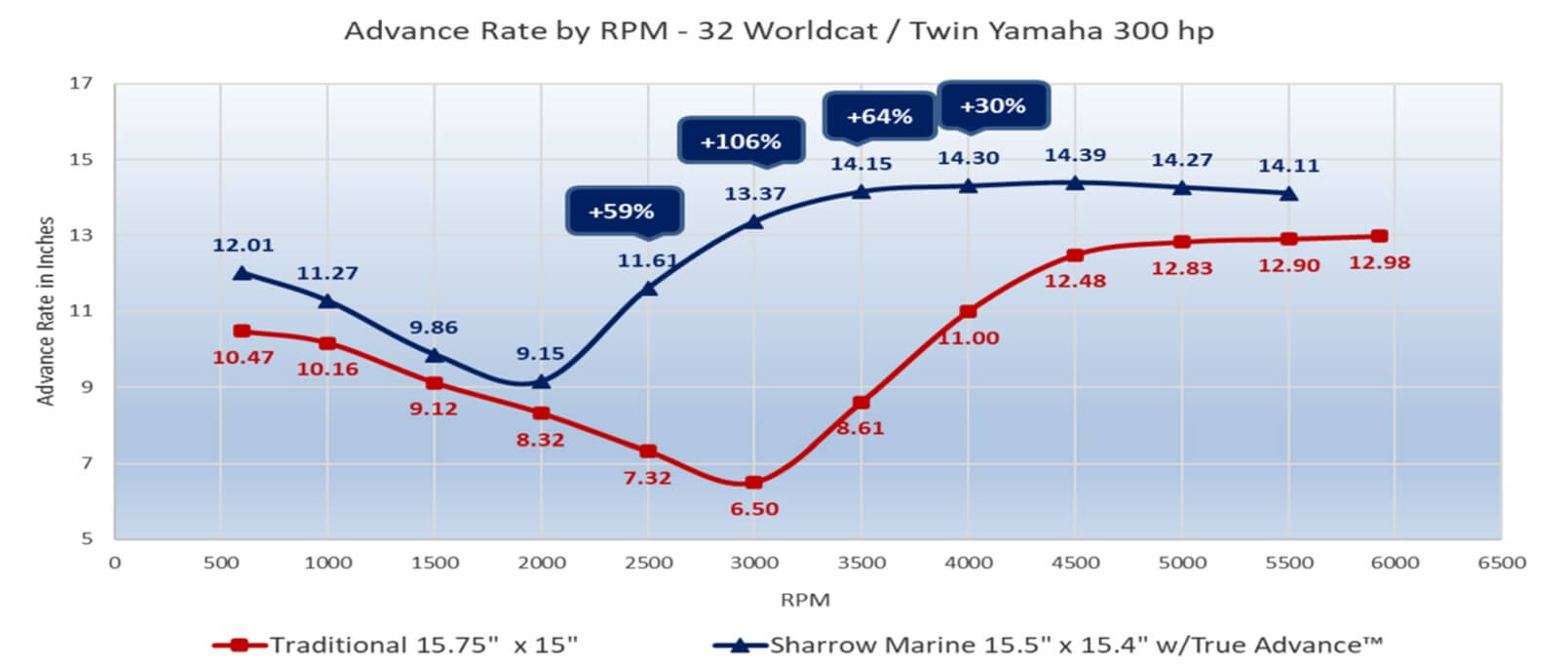
The advance rate is calculated by dividing the boat's speed by the product of the propeller's rotational speed and its diameter. A higher advance ratio generally indicates better efficiency, meaning the boat moves further per rotation of the propeller.
As the chart indicates, the Sharrow’s advanced the boat 59% further with each revolution at 2500 rpm, 106% further at 3000 and 64% further at 3500 rpm.
As the boat came on full plane the boat advanced much further per revolution, with the propellers approaching nearest their designated 15.4” pitch at 4500 rpm. This is common in outboard operation, which is why the “sweet spot” in terms of efficiency for many boat/motor packages is around 4500 rpm.
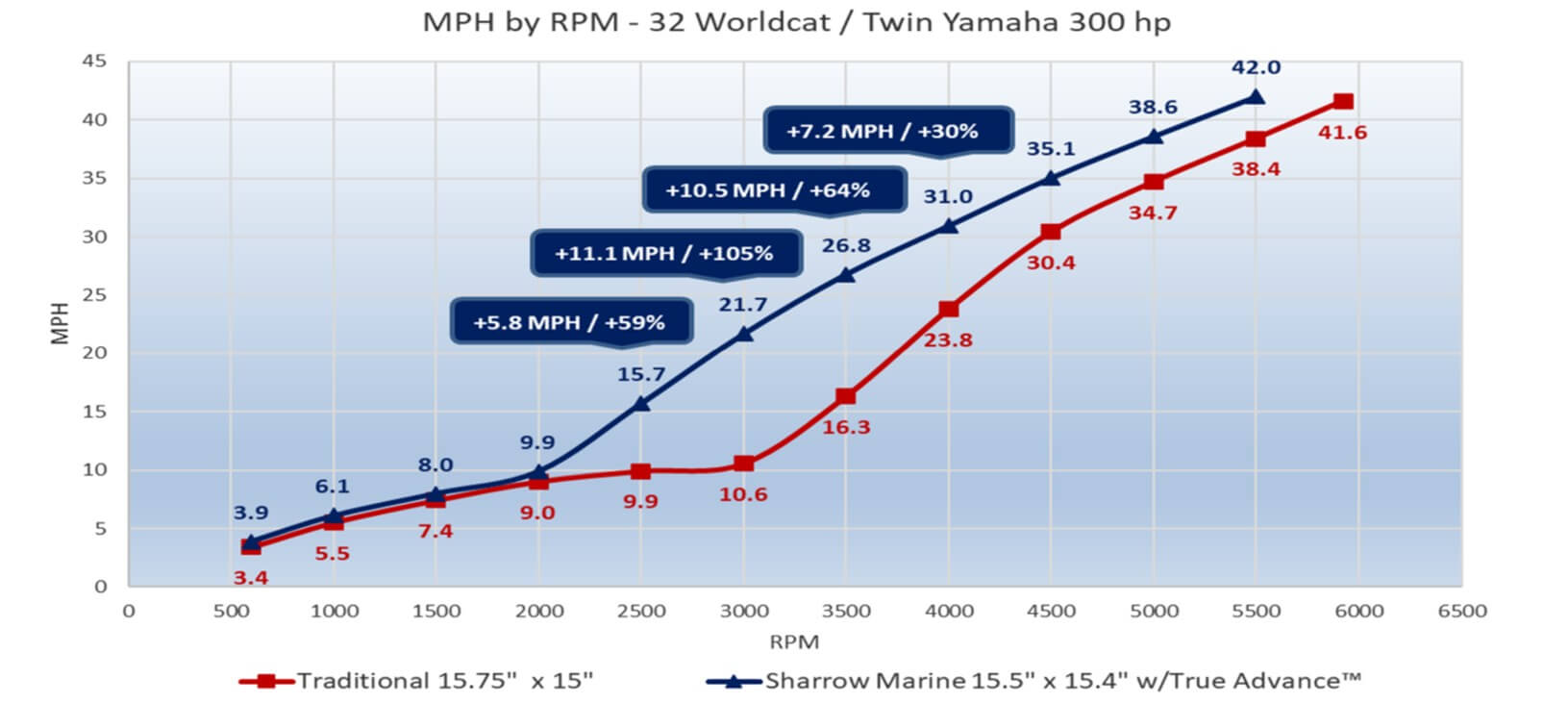
Sharrow propellers are not tuned for maximum speeds, but in this case they delivered a higher WOT speed than the stock propellers, 42.0 vs. 41.6 mph. Note that they reached this speed despite the engines running at slightly lower rpm, 5500 vs. about 5800, an indication that the Sharrow’s converted more of the available power into thrust.
However, the greatest gains occurred in the mid ranges, where Sharrow propellers usually shine. The boat ran 21.7 mph at 3000 rpm, vs. 10.6 mph with the stock props, where it was still laboring to come on full plane.
Throughout the test, the Sharrow’s delivered more speed at lower rpm, which would result in less wear and tear on the outboards, less maintenance and repair costs, and lower noise and vibration levels.
Again, it appears the Sharrow propellers, though more expensive than conventional propellers, can pay for themselves over a few years of heavy use.