Sharrow Props Greatly Improve Performance on a Grady-White 208 Adventure
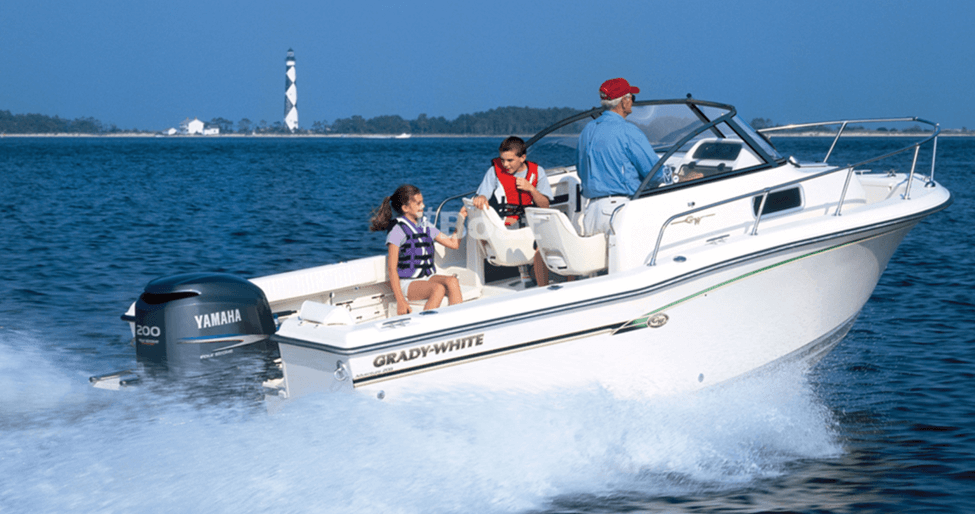
The efficiency of the Sharrow Marine propeller design has been widely proven on a variety of sizes and styles of recreational and commercial boats, and the TrueAdvance engineering was equally effective in the most recent test runs conducted by Sharrow Marine on a Grady-White 208 Adventure.
The 208 Adventure is a relatively compact walk-around cabin model that runs well with the single 200-hp Yamaha four-stroke outboard. Grady designs all of its boats to be used with Yamaha outboards to maximize the boats performance, and all of its boats are equipped with Yamaha engines in a vender-suppler agreement.
Basic specs.: The 208 Adventure has a 20’4” LOA with an 8’1” beam and a 15” draft. Fuel capacity is 82 gallons, and she’s rated for up to a 250 hp outboard.
The test package was equipped with a stock Yamaha 14.25” x 17” three-blade stainless steel propeller, and reciprocal performance runs were made, and recorded. Immediately afterward a Sharrow MX 14.61” x 16” continuous blade stainless steel propeller was fitted to the boat, and the performance runs were repeated.
Disclaimer: While these tests were not conducted by BoatTEST captains, we have confirmed a number of their test findings over the years and have found their results to be consistently the same, or nearly the same as our own.

The Sharrow Prop Design
Sharrow propellers are engineered with a unique loop-blade structure that creates one continuous blade to and from the hub, with no “blade tip.” By eliminating the blade tip, blade tip vortices are also eliminated, and thereby the drag and cavitation that naturally occurs on all standard designed-props virtually vanishes. This attribute, combined with what amounts to six blades in the water, instead of three, decreases vibration and give the prop a much better grip on the water, making handling much more controllable and precise.
Underwater videography of propellers shows a stream of bubbles emanating from the tip of a standard prop are all RPM settings. These bubbles when they reach the surface of the water “pop” – a phenomenon that creates much of the noise that is heard with an outboard engine. It is for this reason – along with reduced vibration transmitted to the hull body -- that makes operation with Sharrow props a quieter experience.
Each propeller in the MX series is custom-machined to specific parameters, ensuring optimal performance as well as smoother, quieter operation.
Parsing Results from Comparative Testing
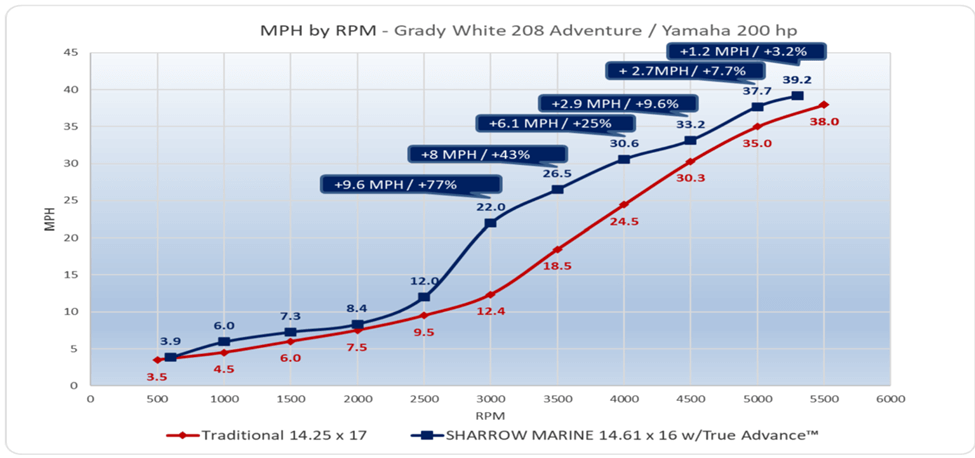
In the chart MPH x RPM, the blue curve (Sharrow MX™ prop) vs. the red (traditional 14.25×17 prop) shows a dramatic mid-range advantage: at 3000 rpm the Sharrow is +9.6 mph faster (and other callouts show +8.0, +6.1, +2.9, +2.7 and +1.2 mph at successive rpm points). Practically, that means the same throttle setting produces materially higher boat speed through the commonly used 2,500–4,500 rpm band — better hole-shot, quicker plane, and higher cruise speed without raising engine workload.
For owners who run most often at mid-rpm as most recreational boaters do, the MX shifts the boat’s usable speed envelope upward, improving transit time and responsiveness. The boat also gets on full plane quicker, reducing the sometimes tricky period when bow rise can interfere with operator vision.
These tests were conducted with two people aboard. With more people aboard, the boat will have a more difficult time getting on plane with both props, but because the Sharrow props do a better job of delivering engine torque to the water, no matter what the weight of the boat, when equipped with the Sharrow prop, performance will be much better.
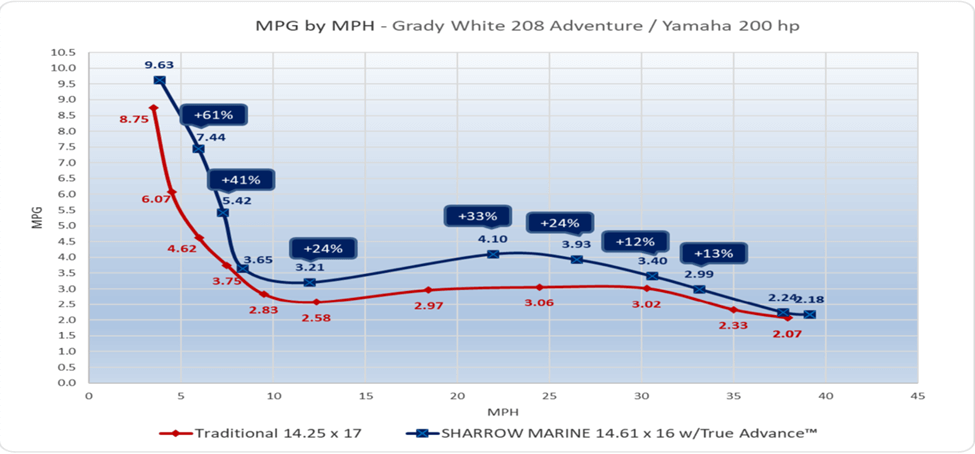
The MPG x MPH graph maps economy against boat speed and shows the Sharrow prop delivering large percentage gains across the board: callouts show an astounding +61% improvement at idle, +41% at slow cruise, then +24%, +33%, +24%, +12% and +13% at higher cruise speeds.
ICOMIA boat use data indicates that the typical boat owner operates the engine 40% of the time at idle.
In real terms the MX prop increases miles per gallon at every tested speed, meaning lower fuel burn for the same speed or the ability to go faster for the same fuel consumption.
This is especially significant in the mid-to-upper cruise range where small MPG improvements compound over longer trips — less frequent fill-ups, lower operating cost, and extended time on the water per tank.
More efficient propulsion also means less wear on the engines, extending time between repairs, rebuilds or replacement.
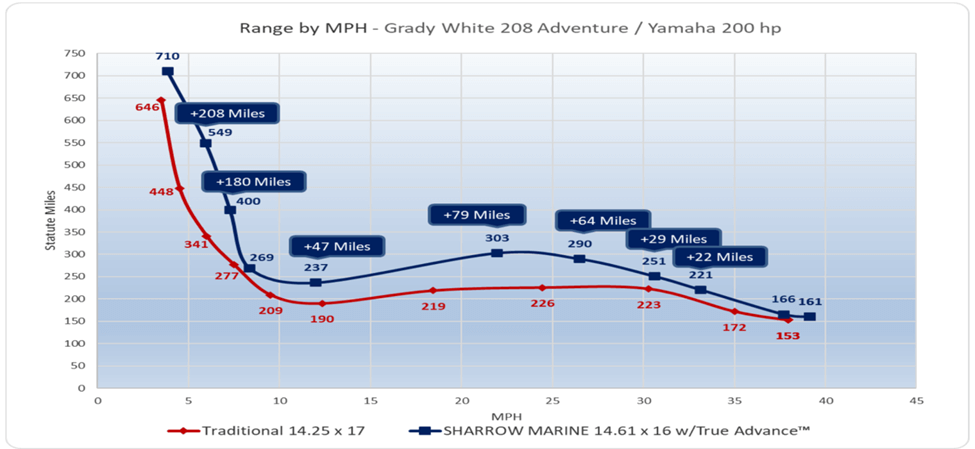
Range x MPH directly translates the MPG gains into usable distance. The Sharrow curve shows big range increases across speeds: labels note +208 and +180 miles at the very low end, then +47, +79, +64, +29 and +22 miles at typical cruising speeds compared with the traditional prop. That means, for example, the same fuel load can take you tens — even hundreds — of miles farther depending on speed.
For anglers and cruisers this increases operational flexibility (longer day trips, farther fishing grounds, or larger safety margins), and reduces time/frequency spent refueling during extended outings. “Range anxiety” is less likely, and more remote destinations come within safe operating distance.
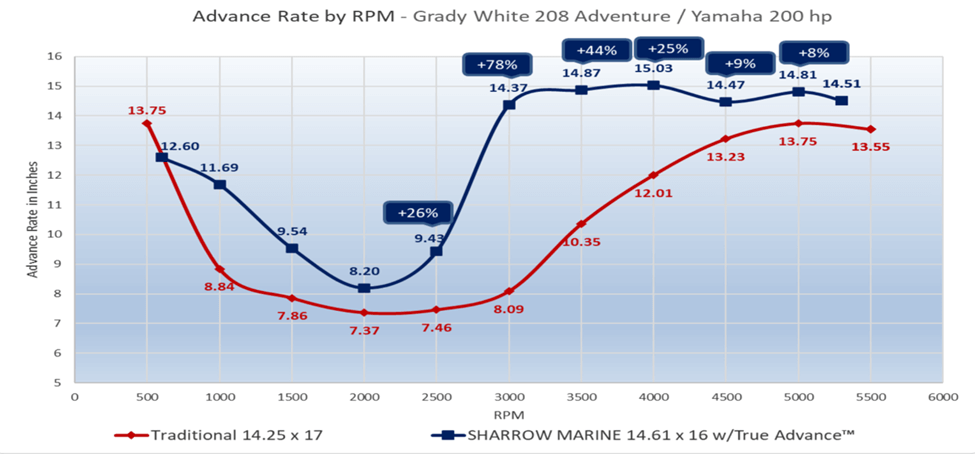
The Advance Rate x RPM chart gives a better idea of why the Sharrow Marine propeller functions so well—particularly in the mid-ranges, it propels the boat significantly farther on each revolution than does the stock propeller. The unique blade design gets a better grip on the water, produces less slip and results in better performance.
This is the reason that Sharrow Marine calls it props “TrueAdvance” – simply because its props come far closer to their theoretical advance rate than conventional prop designs.
Sharrows are also noted for improving control at docking speeds thanks to their grip on the water at low rpm, and they work as well in reverse as in forward per users. Sharrow claims its props produce 50% more usable thrust in reverse compared to conventional prop designs.
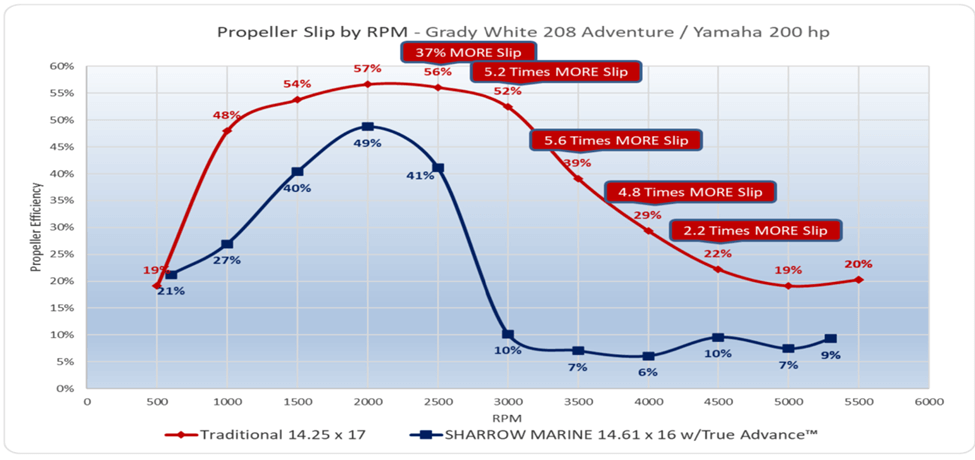
Prop Slippage: The final chart quantifies the calculated “slip” of both props throughout the RPM range. “Slip” is the word used to characterize the difference between a boat’s theoretical advance rate (pitch in inches x RPM) and it’s actual advance. Less slip means greater efficiency, including greater speed at a given rpm and better mileage.
Note that at 3500 rpm, the conventional propeller slip is 5.6 times greater than the slip of the Sharrow, which calculated to just 7 percent.
At full throttle, the Sharrow had less than half the slip of the conventional propeller in this application.
Overall, in this comparison, as in many others, the Sharrow Marine propeller proves to be a major advance in propeller technology.
Sharrow props are expensive – typically $1,595 for aluminum props to $5,000 for stainless steel props – the leap in performance they provide can’t be matched by any other means.