Sharrow XO Boosts Performance on a Cape Horn 34 XS with Twin Yamaha 425 XTO’s
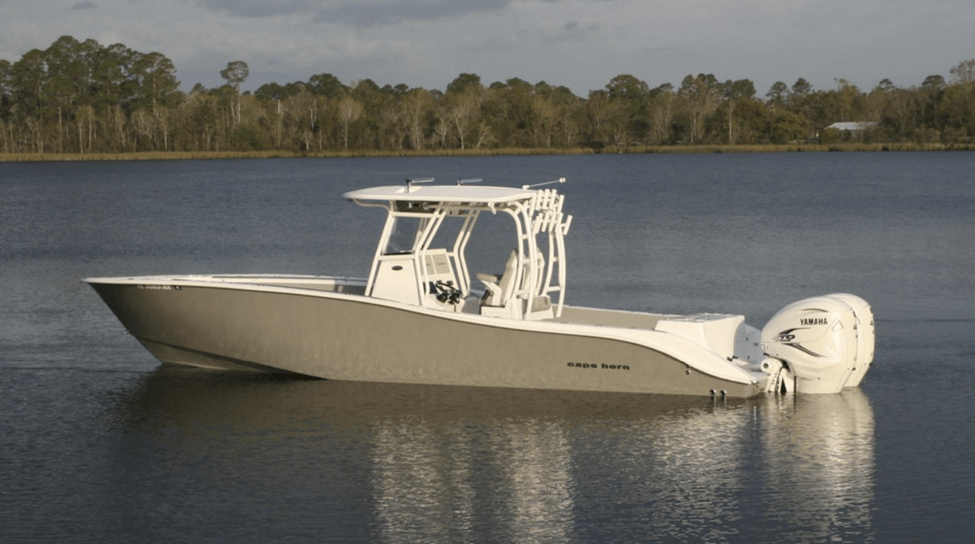
The Cape Horn 34 XS in this test by the Sharrow Engineering team was a 34-foot, 11-inch (10.64 M) center console with a 9-foot, 3-inch (2.74 M) beam and a 23-degree deadrise. It had a dry weight of 8,000 lbs (3,628 kg) (without engines), a max horsepower of 900, and a fuel capacity of 350 gallons (1,325 L).
The Sharrow continuous blade propeller is a tipless prop designed to improve efficiency, and deliver a smoother ride at all RPM settings, and stronger thrust in both forward and reverse compared to conventional props.
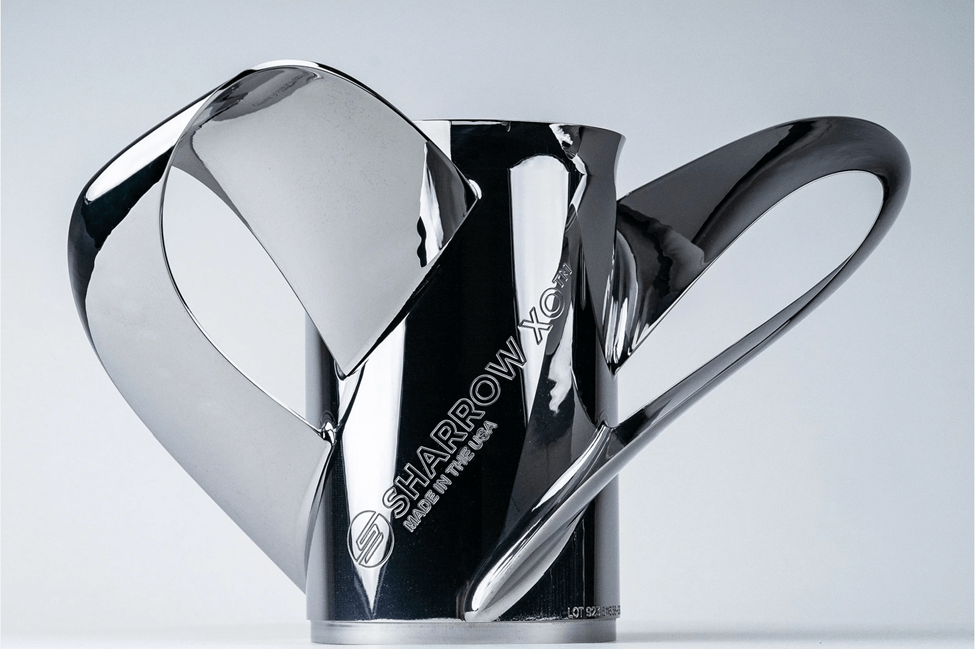
For the test, the twin Yamaha 425 XTO’s were first run with traditional 16.125 x 22 stainless three blade propellers for baselines. They were then run with Sharrow Marine 16.63 x 21 w/TrueAdvance stainless steel propellers selected as the best fit for the power and weight of the test package.
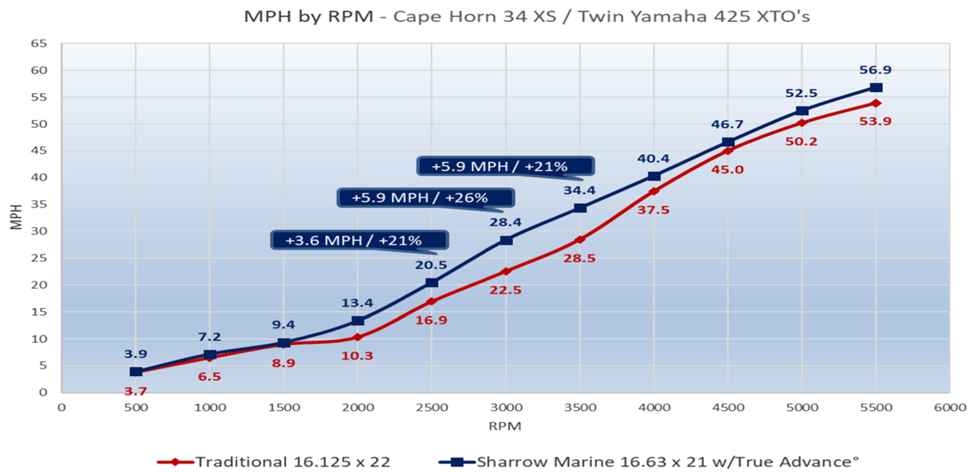
While Sharrow propellers are nearly always faster than traditional propellers in the mid-ranges, as this chart shows, the Sharrow advantage was significant all the way to WOT on the Cape Horn, with a top speed a full 3 mph higher.
Note that the Sharrow’s were nominally a slightly lower pitch than the conventional propellers. Yet in the tests, they were not only faster on takeoff and mid-range but also faster at top end, a clear indication that the design takes full advantage of the available horsepower.
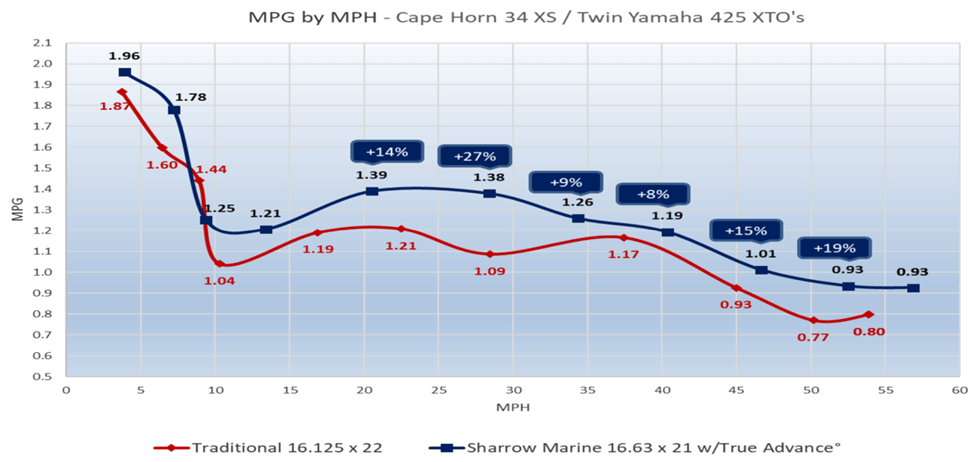
The Sharrow mpg advantage in the most common operating range for an offshore boat, roughly from 20 to 40 mph, is dramatic, as seen here, and is also notable at full throttle. At WOT, the Sharrow’s show nearly 20 percent better mpg.
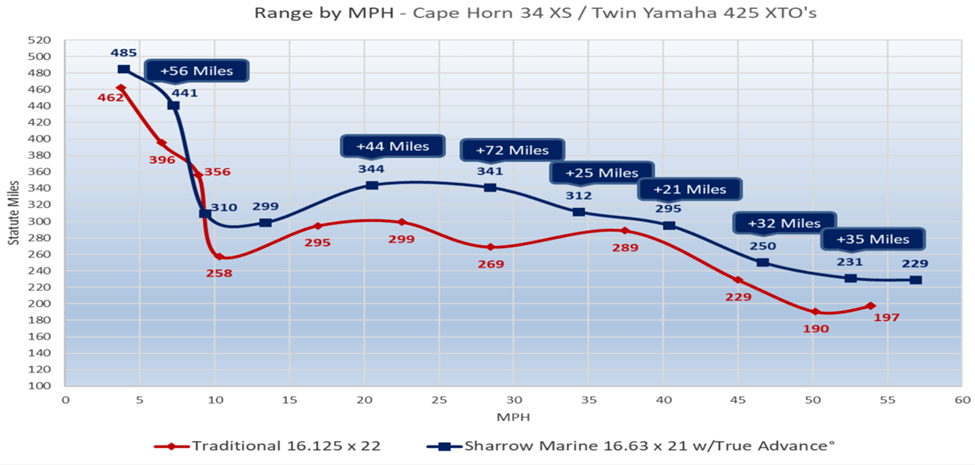
Since the Cape Horn is likely to be used for low speed trolling for many hours offshore, the impressive efficiency at near idle speeds gives anglers an advantage over the traditional propellers.
And at cruising speed just under 30 mph, the efficiency adds an impressive 72 miles to the range, greatly improving the capability of the boat to reach distant reefs or rigs as well as for island-hopping.
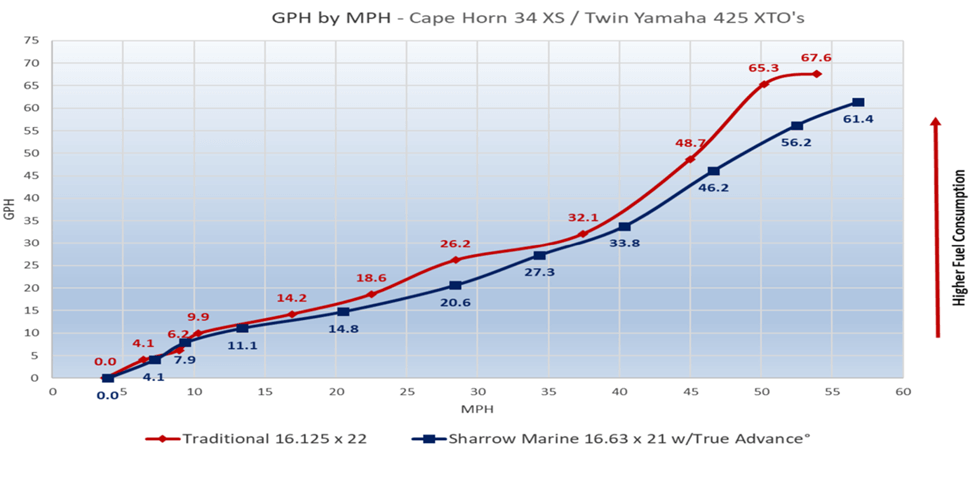
Gallons per hour is a fuel burn rate. It tells you how fast an engine is using fuel at a given throttle setting or RPM. High GPH means it’s burning a lot of fuel per hour—is that fuel use going into the most efficient propulsion possible?
As this chart shows, with the Sharrow, there’s a distinct improvement. The engine doesn’t work as hard for a given speed. So it’s not only saving fuel, adding range and cutting operating costs, but the engine doesn’t have to work as hard. This means it’s likely to last longer before needing repair, rebuilding or replacement.
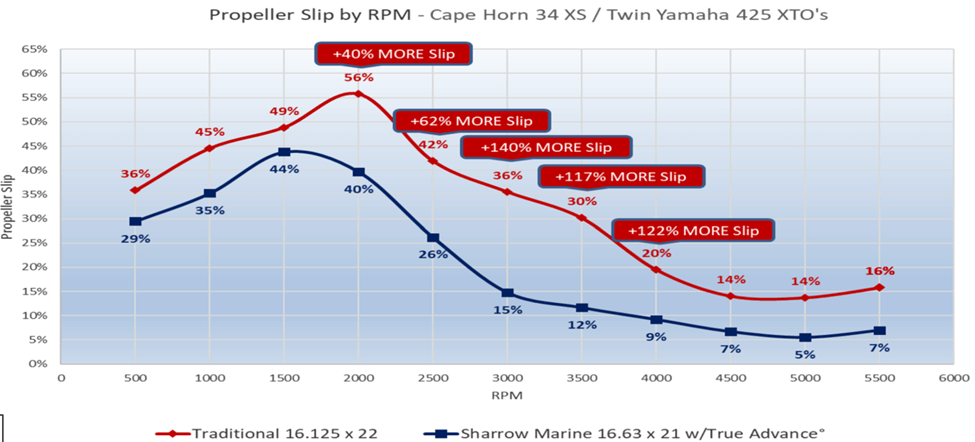
All propellers slip, and some slippage is required for the motor to spin up on takeoff and put the boat on plane. However, once on plane, more slip means less speed at a given rpm and/or lower mpg. The Sharrow design shines in this measure, delivering an astounding 140 percent less slip at 3000 rpm than the conventional propellers and 122 percent less at 4000 rpm.
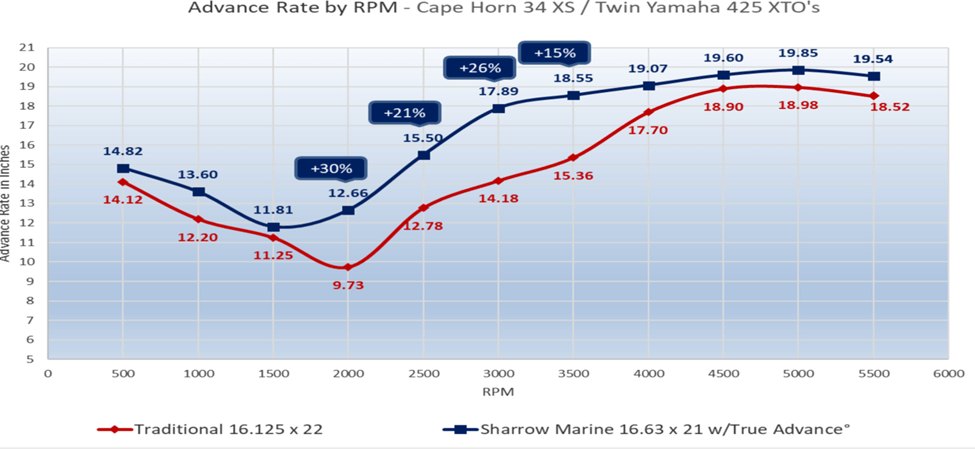
The advance rate, how far forward the boat travels with each revolution of the propeller, is another way of measuring efficiency. As this calculation shows, the Sharrow’s push the boat 30 percent farther at 2000 rpm as the boat breaks over on plane, and even at WOT still maintains a more than a 1-inch per revolution advantage.
Users also report less noise and vibration underway thanks to the carefully balanced propellers, and better low speed handling for easier docking.
While Sharrow stainless propellers represent a significant investment, many owners report that the dramatic increase in efficiency quickly pays for a set of Sharrow propellers in boats used regularly for long-range operation.