Shellfish Waste Could Help Clear Oceans of Microplastics
By Jake Kavanagh
A proof-of-concept project has shown that a new type of water micro cleaner made from natural colloids can bond with microplastics and bring them to the surface for removal.
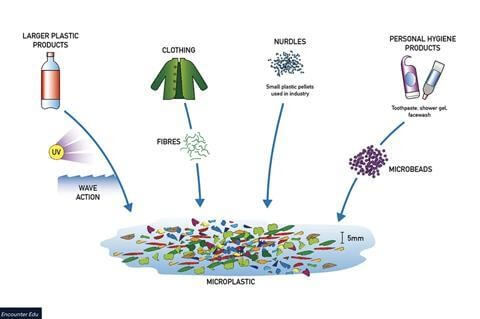
The problem of microplastics in our rivers and oceans is of growing concern, but a new body of research from the North Carolina State University suggests that there may be a natural solution. The project revolves around ‘single cycle’ cleaning, in which soft dendritic colloids are released into the polluted water. These colloids, which have the natural ability to stick to almost anything, sink into the water, attach themselves to any nearby microplastics and then bring them up to the surface. Here, they form a biological scum which can be removed using a skimmer pump.
Although the process sounds simple, it has so far only worked in laboratory experiments, so scaling it up would be a challenge. The science is also quite complex and involves using several natural chemicals and additives to turn small pellets into tiny submarines. These dive, float around for about 30 minutes whilst bonding to microplastics, and then surface again.
The two authors of the paper, Orlin Velev, Distinguished Professor of Chemical and Biomolecular Engineering at NC State, and Ph.D. student Haeleen Hong, say that they have demonstrated how multiple principles can be integrated into a single cycle.
“The cleansing particles in this research are made from chitosan, a biodegradable polymer originating from chitin, which comes from processed shellfish waste,” Velev said.
The dendritic colloids are made into soft pellets, with one side coated with a plant-based oil which acts as propulsor using the so-called ‘camphor boat effect.’ When the pellets are dropped into water, they sink, and the oil makes them disperse. They move outwards and downwards from the drop point, and as they travel through the ocean they bump into microplastics, which to stick to them.

To bring the pellets to the surface again, they have been coated with magnesium, which forms tiny bubbles as it reacts with water. The more bubbles that form, the more positive the buoyancy. To extend the cleaning time, a layer of natural gelatine has been placed over the magnesium to slow down the reaction and keep the pellets active at depth for longer.
“Potentially, the collected scum can be bio-processed into more chitosan, which can then be used to create more micro cleaners in order to capture more microplastics,” Velev said.
Whilst still in the early stages of experimentation, when fully scaled up this type of process could start to reduce the concentration of harmful microplastics in the World’s oceans. These tiny plastic particles are being blamed for a negative impact on aquatic life and are also finding their way into humans via the food chain.
The research has been funded by grants from the National Science Foundation, and the team say that the use of naturally occurring materials makes the process far more sustainable for long term use.