Strangled!
Your Politicians Are Hell Bent to Kill Boating as We Know It
These are the best times ever for boating and recreational boating industry, right? Hell, boats are sliding out of sales rooms, new people are being introduced to the water and the used boat market is as tight as a clam’s butt. You would think all of us in the business should be happy and looking forward to many more years of success and expansion, right? Wrong, bilge breath! The fact is, these are some of the shakiest, scariest times the industry has ever seen as we are slowly being strangled by regulations destined to kill the boat industry, as we know it.

Most all of this is being driven by tree humpers, er huggers, wacko green groups worldwide composed mostly of unshaven (even the women!), long haired, underachiever geeks who’s goal in life is to bring the lifestyles of everybody down to their old, rusty Volvo level. If they can’t own a boat, nobody should own boats. Since they are far better organized than recreational boatsmen who just want to get out and enjoy the water, they have our phony politician’s attention. That’s the basic problem here and it will get worse. Al Snore (who, when you read this may be our first wacko, green president) advocates all of us riding bikes to work (while he gets ferried around by the Air Force and a fleet of limousines). Let’s look at just a few of the problems we are now facing:
Manatees: back in sailing ship days, sailors mistook manatees for beautiful mermaids. Folks, did you ever look into the face of a manatee? These sailors had to be either very drunk or extremely hard up. Anyway, manatees are a big problem in Florida thanks to manatee huggers. Oppressive speed limits are being imposed up and down the intercostal waterway and land development will be severely curtailed even though some studies show that the manatee population is growing.
Comment: did you know that manatees are not indigenous to Florida? No, they were imported from the West Indies (for what, pets?). Why not round up all the manatees and ship them back to the West Indies were they can live in peace and quiet? Does this make me a manatee racist?
Propeller Guards: greedy lawyers want to protect the public from being killed by propellers. These sleezebags are pushing for legislation and organizing class action suits against boat and engine manufacturers, which will leave victims with some compensation while they (the lawyers) become Trump wealthy.
Comment: the Coast Guard can only document a total of 8 fatalities caused by propeller strikes over the last three years – an average of 2.7 deaths per year. For this we need class action? Let’s face it, most of these accidents are caused by stupidity on the part of the operator, the swimmer (or both). Hell, car doors are huge scissors that can maim and kill. Should we legislate against car doors and go back to open buggies?
Volatile Organic Compounds (VOCs): the impact of this could be huge. VOCs are a byproduct of the fiberglass manufacturing process in open tooling or molds – a process currently used by most boat builders worldwide. The EPA wants to limit the transmission of HAPs using processes called MACTs regulated by BACTs to produce laminates using RTM techniques such as SCRIMP or VEC. You got all that? Translation: the EPA wants to limit transmission of volatile gasses (such as styrene) from open molds to the atmosphere. This can be controlled using closed mold systems presently used by some high-end builders. It will be extremely expensive for mass producers of watercraft to switch to these systems.
Comment: fallout could result in having just a few huge certified fiberglass composite manufacturing centers around the country requiring all builders to subcontract their fiberglass work to these centers or, laminate production could shift to countries that do not have such regulations such as Brazil and China. Either of these options would greatly increase the cost of boats. Does anyone really know how much the relatively tiny fiberglass boat industry contributes to the VOC total? Not much, I’ll bet.
Diesel Emissions: pushed by the EPA, marine diesel manufacturers are being forced to computerize all diesel engines for cleaner running. Catalytic converters may be included in the exhaust system.
Comment: Using straight, mechanical diesel engines, one could confidently install a single engine in a commercial or pleasure boat and feel confident that the machine would be utterly reliable. A splash of diesel fuel, some compression and the engine runs. Computerizing these engines makes them infinitely more complicated. Would you attempt to cross an ocean in a single screw vessel using these engines? Not without a qualified computer technician aboard! The result will be more cost, more maintenance and more twin-screw boats. Worse yet, regulations are being proposed to retrofit emission devices on existing diesel engines at a cost of up to ten grand per engine! If you don’t spend the bucks comrade, you cannot use your boat. Having two red-hot catalytic converters in my engine room that could explode at any time will infinitely add to my boating pleasure.
Anchor Requirement: the US Coast Guard is considering a regulation requiring all boats to have ground tackle. This is one of the very few proposals that make any damn sense at all. Anybody that goes out in a boat without an anchor is a jerk.
Comment: surprisingly, the recreational marine industry is objecting to this on the grounds that – get this now – “it will foster the idea that boating is a dangerous sport!” Using the same convoluted logic, we should do away with the laws requiring life preservers and fire extinguishers aboard. Pure stupidity.
Boating by the Hour
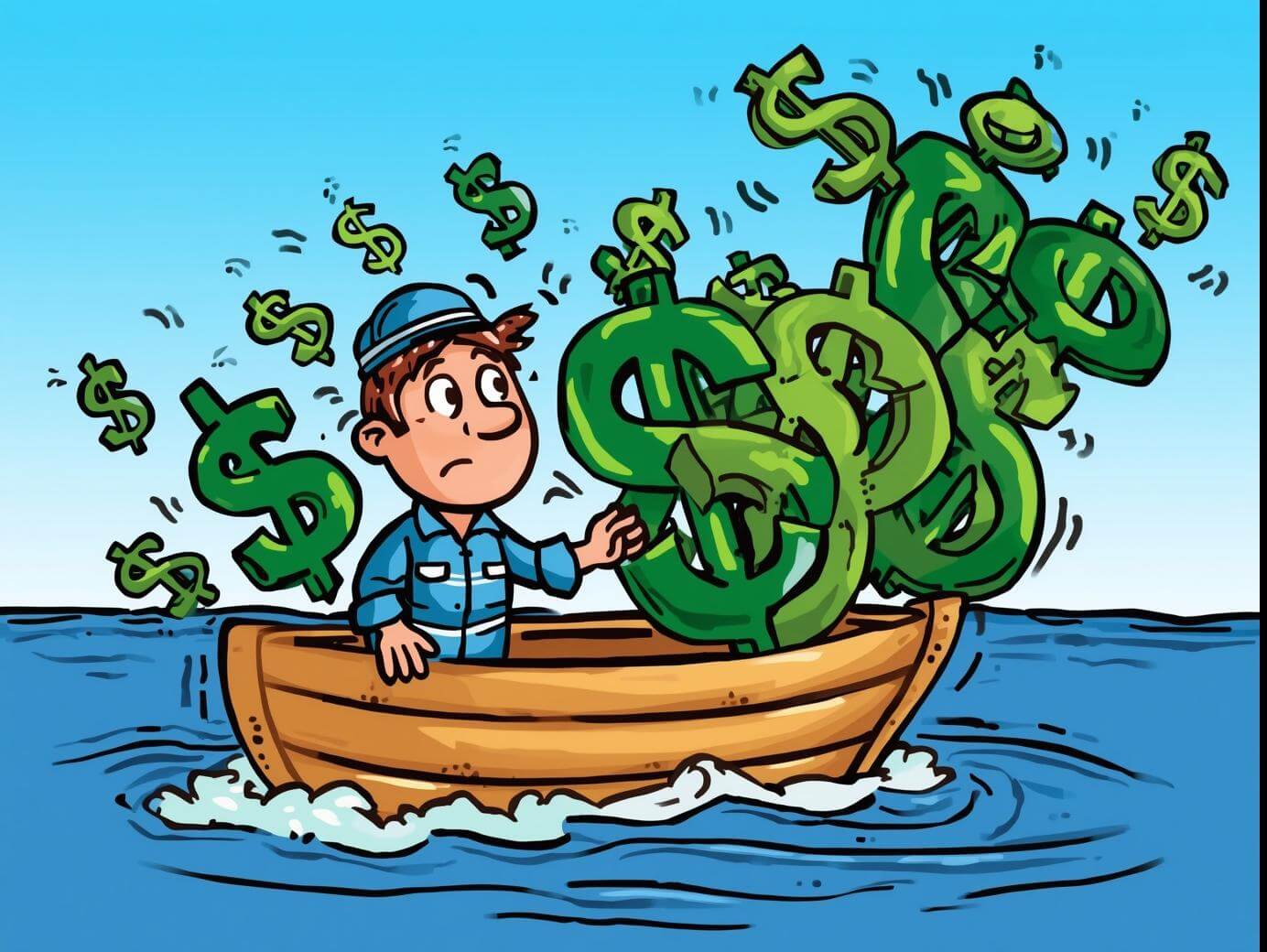
What this all boils down to, friends, is bucks. Any piece of marine legislation winds up costing the boat owner bucks – sometimes big bucks. Nobody needs a boat and, when prices get out of hand, boat owners will move to some other less expensive sport (like chasing women or owning a baseball team or racing cars in Formula One). Boating is already one of the most expensive sports in the world. If you don’t believe that, simply take the total amount of money that your boat costs to use and maintain per year and divide that by the number of hours you use the boat per year. Shocked by the number? I understand that the Boston Red Sox team is on the market.
(Reprinted with permission of Regina Fexas.)
If you would like to read more of Tom's pearls of wisdom, tune in next Friday -- "Fexas Friday."
Better yet, why not get a full dose of infectious Fexas whenever you need it -- and buy one of the volumes below. Better yet, why not buy all of them -- we call them the "Fexas Five." They will provide many evenings of fun reading (better than Netflix), and you'll make the widow Regina very happy knowing that Tom will live on with you the way most of us remember him.
Order 1, 2 or "The Fexas Five" --

To find the "Fexas Five" on Amazon, click here...
Tom Fexas (1941-2006) was one of the most influential yacht designers of the last quarter of the 20th century. With the narrow Wall Street commuters that were built in the 1920s and '30s always on the back of his mind, he wanted to design boats that were at once fast, comfortable, seaworthy and economical to operate. Over the years, he and his firm designed over 1,000 yachts for some of the most prestigious boat builders in the world, including Choey Lee, Palmer Johnson, Grand Banks, Mikelson Yachts, Burger, Abeking & Rasmussen and many others.
Even though toward the end of his career he only designed megayachts and superyachts, including the remarkably influential PJ "Time" in 1987, he is best remembered for his first major vessel in 1978 -- Midnight Lace -- which became a series of 44-52-footers. They were light, narrow, and fast with relatively small engines. He was also influential in the boating community because of the monthly column he wrote for Power and Motoryacht, which began in its very first issue in January 1985.