Suzuki Introduces New Anodizing Treatment
By Craig Ritchie
New anodizing treatment said to provide superior corrosion and heat protection for key components while cutting CO2 emissions by half.
Suzuki Marine has introduced a new engine anodizing process the company says delivers superior corrosion protection for saltwater use and significantly reduced environmental impact.
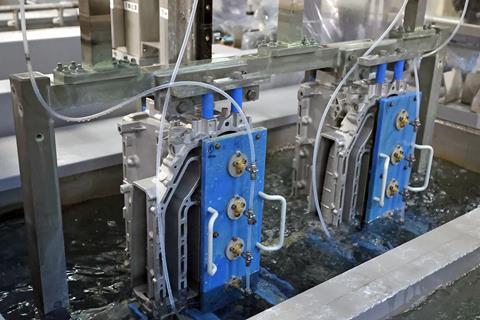
Called Suzuki Edge eCoat, the new production technique was developed by Suzuki to protect key engine components including the cylinder block, cylinder head and crankcase by uniformly coating cooling water passages and other engine components that have contact with cooling water. According to the firm, the process involves immersing aluminum components in an electrified, electrolytic bath to create a porous layer on the surface. Corrosion resistance is further enhanced by the formation of an aluminum oxide coating. By innovating the immersion process to prevent air pockets, Suzuki says it can uniformly treat the complex shape of cooling water passages.
First used in August 2024 in the manufacture of the company’s popular DF140B outboard, the process has since been incorporated into the company’s DF140BG, DF115BG, and DF115B models, and will progressively be adopted across the full outboard line-up.
“We are always looking for ways to improve our products and provide a more robust, reliable product for the boating industry and boaters nationwide,” said Suzuki Marine USA VP of sales and marketing, Brandon Cerka. “This latest development from our factory in Japan accomplishes this, while providing a significant environmental advantage as well.”
Cerka adds that the process not only provides superior protection for key internal engine components, but further also allows for an approximately 50% reduction in CO2 emissions compared to traditional treatment methods which typically involve a chemical treatment followed by painting. “Finding ways to reduce the environmental footprint of recreational boating is an ongoing process at Suzuki Marine,” he said. “With this new process, we are making our engines more durable while simultaneously reducing energy consumption.”